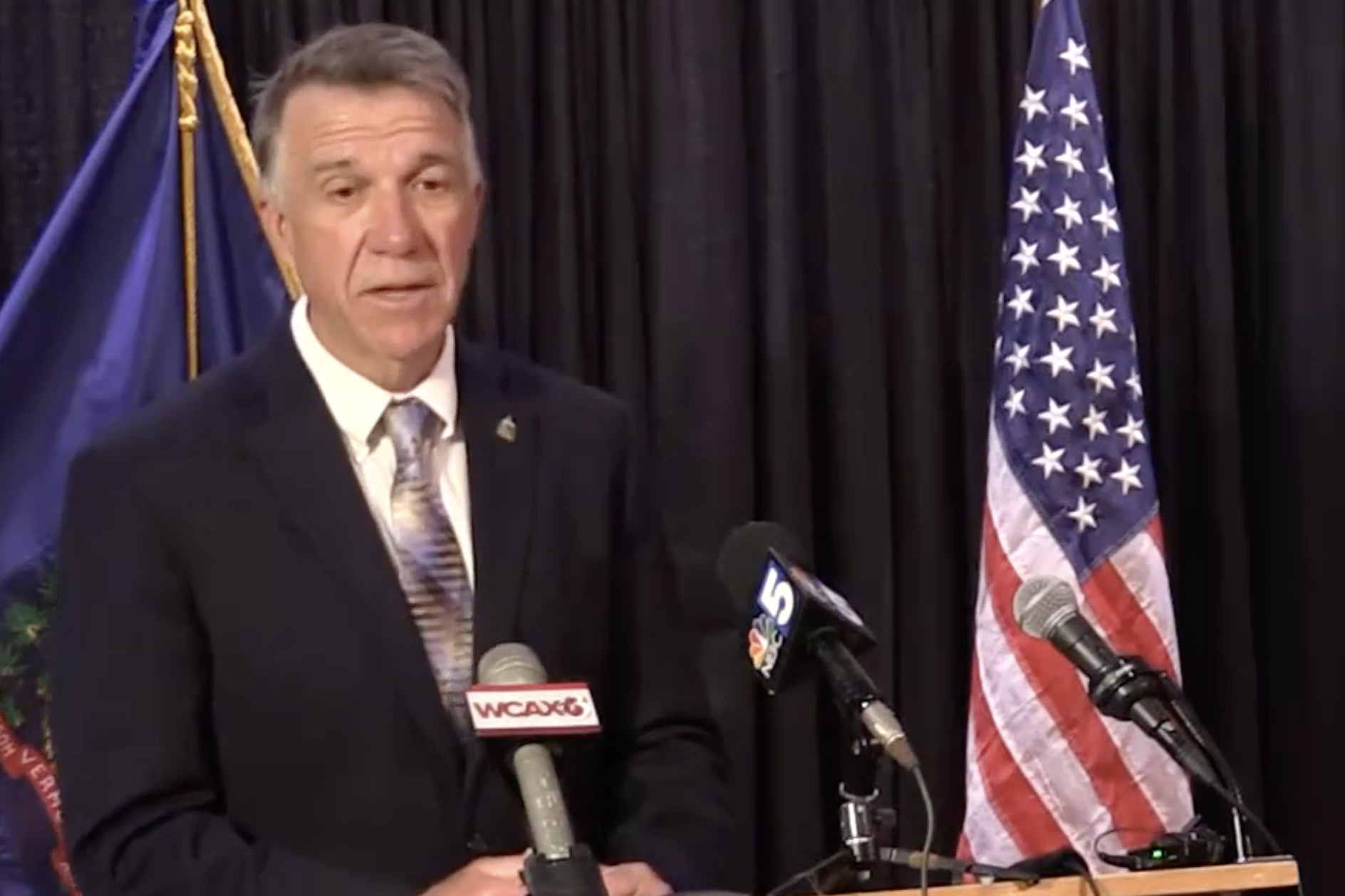
After months of inaction that led to a mass unsheltering of close to 1,500 vulnerable Vermonters, the Scott administration today took a step toward addressing the crisis. A step so insultingly small that the governor might as well have slapped a homeless person across the face.
The administration opened two shelters with space for 17 families. That’s 17 out of close to 1,000 unsheltered since mid-September, when new caps on state-paid motel vouchers took effect. For those unprepared for a bit of higher math, that works out to 1.7% of the need. Want another appalling statistic or two? According to the state, 343 children have been unsheltered since mid-September. These shelters will house maybe a couple dozen or so kids. The rest can go hang.
Actually, as of the orchestrated press tour on Friday morning, only one shelter (in WIlliston) had opened for business. Hasty preparations were still underway at the Waterbury Armory and reporters were not allowed to enter, according to VTDigger. The Waterbury space reportedly features partitioned areas for families, with the partitions not reaching the ceiling. The Williston facility looked a bit more inviting.
Last week, the federal government issued its big annual report on homelessness in America. Not that you’d know it from the Vermont media; the only story I saw about it was a national Associated Press article that the Times Argus ran on page 2.
Which is a damn dirty shame, because the federal report contains a lot of information about Vermont’s situation, which got quite a bit worse from the previous year — and has gotten substantially worse since then.
This news wouldn’t have taken any real effort to uncover. But hey, I guess we’ve had our fill of bad news on homelessness. Such a downer, you know.
The report in question is the U.S. Housing and Urban Development’s Annual Homelessness Assessment Report to Congress. It takes data from a “point in time” (PIT) — a single night in January 2023 — and turns it into a real deep dive on homelessness. It’s an imperfect instrument that almost certainly produces significant undercounts because, well, the unhoused can be hard to find. But it does provide a lot of valuable information.
The depressing topline: Homelessness in America increased by more than 12% from the previous year’s AHAR. Vermont, again, had the second worst rate of homelessness in the country, trailing only New York. (In the 2022 report, Vermont came in second to California.)
Well, you might say, we might still be bad, but at least we didn’t get any worse.
Not so fast, my friend.
The AHAR data shows that homelessness in Vermont increased by 18.5% from the previous year, a jump more than 50% higher than the abysmal national figure.
And we know for a fact that things have gotten even worse in Vermont since the PIT count was taken eleven months ago.
How so? Let’s take a step back. The AHAR count includes all the unhoused — both sheltered and unsheltered.
“Wait,” you might be saying, “how can a sheltered person be homeless?”
Anyone with no fixed address is considered homeless, even if they’ve resorted to couch-surfing or staying with a relative or squatting in an abandoned building or, horrors, returned ot a home they’d fled to escape an abusive or addicted or criminal partner. Those people have shelter, but it isn’t a stable, lasting arrangement. They can’t count on it. It might be a roof over their head but it isn’t, well, home.
Step forward. In the 2023 AHAR, Vermont scores very well in one measure. We have a lot of homelessness, but we have a relatively low rate of unsheltered homeless. Most of our unhoused have places to stay.
Ahem. They did, until the Scott administration and the Legislature decided to ramp down the motel voucher program, which had kept thousands of unhoused Vermonters in liveable shelter. The program was dramatically cut at the end of June, and the administration has been doing its level best to ratchet down eligibility since then. Most of the people who were staying in motels last May are now out of the program. And only a small fraction of the departees are known to have found stable housing arrangements. So it’s a virtual certainty that the ranks of our unsheltered homeless have swollen dramatically since the PIT count was taken in January.
But wait, there’s more!
Since federal pandemic-era rental assistance programs have ended, more and more people have fallen far enough behind on rent to be subject to eviction. As Seven Daysreported last week, sheriff’s departments across Vermont are up to their ears in court-ordered evictions they have to enforce. And it seems certain that more are on the way. It takes months, at least, for a tenant to fall far enough behind to be subject to eviction. Says here we’re only at the beginning of a wave of forced unhousing. Rental supplies are abysmally short, prices are skyrocketing, and many Vermonters — even those with steady employment — can’t keep up.
Homelessness in Vermont has almost surely increased, by quite a lot, since the PIT count in January. There is every reason to expect that it will get even worse. And yet, it doesn’t seem like anyone’s paying attention. Since early November, when administration officials issued a truly dire assessment of our housing shortage to lawmakers — and the media pretty much ignored that hearing — there’s been almost no reporting about the situation.
The decision by administration and Legislature to slow-walk the dissolution of the voucher program averted a singular humanitarian disaster. Instead, it’s been spread out over a period of months and months. A slow drip-drip-drip, not a tsunami. If I were a cynical sort, I’d suspect that Our Leaders wanted to avoid the impression of a catastrophe by enacting it in slow motion. It seems to have worked. That’s a damn shame. And a damn disgrace.
Gov. Phil Scott indulged his passive-aggressive tendencies this week by refusing to sign or veto H.145, the budget adjustment act. He laid down his pen despite the fact that the Legislature gave him everything he asked for in his budget adjustment plan.
But lawmakers did have the temerity to toss in a few items of their own. This was apparently too much for the governor. In his position, a Republican facing Democratic supermajorities, you’d think he might be willing to meet them halfway, but no sirree, not Governor Nice Guy.
As is often the case with vetoes or refusals to commit, Scott’s reasoning was awfully thin. He avoided taking a position on the Legislature’s additions, he merely wants them to wait another couple of months. And he chided lawmakers for failing to live up to his standard for “discipline and clarity” in appropriating state funds.
To put it the other way, he sees the Legislature as fuzzy and undisciplined. Nice guy.



 The Vermont Political Observer.