Recently I had the opportunity to sit in on an update and short-term forecast of the economy and the markets. It was an exercise in what they call “wealth management” — stewardship on behalf of the well-to-do. I did so as an investor with retirement funds in the markets, who’s been feeling a fair bit queasy about the chances that Donald Trump’s doggedly anarchic policies might cause everything financial to drop straight into the toilet.
Well, I have some very good news wrapped in a bad-news burrito.
The good news, from this analyst’s perch: The economy is doing pretty well, actually. It has weathered Trump’s reign of error because of some very strong fundamentals. Also because deregulation and tax cuts are business-friendly. By every measure, the outlook is positive.
In the aggregate, that is.
But within the aggregate, there are distinct winners and losers. I bet you can guess who falls into which category.
Apologies for another belated posting of this feature and the general lack of posting recently, but last week was kind of all over the place. Plumbing problems, likely mold issue, business trip out of town, blah blah, trying to catch up. Here we go!
When local coverage really matters. A couple weeks ago in this space, the lead item was a piece in The Stowe Reporter detailing the tremendous number of short-term rentals owned by non-locals. And now, reporter Aaron Calvin gets to follow up in what must have been a satisfying way: the town Planning Commission is considering limits on short-term rentals, and as Calvin writes, “the need for such a cap is generally agreed upon; the discussion centers around how best to go about implementing it.”
We can’t say for sure that the earlier story influenced the Planning Commission’s approach to short-term rentals, but the timing would suggest that it did. This is an excellent example of why good local coverage is so crucial.
The Commons continues to track the Trump damage. Last week, The Commonsgrabbed the lead spot in this space with a good piece about how Trump’s Big B**** Bill is likely to impact Brattleboro Memorial Hospital. For those just tuning in, the story quoted BMH’s chief exec as calling the bill “vicious” in its effect on rural hospitals. Well, reporter Joyce Martel followed up with an equally vital story about Grace Cottage Hospital, the state’s smallest hospital. Grace Cottage CEO Olivia Sweetnam was more measured than her Brattleboro counterpart, but she did say that dealing with the BBB “is going to be very difficult.”
As I wrote last week, every local outlet in the state should be covering their hospitals and other major health care facilities in the same way. (For example, I would suggest to my co-conspirators at The Hardwick Gazette that there’s a story in how the BBB will impact the Plainfield Health Center, a major provider of primary care health care for miles around.)
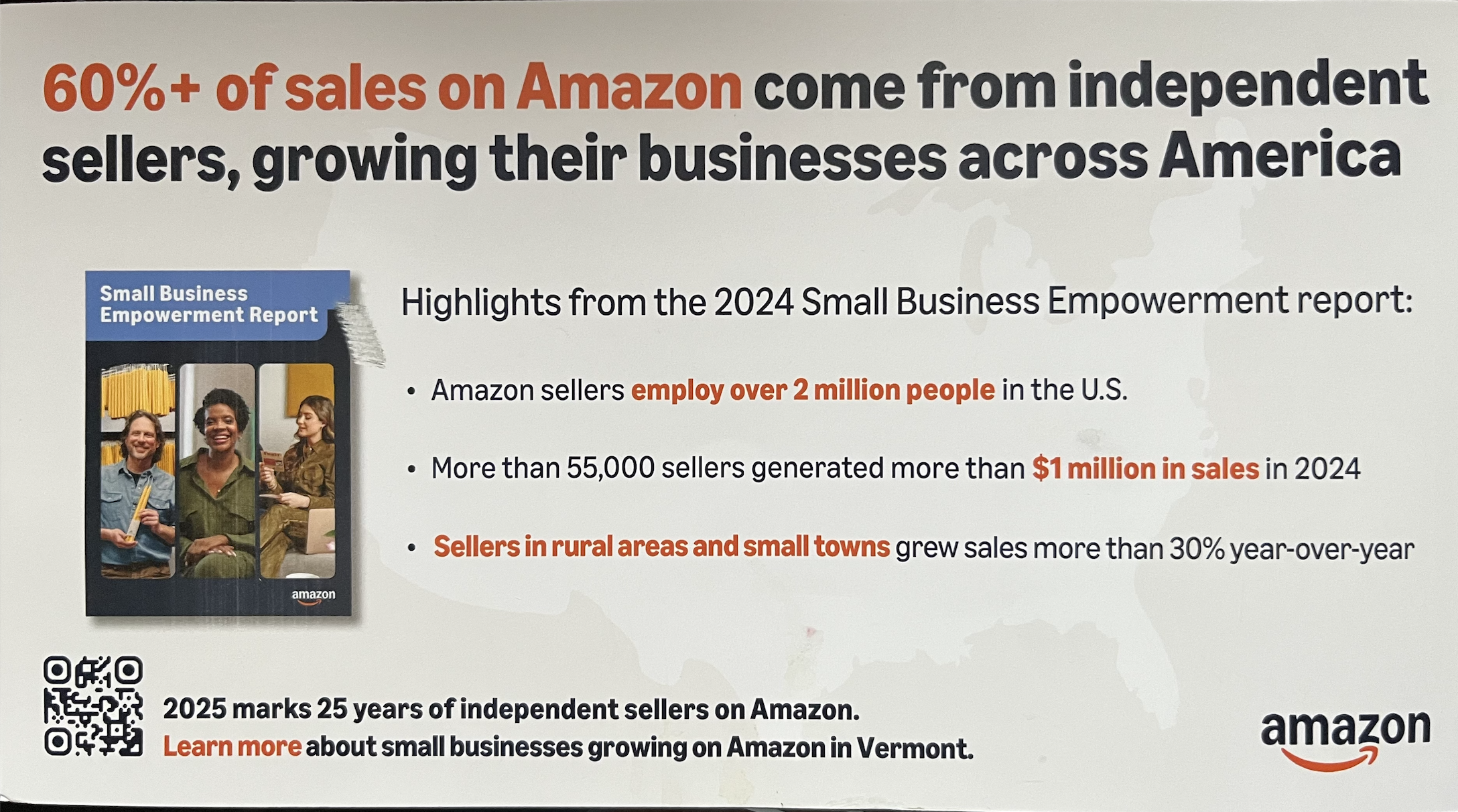
It’s an extremely transparent attempt by the world’s biggest corporation to try to make itself seem all Vermonty: Cozy, human-scaled, not at all the most voracious shark in the ocean. Problem is, the flannel shirt still has a sales tag on the collar and the jeans and work boots are unsullied by exposure to dirt, mud, or physical labor.
I have to assume this is a PR blitz related to the ongoing controversy in Essex, where Amazon wants to build a 107,000-square-foot distribution facility in an industrial park, a proposal that has outraged many area residents. Now, I live nowhere near Essex, so I don’t know why Amazon is trying to convince me that its purpose in life is enabling human-scale entrepreneurship. Probably the difference between a mass mailing to Essex and a mailing to the entire state of Vermont is mere pocket change for Jeff Bezos. (I’m imagining him cackling softly and caressing a snow-white cat while approving this piece of corporate greenwashing.)
Do I have to critique this thing? Well, I guess I do. I am the one writing about it, after all.



 The Vermont Political Observer.