Category Archives: Vermont Democratic Party

The limits of messaging

Just finished listening to a Reporter’s Roundtable on VPR*, with three of the better reporters around — VTDigger’s Anne Galloway, VPR’s Peter Hirschfeld, and the Freeploid’s Terri Hallenbeck– examining the entrails of last week’s primary election and the prospects for November. 

*Audio not yet available online, but it should appear here later today. 

Thin gruel, to be sure; the key races are essentially over, with the possible exception of Phil Scott vs. Dean Corren for Lieutenant Governor. But when the race for a mainly ceremonial position is your biggest source of intrigue, well, that tells you all you need to know. 

There was a lot of dancing around the fact that November is in the bag for the Democrats, with the noble exception of Galloway coming right out and saying that Governor Shumlin was going to win. The dancing is understandable, considering that (1) journalists want to appear objective, and (2) as political journalists, they’ve gotta cover this puppy for two more months, and what fun is it when there’s no intrigue? 

Much of the dancing centered on the idea that good “messaging” could carry a Republican candidate into a competitive position. The Dems aren’t invulnerable, the reasoning goes, it’s just that neither Scott Milne nor Dan Feliciano seems capable of delivering a solid, appealing message. 

That’s true, insofar as it goes. But there are three much more powerful factors operating against the Republicans: most voters pay little or no attention to messaging, the electorate is solidly center-left, and today’s Republican Party has little to offer on the key issues in Vermont. 

First, reporters and insiders overestimate the impact of tactics and strategy and messaging. The vast majority of voters have their minds made up before the campaigning starts. The only thing that could change their minds is some sort of shocking revelation or catastrophic event. Some voters do actually watch debates and bring an open mind to campaign coverage, but they only matter when an election is otherwise close. 

Second, it’s obvious from the results of the last decade or so that most voters prefer Democrats. The Legislature has been solidly Democratic for years. Among statewide Republicans, only Jim Douglas and Phil Scott have been able to buck the trend. Both have done so because of their unique personal appeal and by projecting an image of moderation and willingness to compromise. 

And third, Shumlin and the Dems are potentially vulnerable on issues like health care reform, the Department of Children and Families, the economy, taxation (especially school taxes), and the environment (Lake Champlain, the natural gas pipeline). 

On all those issues, the most appealing solutions involve more government, not less. Shumlin is more vulnerable to his left than to his right. 

In spite of Vermont Health Connect’s troubles, health care reform remains popular. Republicans have no answer aside from letting the market do its magic. Fixing DCF would require more resources, or at the very least more effective management. Have the Republicans given anyone reason to believe they care more than the Dems about poor people? Hell, no. Do the Republicans have a track record of good management? Only in the minds of Jim Douglas and Tom Pelham. 

Would the Republicans be better stewards of the environment than Dems? Ha ha. Can they plausibly portray themselves as defenders of public education, which remains extremely popular in Vermont? No; their only solutions are competition and union-busting. Can they convince voters that they’d preserve local control? Not if you could saw money by centralizing. 

On the economy, the Republicans have little to offer aside from the tired, discredited supply-side nonsense. Which took another bullet yesterday with the news (from the Federal Reserve Bank) that our post-Great Recession “recovery” has benefited the wealthy while middle- and working-class wealth has actually declined. One-percenters and corporations have a larger share of our wealth than ever, and all the Republicans can offer is policies that will further enrich the rich. 

And as for taxation, Vermonters may be dissatisfied with rising school taxes and worried about the cost of single-payer health care, but they also favor a robust government that can tackle problems effectively. Most voters don’t want a mindless “cut, cut, cut” approach, and that’s the standard Republican line. 

Here’s what a Republican would have to do, to be competitive on a statewide level: Bring an established reputation for effective governance, or at least an open-minded attitude toward the notion that government can actually solve problems. Express skepticism about political dogma, especially the cherished beliefs of the right. And do that without, somehow, losing too much support among the Republican base. And, finally, regain the support of the business community, which has largely abandoned the VTGOP in favor of a cooperative relationship with the Democrats. 

Now. If a Republican can identify and execute a strategy that accomplishes those things, s/he can win. Otherwise, no amount of good messaging will carry the day. It’s not impossible; there’s at least one potential Republican candidate who could manage it. But he ain’t running this year. 
More on primary write-ins

A small addition to my earlier post about today’s Board of Canvassers certification of the primary results. 

In the Democratic race for Lieutenant Governor, Progressive Dean Corren took the nomination with 3,874 votes, or 60% of the total. Republican incumbent Phil Scott received 1,895 write-in votes on the Democratic line, or 40%*. And in the race for the Republican gubernatorial nomination, Libertarian Dan Feliciano managed to get 2,093 write-in votes in losing to Scott Milne. 

*Correction: Scott received 29.6% of the Democratic write-in vote. My mistake. I should never try to do math while blindfolded. 

Earning nearly 4,000 write-in votes is an impressive accomplishment for a, frankly, little-known candidate. Scott’s a well-established and well-liked figure, while Corren is a former State Rep who hasn’t been a candidate for any office since 1998. 

This is Corren’s second notable achievement in the campaign. The first, and more significant, was qualifying for public campaign financing. He must have a solid organization, and he must have some measure of appeal. We have yet to see whether a focused enthusiasm will translate into broad support from the public at large. 

At first glance, his 60-40 margin of victory over Scott, who wasn’t even campaigning for the Democratic nomination, doesn’t look too strong. If the primary electorate was representative of the general public, I’d say Corren is in serious trouble. But the primary voters — the 9% of all registered voters who bothered to show up — is a self-selected group of people with a strong interest in politics. Strong enough to cast a ballot in a relatively inconsequential primary. Scott’s 40% does not mean he can count on 40% of the Democratic votes in November; far from it. An indeterminate number of his votes were from Republicans taking advantage of (a) Vermont’s open primary, and (b) the complete lack of anything worth voting for on the Republican ballot. For many Republicans, the most constructive thing they could have done last Tuesday was to get Phil Scott on the Democratic ballot. That would have ensured his re-election. 

All that said, Corren remains a longshot. Phil Scott is well-known and well-liked, and the argument by people like Ed Adrian (that we need at least one Republican in a statewide office, and that Scott serves a valuable function in that role) is likely to have some resonance. Especially since Scott projects such a friendly, reasonable persona. And the Shumlin Administration’s continued bungling of Vermont Health Connect won’t exactly help Corren, who’s committed to single-payer health care. 

As for Feliciano, he took 93% of the Republican write-in votes for Governor. Or, about 13% of the total vote. It wasn’t enough to challenge Scott Milne, who had 72% of the total vote. A couple thousand write-in votes is a respectable number, but it’s not enough to indicate a real split among Republicans. But that could change; if Milne continues to stumble on the campaign trail and in fundraising, and it becomes clear that he poses no threat to Shumlin, then conservative voters will have nothing to lose by casting a protest vote for Feliciano. And if Feliciano finishes a solid third, he’ll push Milne into laughable-loser territory, and that would encourage the true believers to carry on their fight for control of the VTGOP. 

One housekeeping note. This was the first election in which town clerks were legally required to report their results on election night. Some failed to do so; 31 precincts out of 275. Secretary of State Jim Condos said, “We’ll reach out to towns that didn’t report on Tuesday night, and find out why they didn’t.” He speculated that there might have been confusion with a new reporting system, or ignorance of the new legal requirement. 

Condos is hoping for complete returns on time in November, but he doesn’t have a stick to go with his carrot. When the Legislature adopted the election-night requirement, it did not enact any penalties for failure to comply. 


You can put it on the board: Dean Corren will be the Democratic nominee

Notwithstanding efforts by certain determined Phil-o-philiacs, the extant signs and portents indicate that Progressive Dean Corren will win the Democratic nomination for Lieutenant Governor, and will appear on the November ballot as a Prog/Dem. A fashionable outfit these days, no?

To recap: Corren had actively sought support from the Democratic State Committee and campaigned for write-in votes in yesterday’s primary. Counterpunching were some supporters of incumbent Republican Phil Scott; they urged Democratic write-in votes for Scott.

No official count will come until Tuesday, but everything I’m hearing points to a fairly easy Corren win. There are counts from a few scattered communities, all with lopsided Corren totals. There’s the feeling among top Democrats not named John Campbell or Dick Mazza, that Corren’s won the thing. And there’s this from a Corren banner ad on Green Mountain Daily:

There were thousands of write-in votes so we won’t know the official outcome for a few days, but it looks good.

Which is about as close as a candidate can come to shouting “Whoopee!” before the count is official.

Assuming all this holds true, and I’m bettin’ it does, the next step will be securing an endorsement from the Democratic State Committee. And that also looks to be in the bag. He got a very positive reception at the DSC’s last meeting, but there was no move to endorse before the primary. If Corren does indeed win the vote, the state committee is almost certain to go along. Personally, I’d strip out the conditional: he will get the state committee endorsement.

He may not get a lot of tangible support beyond that, however. Because Corren qualified for public financing, he can’t accept additional donations — and that seems to include participation in the statewide Coordinated Campaign. But Corren has the means to run a competitive campaign on his own. And the most important thing, by far, is securing the Democratic line on the November ballot. You can put it on the board: he’s done it.

Still a publicity stunt

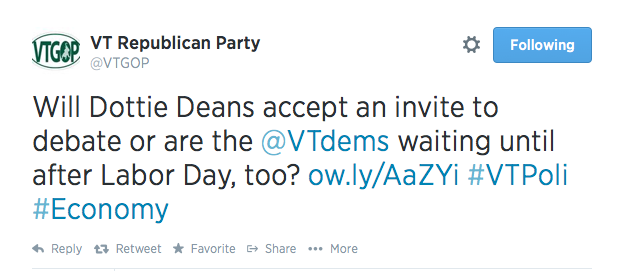
VTGOP Chair “Super Dave” Sunderland continues to push his hokey “challenge” to meet his Dem counterpart, Dottie Deans, for a debate on the Vermont economy. He first threw down the gauntlet in a letter dated July 10, and has occasionally refreshed it via Twitter ever since. Last night, for instance:

Screen Shot 2014-08-12 at 8.30.24 AM

Funny, it hasn’t drawn a reply from Deans, nor has it attracted the slightest interest from the Vermont media. Pretty sure I’m the only person who’s reported it (outside of GOP circles), and that’s only been to make fun of it.

Because it’s a publicity stunt, and Super Dave knows it. He knew from the start that Deans wouldn’t respond. He was just hoping for a little free publicity, or simply for the chance to call Deans a coward.

Which she isn’t, not at all. She’s kinda busy these days, having a strong party apparatus and a robust staff to manage. I realize that Super Dave is just kinda rattling around in his largely empty VTGOP headquarters (paid staff: TWO, and both probably part time*) and thus has time to issue bogus challenges. And I realize that he’s grasping at straws for free media. But he knows that it’s not the party chair’s job to engage in public debates.

*Considering that “Victory Coordinator” Jeff Bartley is still on staff at the Tarrant family firm MyWebGrocer and, per his Twitter feed, recently took a trip to Disney World, I doubt that he’s got his shoulder to the campaign wheel 24/7. 

The party chair is responsible for the organization, administration, and growth of a party’s infrastructure. It’s a big job, and it’s primarily done behind the scenes. Dottie Deans knows what her job is, and what it isn’t. You’ll note that, as reflected in the above Tweet, she doesn’t even have a Twitter account of her own. If Super Dave hasn’t achieved a similar level of clarity about his own responsibilities, well, that’s his lookout.

Besides, there’d be little public interest in a debate between two party chairs. The vast majority of voters see high-profile candidates as a party’s public face, not some internal functionary. Voters will pay attention to the Shumlin/Milne debates this fall. They would have no reason to watch a debate between two people who are not running for any office where they might actually affect public policy. 

So it’s a publicity stunt, then, now, and forever.

Everybody loves good ol’ Phil

I think I’ve identified the source of Lake Champlain’s outbreak of blue-green algae: last week’s party in Senator Dick Mazza’s Corvette-laden “garage” on behalf of Lieutenant Governor Phil Scott. Enough horseshit was generated to feed an algae bloom for months.

I’m sorry I missed it. Guess my invitation got lost in the mail. Fortunately, the Freeploid’s Nancy Remsen was there, and made the Mazza Tov the centerpiece of her Phil Scott profile in the Sunday paper. From her account, I extract a few gems…

The Republican lieutenant governor glad-handed Republicans, Democrats, lobbyists and business leaders…

I guess Good Ol’ Phil won’t be a supporter of VPIRG’s campaign finance reform agenda. Just a guess.

“It is great to see such a bipartisan crowd,” [former Governor Jim] Douglas observed. He wasn’t surprised, he said, noting, “Phil Scott is the kind of Vermonter who doesn’t worry about someone’s party label.”

Immediately thereafter, Douglas revealed himself to be the kind of Vermonter who DOES worry about party labels:

Douglas urged the crowd to help re-elect Scott to “make sure we don’t have lopsided government.”

As I have observed before, should we be electing people based on affirmative action? Or should the onus be on Republicans to craft a message that actually resonates with the Vermont electorate?

Oh wait, here comes Senate Penitent Pro Tem John Campbell, who was on hand to offer his almost-not-quite-nudge-nudge-wink-wink non-endorsement.

“I’m here to support a friend,” Senate President Pro Tempore John Campbell, D-Windsor, said as he stood near Scott in the Corvette showroom. Campbell qualified his support, saying, “I’m not raising funds for Phil.”

Isn’t that nice. I guess I shouldn’t think of this as treason.

No, I guess not, because as Campbell says, he’d support a real actual Democrat for Lieutenant Governor, but he won’t support Progressive Dean Corren even if he wins the Democratic nomination. Campbell just can’t overlook Corren’s long-ago “bashing” of Democrats, even though today’s Corren has definitively foresworn any and all Dem-bashing, promises to work hand-in-hand with Democrats, and is much more politically aligned with Governor Shumlin than is Phil Scott. But I guess Campbell, like Jim Douglas, is unfortunately obsessed with party labels.

Also on hand, making excuses for their Phil-anthropy, were State Senator Dick McCormack and Burlington Democrat Ed Adrian. McCormack “acknowledged that his views on many issues are probably closer to Corren’s, ‘but what I’ve done with Phil really counts for a lot.'”

Awwwww, how thweet. As for Adrian, well, he offered his own variation on the VTGOP’s affirmative action theme: keep Phil around as the token Republican.

If Democrats occupy every position of power, they are just going to fight among themselves. What is wrong with having a moderate, token Republican who would frankly be considered a Democrat elsewhere in the country?

Sorry, Ed, color me unconvinced. What’s wrong with having a “token Republican” in the Lieutenant Governor’s office is that, as a member of the Senate Rules Committee and the tiebreaking vote on legislation, he could become a significant roadblock in the push for single-payer health care and campaign finance reform. And I am unmoved by the fact that Scott would be considered a Democrat in West Virginia or Nebraska. It’s like Roger Allbee running for a Democratic Senate seat in Windham County: he may be a liberal Republican and he might make a really good Senator from, oh, Rutland County or the Northeast Kingdom, but he’s too centrist for the Windham electorate. Same with Scott: he’d be a fine Lite-Gov if it were entirely a ceremonial position, and he’d be a breath of fresh air in Montana or Wyoming, but as Lieutenant Governor of Vermont he’s a potential obstacle to Governor Shumlin’s top priority. Which is why Shumlin has all but endorsed Dean Corren.

Maybe it’s because I’ve never had the chance to fall under the up-close-and-personal spell of Phil Scott’s charms*, but I don’t get the Scott fetishism among so many of our Democratic officeholders. It’s reminding me quite a bit of the Vince Illuzzi fetishism of two years ago. Nobody gave Doug Hoffer much of a chance because he was a Progressive, and a rather abrasive one at that, while Everybody Loved Vince.

*Maybe it’s his private-label cologne, a bi-attractant blend of pleasing moderation with rich, manly undertones of racing fuel and asphalt. 

Except when it came Election Day, it turned out that the inside-the-Dome crowd didn’t represent the electorate as a whole. I’m hoping the same thing happens with Corren, for the sake of single-payer’s prospects in the Senate, and in order to drive another stake into the heart of the old-boys’ network, go-along-get-along atmosphere that beclouds our Most Stagnant Deliberative Body.

The curious incident of the dog in the night-time

So yesterday, your top three Republican officeholders held a well-timed dog and pony show on the subject of Vermont Health Connect. Lt. Gov. Phil Scott, Senate Minority Leader Joe Benning, and House Minority Leader Don Turner praised Governor Shumlin for finally pulling the plug on the troubled CGI contract, but called for a thorough “scrubbing” of the process and perhaps the firings of some Shumlin Administration functionaries.

Standard stuff, and a sound political move. The Administration deserves all the criticism it gets until it delivers a fully-functional VHC. But what struck me most about the event was a conspicuous absence: Republican gubernatorial candidate Scott Milne, the party’s putative standard-bearer, was nowhere to be seen. Or, in Sir Arthur Conan Doyle’s immortal words:

Gregory (Scotland Yard detective): “Is there any other point to which you would wish to draw my attention?”

Holmes: “To the curious incident of the dog in the night-time.”

Gregory: “The dog did nothing in the night-time.”

Holmes: “That was the curious incident.”

Scott Milne, the dog that did nothing.

According to a reporter who attended the event, the three addressed Milne’s absence by saying that they were discussing legislative action and Milne’s not in the legislature.

To which I say nope, not buyin’ it.

I don’t necessarily think they were lying. But I do think there are three possible explanations, none of which involves the imaginary line between politics and legislation.

First of all, a few facts. The CGI termination was announced on Monday, so it made sense for the Big Three to have a presser on Tuesday. And, according to Milne’s campaign schedule, he was in the Bennington area most of the day. So attendance at a Statehouse event would have been difficult.

But still. Milne is the head of the VTGOP’s ticket. Wouldn’t it have been nice to give him a share of perhaps the biggest single spotlight of the campaign so far?

I can see why the event had to happen shortly after the CGI announcement. But couldn’t they have, oh, found a way to work it out? Fit the presser into Milne’s schedule, or have Milne shuffle his? Or, failing any of that, have Milne there by Skype or videoconference? There were ways to make this work.

Back to my three explanations, none especially flattering.

1. They truly saw this as a purely legislative event and didn’t think of inviting Milne. That’s called not seeing the forest for the single tree of an ersatz principle. This was a great opportunity to present a unified front on one of Shumlin’s greatest vulnerabilities.

2. Milne was invited and chose not to shuffle his schedule. Which would be a political fumble of the kind all too typical of his nascent campaign.

3. The Big Three didn’t really want Milne there. Which would be the most damaging option. It’d be a strong indication that the VTGOP already sees Milne as a lost cause and a liability.

Take your pick.

The Democrats run something called the Coordinated Campaign, in which candidates contribute to a central fund that helps pay for all kinds of organizational goodies, like compiling voter data, managing volunteer activities, shared mailings and other campaign materials, GOTV, etc., etc. And whenever there’s a media event featuring Governor Shumlin, appropriate Democrats are part of the action.

At best, the Republicans are running an Uncoordinated Campaign and missed a golden opportunity to showcase their top man. At worst, Scott Milne is an isolated, doomed figure and nobody wants to be seen with him.

School consolidation: It’s coming

Interesting sidelight from Saturday’s meeting of the Democratic State Committee. Various candidates for statewide office spoke to the Committee, seeking its endorsement… including Governor Shumlin. He delivered an energetic stem-winder of a speech, citing accomplishments and goals and thanking the party faithful for making it all possible.

There was one glaring omission from his list of issues: Public school funding and organization. Not a word.

Then he took a few questions, and longtime committee member Bill Sander asked directly about school consolidation. He’s not a fan.

The Governor’s answer was a masterpiece of pointillism, the technique in which, sez Wikipedia, “small, distinct dots of pure color are applied in patterns to form an image.”

The image that emerged: School consolidation is on the way.

He first credited legislative leaders for their “courage” in bringing up the idea earlier this year. Of course, they showed equal amounts of the opposite of courage in ditching the idea when the negative reaction came in waves.

That negative reaction in mind, Shumlin offered a “collaborative” approach which, boiled down to essentials, consists of “We’ll convince you that our plan is right.”

“I’ve asked my Education Secretary to sit down with local schools and show them the math,” he said, “and let the local communities discuss how best to proceed.” He calls this “a partnership, especially with schools that are becoming too small.”

He spoke, not of saving money or centralizing decision-making, but of educational opportunities. He pointed to schools too small to field a football team or cast a theatrical production; of a lack of “a critical mass to provide an educational experience” in classes with only a handful of students.

“Take it from that perspective,” he concluded, “Providing a quality educational experience, plus cost, and we’ll work through it together.”

Yes we will. We’ll work through it to a preformed conclusion.

I’m not necessarily against consolidation, but let’s be honest: as far as the Governor is concerned, the debate on the big question is fundamentally over. Now, it’s a PR blitz and detail work.

Did the Dems really need more good fundraising news? Well, they got some.

Side note from Saturday’s meeting of the Vermont Democratic Party State Committee: VDP Executive Director Julia Barnes told the gathering that this year’s Curtis Award dinner featuring Senator Elizabeth Warren was a huge success, grossing $146,000. As Barnes pointed out, that’s enough to cover half the party’s total budget for this year. Correction: one-third of the party’s administrative budget for the year.

And there was the collateral benefit of energizing donors and volunteers, Barnes noted, thanks to the enthusiasm generated by Warren’s strong message.

I can’t directly compare the Curtis Award take with the VTGOP’s vaunted Chris Christie event from last December because, as far as I can tell, the party has never publicly announced its total receipts. Beforehand, it was happy to throw around estimates of $200,000 to $300,000.

Funny thing about that. The VTGOP’s campaign finance report filed on March 15, which covered the period from July 2013 to March 15, 2014, listed total donations of $45,567.32. The vast majority of that was given between mid-November and mid-December.

Unless some of the Christie-related donations went directly into other accounts, the Christie fundraiser appears to have grossed a little under $40,000.

If any Republican apparatchiks want to correct my reckoning or, preferably, provide the actual take, please do so in the comments below or contact me directly. At least some of you know how. And I’d really like to know.

In the meantime, let’s stick with 40K. Compare the two high-profile fundraising events, and see which one was the bigger success.

Not to mention that during the March 2014 reporting period (July to March), the VTGOP spent just under $40,000. So the Christie take was pretty much gone by mid-March, leaving the Party once again starved for funds.

Corren meets the Dems

The Democratic Party State Committee met Saturday in Montpelier, and gave its endorsement to the Party’s expected slate with one exception: Dean Corren, Progressive candidate for Lieutenant Governor. He did not actually seek an official endorsement from the state committee, but he did address the gathering and asked for their support in getting people to write in his name in the August primary.

“I got into this race on one issue,” he said, “Single payer health care.” He described this as a critical time for the issue, and said “We need a Lieutenant Governor working shoulder to shoulder with Governor Shumlin. I would be a good partner in this fight.”

(He didn’t say, but I will, that the Lieutenant Governor casts tie-breaking votes in the Senate. If Corren’s there, passing single-payer becomes easier than if Phil Scott wields the gavel. That, in itself, is a powerful incentive for Democrats, Progressives and liberals to unite behind Corren, no matter how much of a nice guy Scott may be.)

He also emphasized his common ground with the Democrats on two key issues: campaign finance reform and renewable energy. Since he qualified for public financing, you could say he has struck a real blow on the issue of money in politics. On energy, he pointed to his own professional involvement in climate change and green energy.

He also addressed the past (and for some, present) tensions between Democrats and Progressives. “We are more interested in progress than in bashing anyone.”

There was a lot of favorable reaction in the room. Corren took several questions, and all were supportive.Longtime committee member Bill Sander recalled past times when the party actively considered endorsing Republican challengers to then-Congressman Bernie Sanders, on the theory that they could get rid of Bernie and then beat the Republican two years later. Now, Sander said, “Our goal is to further the policies we believe in,” and that includes working alongside Bernie instead of trying to undercut him.

Some committee members obviously wanted to go ahead with an endorsement, but it wasn’t on the agenda. John Wilmerding of Windham County posited an endorsement via the transitive property: the state committee had previously endorsed then-candidate John Bauer; since then, Bauer has endorsed Corren; and if A equals B and B equals C, then maybe the committee has already, kinda-sorta, endorsed Corren. No one argued the point, but it remained in the unofficial realm.

After his presentation, Corren had a brief media scrum in the hallway. He pronounced himself “extremely” encouraged by the committee’s reaction. “It was wonderful. I couldn’t be more pleased.”

He was asked if he’d run into any Dem/Prog tensions in his contacts with party officials. “Actually, I haven’t,” he said. “My calls to state committee members and county chairs and so forth have all been incredibly positive.”

After this week’s anti-Prog comments from a few state senators, it was good to see the Democratic hierarchy taking a more positive view of Corren. Maybe the “Dems for Phil Scott” idea is mostly a creation of the Senate’s clubby, cloistered atmosphere.

I certainly hope so.

It’s time to grab the State Senate by the ankles, flip it upside down, and give it a damn good shake

Poor, poor Democratic State Senators. They face such a difficult decision.

As VPR’s Bob Kinzel reports, they’ll have to choose between their longtime colleague, Lt. Gov. Phil Scott, and his Progressive challenger Dean Corren. The usually reliable but somewhat clubby Sen. Dick McCormack:

Then the question is who would you cross party lines for? Phil is a friend I’ve worked with for years, work well with. And Dean, the public financing is very admirable I have tended to agree with him on most issues so for a lot of us I think it creates a real dilemma.

Okay, wait. I’ll admit I don’t have a dog in the tired old Dem/Prog slapfights — I wish they’d each get over themselves — but McCormack thinks that supporting a Progressive and supporting a Republican are equally tough? C’mon now, which party is more closely aligned with yours on policy questions? You’re honestly having trouble choosing between the guy who’s in line with your party’s biggest policy priority (single-payer health care) and whose very campaign highlights your party’s concern with money in politics, and the guy whose party is opposed to single-payer and is uninterested in campaign finance reform?

As a nonaligned liberal, allow me to throw up in my mouth a little.

As for throwing up a lot, let’s turn to Senate Penitent Pro Tem John Campbell, who has already endorsed Scott’s candidacy. His knickers are in a knot over the prospect that a non-Democrat could become the Democratic candidate by winning the nomination on primary write-in votes:

“[To] say ‘oh well I’m  going to really run under this Party but then I’m going to try to take the nomination by getting a bunch of people to write in my name. I just think it’s a flaw in the system.”

Er, John. C’mere.  Closer. Yeah, right there.

[flicks Senatorial nose]

A couple of obvious points. First, if you wanted a Democrat to run for Lieutenant Governor, your party should have gone out and FOUND somebody. It’s your own party’s fault that there’s an appealing blank space on the primary ballot. Second, if Corren doesn’t win the Democratic nomination on write-ins, the most likely winner is Phil Freakin’ Scott.

But I guess that wouldn’t outrage Campbell because Phil Scott is a friend of his. In truth, John Campbell has no principle in play; he has a friendship and, as a very conservative Democrat, a profound aversion to Progressives.

Which gets back to the title of this post. Maybe it’s just me, but it makes no sense that a Senate that’s two-thirds Democratic defers so often to Phil Scott and fails so frequently to support solid liberal legislation.

It makes no sense to me that clubby insiders who value friendship over party — John Campbell and Dick Mazza, come on down! — are allowed to occupy such positions of power in the Senate.

So, after the election, could we please have some new leadership? Get rid of that stale air? Pretty please?