Category Archives: The media

… and a child shall lead them.

About a month ago, a journalism class at Bennington’s Mount Anthony Union High School posted a video on YouTube in which they systematically dismantled the integrity of Fox News “journalist” Jesse Watters. The video’s gotten 370,000 hits, and is well worth watching.

This has received quite a bit of notice outside Vermont, but not much within our borders. Probably something to do with Vermont media’s northern orientation; Bennington is a virtual black hole because it’s far away and not easy to get to.

A while ago, Watters ran a piece on “The O’Reilly Factor” in which he visited Vermont to confirm its reputation as a liberal hotbed. His visit was as pro forma as it could have been; he went to Bennington, the closest town to his NYC base, and did a handful of “man on the street” interviews with questions designed to prove his prefabricated point that Vermont is a haven of the far left. Questions like, “Why do you think the President has allowed terrorists to take over a third of Iraq?” (Pronounced eye-RACK.) His interview subjects were stereotypically flaky young people. (I doubt he considered asking anyone in a business suit to take part.)

Mr. Integrity.

Mr. Integrity.

The MAUHS students compared Watters’ report with the ethical standards of the Society of Professional Journalists, and found him guilty of “too many violations to count” resulting in a “wholesale distortion of truth.” As one student concludes, “By watching Fox News, we have learned buckets about journalism: what to do, and more importantly, what never to do.”

The conclusion isn’t a surprise, but what’s notable is the diligence and thoroughness of these students. Their work is worth noting and celebrating. Fox News didn’t see it that way, naturally; Bill O’Reilly referred to the students as “pinheads.” Stay classy, Loofah Man.

Oh, and just in case you want to stereotype these kids as loony liberals, the same class has taken the New York Times to task for its overheated reporting on drug abuse in Vermont, particularly the Times’ assertion that “the hallways of Mount Anthony Union High School… were littered with bags of heroin.”

Tweaking the noses of the powerful: one of the core functions of real journalism.

Tomorrow’s Burlington Free Press might be a bit thinner than usual

Today’s a Big Day for Gannett’s Newsroom of the Future initiative. See, Gannett has signed a big-ass contract with the Poynter Institute to provide virtual re-education camps for its rapidly dwindling cadre of newsies.

Shiny happy journalists.

Shiny happy journalists.

The Gannett-Poynter Training Partnership has its official kickoff today at 1:00 with an Employee Town Hall Webcast featuring Gannett President/CEO Gracia Martore “highlighting recent company news and a discussion about what’s ahead.” Expect a load of happy talk about how recent transitions (read: layoffs) have repositioned the corporation for a bright future.

Attendance, I suspect, is mandatory. I hope there’s no big news this afternoon.

After the launch party, staffers will undergo “four to seven modules that address a specific training need,” all with a goal of enhancing Gannett’s digital footprint and engaging the audience (they used to call us “readers”).

Poynter’s “training opportunities” include a bunch of courses in audience analytics, “building your brand,” “developing your social media voice,” promoting content online, and effective Tweeting. (I strongly suggest Michael Townsend sign up for that one.) Other notable “content modules” (they used to call them courses) include…

“Business Models and Strategies” — “innovative ideas that can bring new streams of revenue to your operations.” Which means partnering with sales staff and working with advertisers.

“Best practices for working with citizen journalists” and “How to Tell Great Investigative Stories with Dwindling Resources.” Meaning, we can’t afford reporters anymore.

“Cleaning Your Copy: Grammar, Style and More.”  Meaning, we can’t afford editors anymore.

“The Camera With You: How, and When, to Shoot with a Smartphone.” Meaning, we can’t afford photographers anymore.

Modules for the newly minted position of Content Coach include Managing Creative People (those damn crazy reporters), Dealing With Difficult Conversations (I’d think Gannett managers would already be experienced at this), and Language of Coaching (please stop yelling at the reporters).

Some of this is cringeworthy, and reflects a desperate industry making a last-gasp effort to maintain some sort of relevance. Or at least keep the profit streams flowing as long as possible. But to be fair to Gannett, a lot of this will help journalists and editors adjust to new realities being forced upon them. And when, sooner or later, they find themselves jettisoned by their corporate masters, they’ll be better equipped to bushwhack their way through our brave new media landscape where Content is King, but Content Providers are peons. And where salesmanship is at least as important as quality.

A little shameless, and ironic, self-promotion by the Freeploid

Okay, so the Washington Post’s Chris Cillizza puts out a list of the best political reporters in each of the 50 states. He describes the list as a combination of reader recommendations and his own knowledge. It’s fair to assume that the farther away he gets from Washington, the more dependent he is on his readers.

Take Vermont, for instance. Cillizza’s list was sadly incomplete and, in two instances, ironically off-target.

He names four reporters. Paul Heintz of Seven Days; no problem there. Kyle Midura of WCAX; he does a fine job by TV standards.

The other two: Mike Donoghue and April Burbank of the Burlington Free Press.

Hahahahaha.

Nothing against either of them; they’re perfectly cromulent reporters. However…

— Neither is primarily a political reporter. Both are on the Freeploid’s vaguely-named Accountability Team. The Free Press draws heavily on the Associated Press for its political coverage.

— It was only a couple months ago that the Free Press jettisoned its political reporters, Terri Hallenbeck and Nancy Remsen. Both would be better choices for Cillizza’s list than Donoghue and Burbank.

The thickly-laden irony isn’t stopping the Free Press from celebrating its dubious honor. Three Freeploid functionaries have Tweeted the big news; here’s one of them.

Nice, Aki. I’m sure your former colleagues are sharing a bitter laugh.

As for Cillizza, he clearly doesn’t know much about Vermont media. He completely ignores VTDigger and VPR, two of the three best outlets for state political news. The Digger diss isn’t surprising, since he named it the Best Political Blog in Vermont two years ago. Small problem there: VTDigger isn’t a blog. It’s a professionally staffed news operation.

Cillizza does acknowledge the possible incompleteness of his list, and he has added people to it since he first posted it. I’ve sent him an email with my suggestions, and perhaps he’ll include them.

My top three noms: Anne Galloway of VTDigger, Peter Hirschfeld of VPR, and Neal Goswami of the Vermont Press Bureau. If I expanded things a bit, I’d include Dave Gram of the AP, Stuart Ledbetter of WPTZ, Bob Kinzel of VPR, and Mark Johnson of WDEV. Mark doesn’t report as such, but his daily radio show is the best single platform for discussion of state politcs and policy.

On the subject of Vermont’s true Best Political Blog, modesty forbids me.

Sharks in the water, Vermont papers in the lifeboat

Further developments in the selloff of Digital First Media, the corporation that owns more than a hundred newspapers — sorry, media properties — nationwide, including the Brattleboro Reformer and Bennington Banner. And it’s not happy news.

Capital New York is reporting that a couple of slash-and-burn private equity giants have emerged as the front-runners. Apollo Global Management and Cerberus (ooh) Capital Management have similar investment strategies: buy up troubled companies, engage in ruthless cost-cutting, goose the profit margins, and then sell within a few years.

Previous reports had two newspaper chains involved in the bidding: Gannett and Gatehouse, discussed previously. Apollo and Cerberus have an edge, in that they are interested in buying all of DFM’s properties in one go, as DFM would like to do. Other bidders, it’s believed, want to buy bits and pieces.

DFM is the creation of a private equity fund, and has already engaged in round after round of cuts. As Capital New York puts it:

What could a P.E. purchase mean for the papers—and their “digital-first” operations—themselves? By standard practice, Apollo and Cerberus quickly apply reorganizations to find cost-cutting efficiencies. Layers of management and staffing are taken out, centralization of processes are put in place and technology is used to cut the costs of pesky humans.

… All newspaper companies have seen massive cuts… [but] the papers in this deal have seen more than their share of efficiency-wringing. Peer publishers will tell you tell that DFM looks “wrung out.”

Maybe we’ll get to find out if the three-headed helldog has a tighter grip than DFM. Which would be bad news for southern Vermont news readers, who are already underserved.

By the way, DFM itself is less than two years old. Its CEO, John Paton, sought to encourage journalism’s (supposed) next wave by pushing into multimedia digital content. The experiment hasn’t gone well; Paton’s primary backer, Alden Global Capital, has run out of patience with him. So much for the digital future; its only legacy at papers like the Reformer and Banner is shrunken papers and empty newsrooms.

The future: more of the same, at best.

Will somebody please hurry up and invent the future of news already?

Dick Sears moves the target

Interesting piece by the Associated Press’ Dave Gram (now serving as the Burlington Free Press’ de facto Statehouse Bureau) about legislative consideration of the state’s troubled sex offender registry. 

As you may recall, state law requires that the registry pass a “clean audit” before offenders’ addresses can be posted online. And the registry has failed two audits. The most recent, issued last summer, found “critical errors” in 11 percent of cases.

Not good.

But maybe, just maybe good enough for Dick Sears, chair of the Senate Judiciary Committee, and a man determined to get those addresses online. He has said there should be a zero percent error rate on the fundamentals, such as whether an individual should be on the registry in the first place. He said so again last Friday, according to Gram.

But he told a different story at a Judiciary Committee meeting on January 8:

“You can’t keep waiting for a positive audit, without defining what a positive audit is. If we were to define (the error rate), it would probably be 10 percent,” Sears said, according to a recording of the session.

Defender General Matthew Valerio interjected, “Or 5, or 2.”

Sears added, “Or 5 or 2 or 1 (percent).”

That first statement, quickly amended, is pretty damn alarming. He redefined “a positive audit” as reporting a 10 percent error rate? 

Yikes.

While he immediately parroted Valerio’s words, his original statement is still hanging out there: “a positive audit… would probably be 10 percent.”

Sears then acknowledged that perfection might be impossible to attain: “Human beings enter the information.”

He’s right, of course. The problem is, posting the addresses of people labeled as sex offenders is a huge deal with potentially massive consequences. What if a person is wrongly labeled? What if an offender moves frequently, as is often the case, and an old address stays on the list? How about the new resident at that address?

Sears is dead set on getting those addresses online. And it sounds like he’s lowering his standards in order to achieve his goal. Let’s hope we don’t see a bill emerging from his committee that redefines a “clean audit” as an error rate of 10 percent or less.

Postscript. This story is one small sign of the diminishment of our Statehouse press corps. The key event occurred almost three weeks ago, and was not reported at the time. Gram retrieved the Sears comments from the official recording of the January 8 hearing.

As far as can be told, no reporters actually attended the hearing. Now, hearings go on every day, and Gov. Shumlin was inaugurated on January 8. Under the circumstances, it’s not surprising that no reporters attended the committee hearing. But it’s an indication of how thin our Statehouse coverage is, and how many stories go unreported that are well worth our time and attention.

Hey, maybe those ski leases are on the table after all.

I heard something very interesting on the latest edition of “Vermont This Week,” the usually bland and boring (see below) Statehouse news roundup on Vermont PBS.

One of the topics was Auditor Doug Hoffer’s report on the state’s outdated and not very lucrative public-lands leases with our biggest ski resorts. One of the guests was Tim McQuiston, editor of Vermont Business Journal. He ought to have his finger on the pulse of the Vermont business community, right?

Conventional wisdom is that the leases can’t be reopened, because resort operators would have to agree to the move, and the Powers That Be don’t seem to be inclined to push the issue. McQuiston thinks otherwise:

I would suspect, in knowing a lot of these people, that they would come back to the table under reasonable circumstances. They know their industry has changed a lot.

Interesting. And what kinds of circumstances are we talking about?

There’s a lot of environmental law they have to comply with. Act 250 is still out there. They’re very involved with other regulatory entities.

So they might be willing to negotiate better lease terms if they get their way on some regulatory matters. That’s one of those good news/bad news situations, isn’t it? Redoing the leases would bring the state more revenue, but it opens the door to some backroom weakening of environmental standards.

Postscript. I say “Vermont This Week” is bland and boring because, well, it usually is. It comes across as overly scripted, and the panel acts like they’re walking on eggshells. Maybe this is a natural consequence of our political media tending to be on the young side, and having relatively little experience in a panel setting. But I do wonder if part of the problem is how the show is planned and produced. If there was more free interchange, if they tossed out the script once in a while, it’d become appointment television for geeks like me. As it is, I rarely watch. This morning, I was channel-surfing and happened to catch the rebroadcast. I don’t go out of my way for it.

Theme from “Jaws” heard in southern Vermont newsrooms

Looks like the Vermont journalism scene is about to take another step into the abyss. Paul Heintz has a story on the Seven Days website, headlined by a bit of consolidation at the Brattleboro Reformer and Bennington Banner: both papers will now share a single managing editor, Michelle Karas. (When asked if she could handle both papers, her less than reassuring response was “I’m hoping so.”)

To me, though, the more important — and more worrying — news was several paragraphs down in Heintz’ piece: DigitalFirst Media, the corporate parent of both papers, wants to get out of the newspaper business. It’s in the process of selling its entire portfolio of more than 100 papers nationwide. It would prefer to unload the whole shebang in a single transaction, although it may wind up selling things piecemeal.

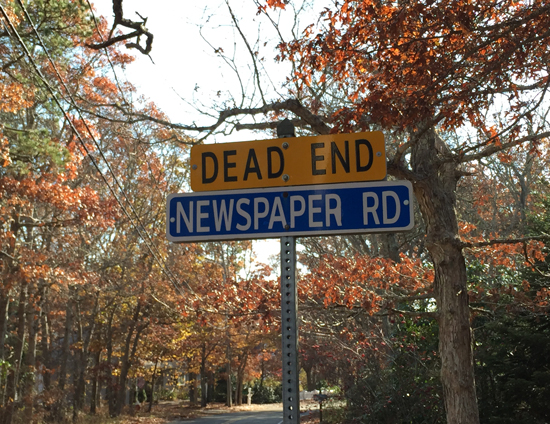
Newspaper Rd. Dead EndDFM’s stash includes such notable properties as the San Jose Mercury News, Salt Lake Tribune, St. Paul Pioneer Press, and Denver Post. Our southern Vermont dailies are afterthoughts by comparison.

And they are about to be thoroughly buffeted by the winds of corporate change.

Possible buyers include a passel of private equity firms, many of which have no experience in newspapers. That’s bad enough, but even worse are the experienced operators said to be in the running. They include Gannett, currently engaged in a slow strangulation of the Burlington Free Press; and GateHouse Media, whose name is poison in Massachusetts.

GateHouse is the creation of another private-equity firm, Fortress Investment Group. Fortress has seen its share of financial trouble in recent years; it nearly went bankrupt in the market crash of 2008. This caused it to default on a huge loan deal to fund construction of the athletes’ village for the 2010 Vancouver Winter Olympics. That forced the City of Vancouver to pony up $450 million (Cdn) to get the village built.

Oh well, you know what they say about eggs and omelets.

Even as it has struggled, Fortress has built a newspaper entity that seems to break all the rules of business. According to the Boston Globe, GateHouse “has never made an annual profit as a public company,” and in 2013 filed for bankruptcy “under the weight of nearly $1.2 billion in debt.”

Even so, Fortress finagled the finances in a way that allowed GateHouse to scoop up 33 more New England newspapers. After which, it immediately imposed draconian staff cuts. Poynter Institute media business analyst Rick Edmonds says GateHouse has a reputation as a “bottom-line, lean operator” that isn’t squeamish about making cuts. “In a case like this, they’ve probably looked at the numbers and said, ‘We can squeeze more [savings] out of this,’” he said.

Through its holding companies, Fortress controls “nearly every newspaper south of Boston,” and also “dominates Boston’s western suburbs.”

Brattleboro and Bennington, just a hop and a skip away. Looking at the two behemoths said to be in the running to buy DigitalFirst, I’d say GateHouse makes a lot more sense than Gannett. And if Gannett winds up buying all of DFM, I wouldn’t be surprised if it spun off the two Vermont dailies, which are teeny-tiny by Gannett standards but right in GateHouse’s comfort zone.

Either way, look for more slashing in southern Vermont’s already sad print-media scene. Which is a real shame; the healthier Vermont media properties, VTDigger, Seven Days, and VPR, all have a clear northern Vermont slash statewide focus. Very seldom does southern Vermont show up on their radar.

There is one thin ray of hope in Heintz’ story. As the Brattleboro Reformer has declined, he notes that an independent weekly, The Commons, has expanded its circulation in recent years.

This may be the next mutation of journalism: a Seven Days approach, including a single weekly print edition and a Web presence with more frequent postings. To be sure, there’s no sign that daily papers will do anything other than continue to diminish in size and quality.

Art Woolf To The Rescue!!!

Throughout the history of its big pipeline project, Vermont Gas has been its own worst enemy — alienating landowners, indulging in ham-fisted PR, and repeatedly raising its cost estimates for pipeline construction.

Nonetheless, the odds are still in VG’s favor. Well-meaning protests notwithstanding, if VG can make a plausible economic case, the thing’s gonna get built.

And who’s helping them build a plausible economic case, according to VTDigger?

The construction of the project will create as many as 444 direct and indirect jobs, according to a report by the Vermont consulting firm, Northern Economic Consulting, Inc.

That’s the consulting firm co-owned by our least-favorite economist Art Woolf, he of the reliably awful “How We’re Doing” column in the Burlington Free Press.

Yes, Art’s a professor at UVM, but I suspect he makes a lot more money from NEC than he does for his academic work. His consulting firm has a number of revenue streams:

— Consulting to a variety of high-paying clients, mostly of the corporate persuasion.

— Providing expert witness services for civil suits of all kinds. (“Have you been hurt in a slip and fall accident? Dial 1-800-CALL-ART for expert testimony on your financial losses.”)

— Running an annual Vermont Economic Outlook Conference. The most recent conference was a five-hour affair, with admission priced at a cool $170/person.

— Publishing a monthly Vermont Economy Newsletter, subscription a mere $150/year.

In short, Woolf is more hired gun than objective expert. Which might explain why his weekly columns, more often than not, come across like they were written on behalf of the Associated Industries of Vermont. George W. Bush once told a roomful of wealthy supporters that they were his base; well, the Vermont business sector is Woolf’s base.

So, about his rosy estimate of the pipeline’s economic impact. Without doubt, the vast majority of those 444 “direct and indirect jobs” are temporary, construction-related jobs.

TransCanada has claimed that the Keystone Xl pipeline would create tens of thousands of jobs. But almost all of those are temporary, appearing and disappearing during the projected two-year construction cycle. Operating the pipeline, once it’s built, would take about 50 workers.

As far as I can tell, nobody’s asked Woolf about the quality or duration of those 444 pipeline jobs. But if his math is similar to Keystone’s, then we should expect no more than a handful of permanent positions at Vermont Gas.

Don’t blame Woolf; he’s only doing what bespoke experts do for their money: putting forth the best possible case for his client.

One more thing. The identifier that accompanies Woolf’s column in the Freeploid mentions only that he’s a faculty member at UVM. Nothing about his corporate clients, nothing about the subscriber base for his costly publication. Considering how many business interests are paying Woolf, how often do you suppose there’s been a direct or indirect conflict of interest that’s gone conveniently undisclosed?

Oh, one more one more thing. There’s a typo in the title of last Thursday’s “How We’re Doing.” In the TITLE, for God’s sake. It’s spelled “minuscule,” not “miniscule.” Any copy editors left at the Freeps?


No good deed goes unpunished

(Note: those visiting this page for the first time may also want to read two follow-up posts: one exploring the historical roots of the proposed motto, and one about a state Senate committee’s consideration of the motto.)

_________________________________________

You try to do something nice…

Last spring, Senate Minority Leader Joe Benning got a letter from an eighth-grader at The Riverside School in Lyndonville. She was studying Latin, and wanted Senator Joe to introduce a bill to give Vermont a Latin motto. We’ve got “Freedom and Unity,” but no Latin.

As the idea developed, those involved came up with a motto: Stella quarta decima fulgeat. The translation: “May the Fourteenth Star Shine Bright,” is a nod to Vermont’s status as the fourteenth state to join the union. Nice. Poetic in both languages. Benning brought the student to Montpelier and introduced her to the Government Operations Committee, which would consider her proposal.

*Also possible endorsement deal with the new 14th Star Brewery in St. Albans?

It was too late in last year’s session to launch the idea, but Benning introduced it this month. Senate Bill 2 would not affect “Freedom and Unity” at all; it would simply establish the Latin motto as a separate thing.

A nice harmless moment, no? A reward for a hardworking, creative student, yes?

Funny thing. Last week, WCAX did a story about Benning’s bill. And the reaction, as Benning told me in an email?

I anticipated suffering the backroom internal joking from my colleagues in the legislature.  What I did not anticipate was the vitriolic verbal assault from those who don’t know the difference between the Classics and illegal immigrants from South America.

Sen. Joe Benning, perhaps on his way back to Mexico. (Photo from his Facebook page.)

Sen. Joe Benning, perhaps on his way back to Mexico. (Photo from his Facebook page.)

That’s right, the WCAX Facebook page was inundated with angry posts from ignorant Vermonters spewing their hatred in barely readable fractured English. (Spelling and punctuation as-is) Warning: Teh stoopid, it burns!

Dorothy Lynn Lepisto: “I thought Vermont was American not Latin? Does any Latin places have American mottos?”

Norman Flanders: “What next Arab motto??”

Kevin P. Hahn: “How about ‘go back south of the boarder'”

Richard Mason: “We are AMERICANS, not latins, why not come up with a Vermont motto that is actually from us”

Judy Lamoureux: “Throw him out of the country tell him to take obama with him!”

Phil Salzano: “My question is, are we Latin, or are we Vermonters? Alright then, English it is…..”

Lori Olds: “I thought this was USA why are they trying to make Americans aliens”

Chris Ferro: “That’s a BIG NO, if you live in the United State YOU need to learn ENGLISH!!”

Julie Kellner: “No, you a USA citizen!.. Learn & understand the language!!!.”

Kurtis Jones: “No cause vt ain’t no Latino area. Leave the motto alone”

Zeb Swierczynski: “ABSOLUTLY NOT!!!! sick and tired of that crap, they have their own countries”

Ken Curtis: “Just when I felt our represenatives could not possibly get any dumber , they come up with this…get real… this is the USA, not some Moslim or Mexican country…stop given in to these people…PRESS 1 for English and forget the rest… worry about the problems you were elected to do”

Ronald Prouty Jr. “No way this is America not Mexico or Latin America. And they nee to learn our language, just like if we go there they want us to speak theirs”

Kristen Wright: “thats un called for this is the usa”

Kelley Dawley: “How do you say idiotic senator in spanish? I’d settle for deport illegals in spanish as a back up motto”

Heather Chase: “Seriously?? Last time I checked..real vermonters were speakin ENGLISH.. NOT LATIN..good god…”

I could go on, but that’s more than enough.

And really, it’s only the tip of the iceberg. For every commenter who didn’t know the difference between Mexico and Rome, there were ten who were apoplectic over the notion that Our Representatives Are Wasting Their Time (as if this bill will take more than a few minutes anywhere), and that Joe Benning is a moron who should be voted out of office and/or evicted from Vermont.

The good Senator is reacting to this with admirable equanimity:

I figure this is a good opportunity for my now ninth grader to learn how to respond to such attacks with fortitude and grace.  I hope to be meeting with her and her parents this weekend to continue the educational experience.

Good on ya, Senator. Illegitimi non carborundum.


Mikey Pom-Poms is at it again

I can explain everything.

Nobody was Tweeting, officer. We were all in the back seat singing.

Last night saw another outbreak of TwitBoasting from serial offender Michael Townsend, the Burlington Free Press’ Cheerleader-In-Chief.

The first one wasn’t that bad:

Okay, fine, share a little love with one of your hard-working scribes. Nothing wrong there. But then came Step Two in Townsend’s descent.

Mike Donoghue was at the Statehouse yesterday, but I’m told he wasn’t covering Shumlin’s budget address; he was dogging people about this delinquent-taxpayer list. Short version: earlier this week, the state released a list of its top 100 tax scofflaws — 50 business, 50 individual. But just the names; not the amounts owed. Donoghue is seeking the amounts.

That’s the big scoop. On the day of Gov. Shumlin’s budget address, when he’s setting the agenda for this legislative session, the Free Press’ senior reporter is stirring up a tempest in a transparency teapot.

And then came Townsend’s topper:

Oh, Mikey.

Look, it’s perfectly okay to talk up your own reporters. But why do you have to run down everybody else?

As I’ve said before, this is why all the other reporters think Townsend is a jerk and the Free Press is a fount of institutional arrogance.

Also, please lose the fake cowboy stuff. Donoghue and Burbank are good reporters; they’re not The Magnificent Seven.