Category Archives: Taxation

The Scott Milne Policy Watch Continues

It’s beginning to seem like a distant memory, or perhaps just a fever dream.

Remember when Scott Milne promised to roll out his platform in September?

If you do, it’s probably because I keep reminding you.

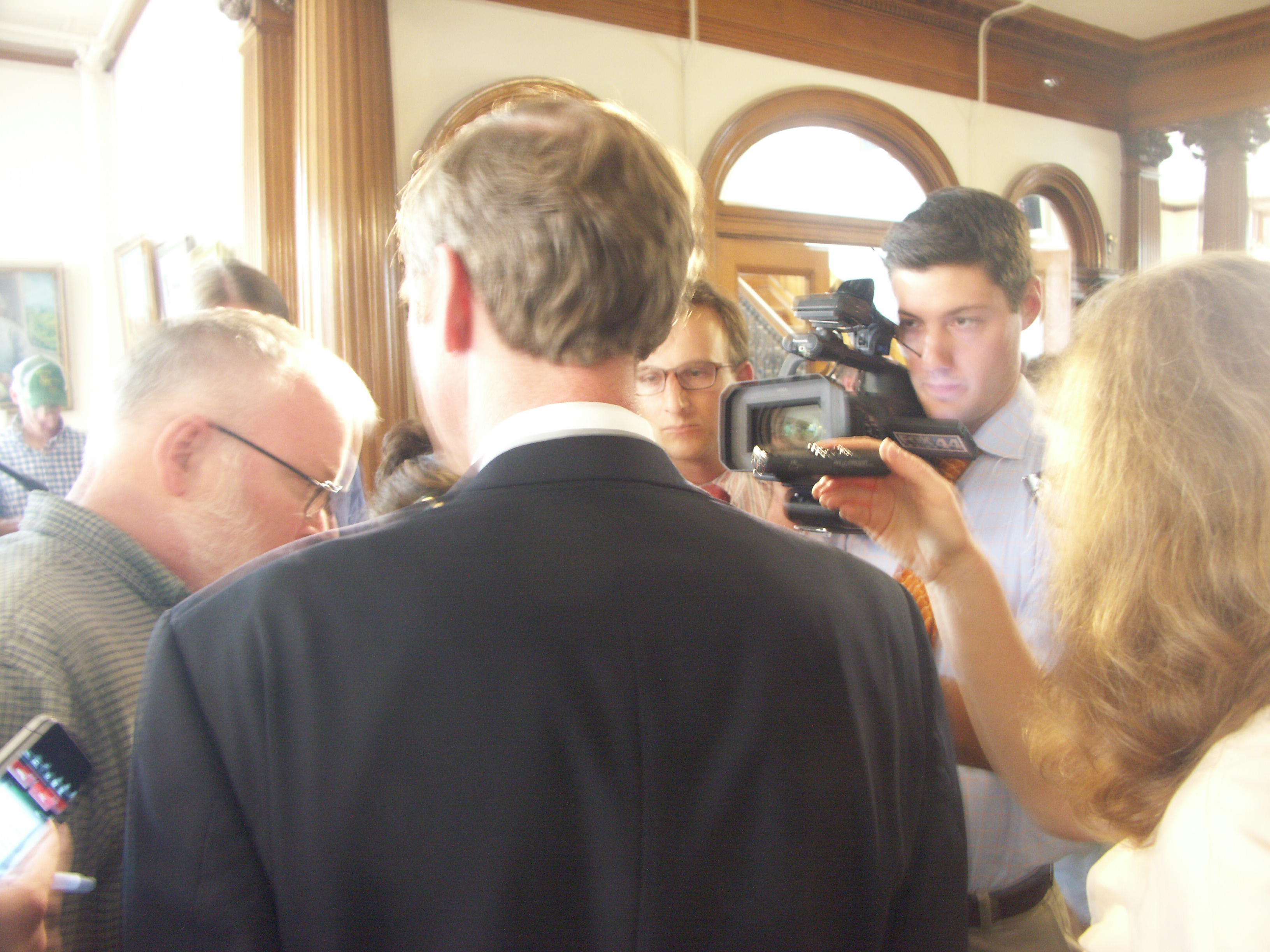
The Ghost Campaign in the flesh

The Ghost Campaign in the flesh

Well, here it is September 19th, and the only shred of policy we’ve gotten is an ill-thought-out proposal to freeze property taxes for two years while we figure out a new system. No hint of how local schools are supposed to cope with rising costs for salary, benefits, and energy, among others. And no clues about the kind of system Milne would like to implement.

Anyway, on Thursday Milne made an appearance before “30 people” at the Colchester-Milton Rotary. (I wonder hwo many left after the raffle and before the guest speaker.) And perhaps out of sympathy, Seven Days sent reporter Mark Davis to cover it. 

Which produced this nugget:

Milne offered few specifics of his agenda. At various times, he told the 30 people in the crowd that he would release his own plans for health care, education and job creation in the coming weeks.

Cough.

“In the coming weeks”?

Weeks?

WEEKS?

Will somebody please remind Our Man Mahatma that Election Day is only six and a half weeks away?  I’m concerned that his Staff Fabricator may have convinced him the election is actually in November 2015.

Mr. Empty Suit steps to the mic

“I’ve got plenty of great ideas.”

So said Republican Scott Milne during Saturday’s gubernatorial debate. His comment came after Governor Shumlin repeatedly slammed his failure to give “us one single plan” on a variety of issues.

And then Milne, predictably, failed to name any ideas.

Well, he did have one: a two-year cap on property taxes, which would put public school into a dire budget situation because many of their costs will continue to rise. It’d force spending cuts from the top down, the very opposite of his claim to be in favor of local decision-making. But hey, at least it was an idea.

Otherwise, nothing much. At another point he said “I’ve got two ideas.” The first was that the Governor had spent too much time out of state. Which is not an idea; it’s an attack.. The second was the property tax cap.

Sigh.

As I said in an earlier comment, Milne managed to exceed the minimal standard of competence, e.g. he didn’t poop his pants. Shows you how dismal his campaign has been, that keeping his shorts clean seems like an accomplishment.

As for actually putting forward an inspiring message, nope. Not at all. He hammered repeatedly on the same old attack lines he’s used since launching his campaign: Shumlin is “the most progressive, radical Governor” who insists on pursing single-payer health care. Milne’s idea for health care reform?

“I will be working very hard with people to get something figured out.”

That is, word for word, what Scott Milne actually said.

On trying to keep young people in Vermont, his only contribution was to assert that the Shumlin Administration “has not been business friendly,” and Vermont needs “a new tone” in its dealings with business. F-sharp, perhaps?

When asked about problems at the Agency for Human Services, he pivoted back to his attack on the troubled rollout of Vermont Health Connect, and cited it as an example of poor management. When he actually addressed AHS, he said we need an agency that “puts the family first.” How imaginative.

When asked about cutting state spending, he gave a halfhearted shoutout to the discredited Challenges for Change initiative, then said “I’m not into cutting,” and then said property taxes are too high.

Confused?

In his closing statement, Milne referenced his late mother Marion’s run for State House in 1994 when, as Milne tells it, a local politico gave her no chance to win. But she ran anyway and won. And so can Scott Milne, if people only believe. And he closed with a bombshell: “Vermont needs a different path. I believe it needs a more moderate path.”

Having, once again, failed to give any real hint of his preferred path for Vermont. It’s been defined almost entirely in the negative: He wouldn’t repeat the alleged mistakes of Governor Shumlin.

And, as I reported earlier, he’s postponed a meeting with VTDigger’s editorial board because his platform isn’t ready yet.

Scott MIlne’s campaign is very close to flat broke. Its campaign manager just resigned. The best you can say about Milne’s debate performance is that he didn’t flame out. But he did nothing to advance his campaign, to provide a substantive option to Shumlin. Or to Dan Feliciano, for that matter.

He did okay by his standards, but that’s not nearly good enough.

Dan Feliciano, man of ideas. Well, three ideas.

Saturday’s gubernatorial debate was a big moment for Dan Feliciano, Libertarian candidate for Governor and presumptive usurper of Scott Milne’s mantle as the real conservative challenger to Governor Shumlin.

Dan the Libertarian Man. Photo by VTDigger.

Dan the Libertarian Man. Photo by VTDigger.

So, how’d Dan the Libertarian Man do? About as well as he could have done. Which is, as you might imagine, a two-edged sword.

Feliciano presented himself as the conservative candidate with ideas. And yes, he has ideas. But to judge from his debate performance, he has precisely three of them: Cut taxes and spending, cut regulation, and institute school choice.

That’s it.

He repeated them over and over during the debate because, well, that’s about all he has to say. It was a good performance but, at the same time, it defined his limit as a gubernatorial candidate. His ideas are simply out of the mainstream.

And, worse still, lacking on specifics.

Let’s take, first, his call for lower spending. What’s his big idea on how to cut the cost of state government?

Challenges for Change.

Stop laughing. I’m serious.

Dan Feliciano wants to reintroduce Challenges for Change, the discredited Douglas Administration plan. This… is our Libertarian’s call to arms? A years-old, formerly bipartisan initiative that was abandoned in 2010 because both parties agreed it just wasn’t working?

Until now, I thought that Tom Pelham was the only True Believer left. But no: it’s him and Dan Feliciano. Sheesh.

I suspect that this is one of Feliciano’s attempts to make himself look less scary to mainstream voters. Don’t start with Libertarian ideas for privatizing schools, prisons, police, fire, and snowplowing; start with a mainstream reform plan. A failed plan, but a mainstream one.

On health care reform, he’s dead against single-payer. His “idea,” though, is weak: cut health insurance regulation to foster competition. We’ve already seen how that works: the competition turns into a race to the bottom, with affordable insurance available only to the healthiest, all kinds of exclusions to minimize claims, and a maze of complicated legalese designed to frustrate consumers.

And Feliciano tried to have it both ways when it comes to community rating, Vermont’s rule that prevents price discrimination against the elderly, the sick, and others with high risk factors.  He claimed to support community rating, but he also called for Vermont to scrap its own exchange and adopt the federal one, as New Hampshire has done. Well, Dan, New Hampshire and other states operating in the federal system don’t have community rating. Which is it?

On schools, he wants spending cuts but doesn’t provide any examples. His Big Idea is school choice, which is going to reduce costs in a way he doesn’t explain. I wonder why. Could it be because the savings are based entirely on free-market dogma? Could it be that, in a system already short of students, spreading them around to more institutions will make the situation worse, not better?

When asked about problems in the Agency for Human Services, he said “We need a wholistic approach to families and children.” Without explaining what in the world he means by that. And when asked about supporting agriculture, his one idea was — you guessed it — cutting EPA regulations.

In spite of rampant pollution in Lake Champlain, to which agriculture is the single biggest contributor.

This is Feliciano’s unique position, and his glass ceiling. He is a man of ideas, certainly. But it’s a small handful of endlessly repeated dogmatic ideas that don’t work in the real world. Much as he tries to water it down, he is stuck with Libertarian dogma. It gives him a clear outline, unlike the endlessly foggy Mahatma Milne. But it also consigns him to fringe status in any race with a credible Republican candidate.

If Milne keeps on soiling the sheets, Dan Feliciano might get into the double digits on November 4. But he’ll never be anything more than that. And whenever the Republicans run a viable candidate, he’ll be back down to Emily Peyton territory.

Scott Milne hints at an actual policy position

So, Our Man Mahatma was up in Newport on Wednesday, hangin’ out at the Agway and talkin’ politics with the folks. And there to capture the excitement was a camera from the Newport Dispatch, an online-only news website.

Simple, short video, a few Q&A’s; one of which concerned rising property taxes. And while Milne did not take an actual position, he did hint at the vague outlines of a position. Which, for him, constitutes news. Take it away, Mahatma:

“I think there’s a need to rapidly address a solution for not having taxes increase any more while we figure out how to restructure things. That’s gonna be one of the fundamental principles of our campaign, something we’ll be talking a lot more about over the next two weeks. So I’d ask you to stay tuned. You’ll be happy with what we’re going to be talking about.”

Sounds like he’d call for a freeze on property taxes while he and the Legislature work out a longer-term solution. It sounds unworkable to me; there’d be a pretty rough immediate impact on school budgets and the transfer payments needed to ensure equal funding across the state. But hey, it’s an idea from Scott Milne. And that’s news.

But then he kinda blows it by promising an actual policy in “the next two weeks.”

Oh, c’mon now. When he outlined his two-stage campaign — attack Shumlin in August, unroll his positions in September — it seemed way too late to introduce a Milne Plan to the voters. Now he’s promising a Plan by the end of the month. Only a few weeks before the election.

Meanwhile, Milne continues to cede the conservative spotlight to Libertarian Dan Feliciano, who once again held a news conference yesterday where he once again got more attention than he deserves. The funny thing is, Feliciano pulled a Milne: he criticized Shumlin on state spending, but refused to say how he’d cut the budget.

Scott Milne has allowed Dan Feliciano to become a big problem. Not as a viable contender, but as a third “real” candidate in the race, likely to be included in gubernatorial debates.

If those debates were simply Milne vs. Shumlin, then Milne would have room to attack and establish his own positions. With Feliciano sharing the stage, there’ll be a lot less room to maneuver. Milne will be the Man In The Middle, and he’ll almost certainly look wishy-washy by contrast to the tight-fisted Feliciano and the self-proclaimed “progressive” Shumlin. He’d have to be a very strong, forceful presence to stand out in that situation. And to date, Milne has shown no ability whatsoever to be strong or forceful.

The limits of messaging

Just finished listening to a Reporter’s Roundtable on VPR*, with three of the better reporters around — VTDigger’s Anne Galloway, VPR’s Peter Hirschfeld, and the Freeploid’s Terri Hallenbeck– examining the entrails of last week’s primary election and the prospects for November. 

*Audio not yet available online, but it should appear here later today. 

Thin gruel, to be sure; the key races are essentially over, with the possible exception of Phil Scott vs. Dean Corren for Lieutenant Governor. But when the race for a mainly ceremonial position is your biggest source of intrigue, well, that tells you all you need to know. 

There was a lot of dancing around the fact that November is in the bag for the Democrats, with the noble exception of Galloway coming right out and saying that Governor Shumlin was going to win. The dancing is understandable, considering that (1) journalists want to appear objective, and (2) as political journalists, they’ve gotta cover this puppy for two more months, and what fun is it when there’s no intrigue? 

Much of the dancing centered on the idea that good “messaging” could carry a Republican candidate into a competitive position. The Dems aren’t invulnerable, the reasoning goes, it’s just that neither Scott Milne nor Dan Feliciano seems capable of delivering a solid, appealing message. 

That’s true, insofar as it goes. But there are three much more powerful factors operating against the Republicans: most voters pay little or no attention to messaging, the electorate is solidly center-left, and today’s Republican Party has little to offer on the key issues in Vermont. 

First, reporters and insiders overestimate the impact of tactics and strategy and messaging. The vast majority of voters have their minds made up before the campaigning starts. The only thing that could change their minds is some sort of shocking revelation or catastrophic event. Some voters do actually watch debates and bring an open mind to campaign coverage, but they only matter when an election is otherwise close. 

Second, it’s obvious from the results of the last decade or so that most voters prefer Democrats. The Legislature has been solidly Democratic for years. Among statewide Republicans, only Jim Douglas and Phil Scott have been able to buck the trend. Both have done so because of their unique personal appeal and by projecting an image of moderation and willingness to compromise. 

And third, Shumlin and the Dems are potentially vulnerable on issues like health care reform, the Department of Children and Families, the economy, taxation (especially school taxes), and the environment (Lake Champlain, the natural gas pipeline). 

On all those issues, the most appealing solutions involve more government, not less. Shumlin is more vulnerable to his left than to his right. 

In spite of Vermont Health Connect’s troubles, health care reform remains popular. Republicans have no answer aside from letting the market do its magic. Fixing DCF would require more resources, or at the very least more effective management. Have the Republicans given anyone reason to believe they care more than the Dems about poor people? Hell, no. Do the Republicans have a track record of good management? Only in the minds of Jim Douglas and Tom Pelham. 

Would the Republicans be better stewards of the environment than Dems? Ha ha. Can they plausibly portray themselves as defenders of public education, which remains extremely popular in Vermont? No; their only solutions are competition and union-busting. Can they convince voters that they’d preserve local control? Not if you could saw money by centralizing. 

On the economy, the Republicans have little to offer aside from the tired, discredited supply-side nonsense. Which took another bullet yesterday with the news (from the Federal Reserve Bank) that our post-Great Recession “recovery” has benefited the wealthy while middle- and working-class wealth has actually declined. One-percenters and corporations have a larger share of our wealth than ever, and all the Republicans can offer is policies that will further enrich the rich. 

And as for taxation, Vermonters may be dissatisfied with rising school taxes and worried about the cost of single-payer health care, but they also favor a robust government that can tackle problems effectively. Most voters don’t want a mindless “cut, cut, cut” approach, and that’s the standard Republican line. 

Here’s what a Republican would have to do, to be competitive on a statewide level: Bring an established reputation for effective governance, or at least an open-minded attitude toward the notion that government can actually solve problems. Express skepticism about political dogma, especially the cherished beliefs of the right. And do that without, somehow, losing too much support among the Republican base. And, finally, regain the support of the business community, which has largely abandoned the VTGOP in favor of a cooperative relationship with the Democrats. 

Now. If a Republican can identify and execute a strategy that accomplishes those things, s/he can win. Otherwise, no amount of good messaging will carry the day. It’s not impossible; there’s at least one potential Republican candidate who could manage it. But he ain’t running this year. 

Sweet deals, or no deals?

The 2015 legislative session looks to be big and contentious, including the likely rollout of Governor Shumlin’s single-payer health care plan and a serious debate over public-school organization and financing. We can also expect a new battle over campaign finance reform, VPIRG’s #1 issue for the year.

And there will be a new fight over taxing sugar-sweetened beverages, a measure that has failed twice in recent years. But a new year, a new push, and a new guy taking leadership: Anthony Iarrapino is leaving the Conservation Law Foundation to head the Alliance for a Healthier Vermont, the coalition that spearheaded the sugar-tax fight in 2013. Iarrapino told VTDigger, in the words of Bullwinkle T. Moose, This time for sure.

“We’re going to have the resources this time around to really mobilize and educate the public and policy makers on the wisdom of Vermont once again leading the nation in an important policy area,” he said.

The Alliance claims to have $200,000 to bankroll its campaign and counter the efforts of Big Food and the ever-vigilant Vermont Retail and Grocers’ Association. It also seeks to piggy-back on health care reform, by offering a short-term revenue boost from the tax and the longer-term cost reductions from lower rates of sugar-induced illnesses.

It’ll be interesting to see how Governor Shumlin plays this. (Yes, I’m assuming his re-election. Aren’t you?) He can surely use every bit of money he can find for single-payer; but he’s opposed this tax in the past, and his campaign is getting heavy support from the likes of Coca-Cola.

But I would be Shocked, Shocked, if there were any quid pro quo involved.

Jim Harrison of the Retail Association is dusting off his talking points, including the hardy perennial “a tax would hurt retailers near New Hampshire.” Yeah, well, it might hurt big supermarkets within shouting distance of the border, since a 2-cent-per-ounce tax adds up if you’re buying a 30-pack of Mr. Pibb. I doubt it’ll impact our cherished Mom and Pop enterprises; hard to see too many folks driving across the border if they’re just stopping in for a quick Gatorade fix.

But Harrison’s biggest laugh line was this:

Nothing has changed since previous efforts to pass the tax, adding that it’s still regressive and “goes down the path of government trying to decide what’s best for consumers through tax policy,” Harrison said.

Bwahahahaha. Stop it, Jim, you’re making me shoot coffee out my nose.

You kiddin’ me? Government uses tax policy ALL THE TIME to “decide what’s best for consumers.” Take the mortgage interest rate deduction or the charitable contributions deduction. Take any stinkin’ tax deduction, break, subsidy, or exception. Take the capital gains tax rate, which decides it’s better to be a rich investor than a working stiff.

And if you just want to talk about sweeteners, well, that’s the mother lode of government using tax policy to “decide what’s best for consumers.” Agribusinesses that produce sugar and corn benefit from extremely generous subsidies, price supports, and free “insurance.” The result is lost tax revenue for the public till, a farm system that’s heavily skewed toward the biggest producers and commodity crops that go into junk food of all kinds, and — pay attention, Jim — higher cost for consumers because of artificially high sugar, corn, and soy prices.

So please don’t insult our intelligence with that “government shouldn’t decide what’s best for consumers” nonsense. That ship sailed a very long time ago.

Anyway, it should be an interesting battle. I expect legislative leaders to trot out the old reliable “too many other issues on our plate” line, in an effort to put off consideration of the sugar tax. It’ll be up to the likes of Iarrapino to make it a fight they can’t postpone. As we saw with the GMO labeling bill this year, it’s possible to build momentum behind an issue that lawmakers might prefer to duck, but it takes a concerted effort.

And it’ll require a softening of Shumlin’s hard-line stance. Not an easy thing to accomplish.

Nanobrew wishes and maple syrup dreams

Ah, Vermont. Home of picturesque farms, covered bridges, general stores, and…

…private estates with their own tennis courts.

Vermont had the largest percentage of single-family home listings boasting a residential tennis court on the real-estate website Trulia.com as of May 30.

… The percentages in every state were small: In Vermont, 0.77% of single-family home listings mentioned a tennis court. In New Mexico, it was only 0.17%. And only 0.23% of the combined listings in the 50 states included a court.

So, Vermont, yay?

This is the Other Vermont, the one concealed at the end of long private driveways behind locked gates and groves of mature trees. The one that, according to Governor Shumlin, pays more than its share of our tax burden. It was only a little more than a year ago that Shumlin was hell-bent on cutting the Earned Income Tax Credit for the working poor, while insisting that the wealthiest Vermonters were ’bout ready to flee the state if they had to pay a penny more in taxes.

You could take this surprising tennis-court factoid two ways: On the one hand, it’d be awfully hard to pack up a tennis court and take it with you. On the other, hey, if there are a lot of tennis court-laden properties on the market, perhaps the Great And Good Of Vermont are already on their way out the door. Hard to tell.

Anyway, as I reported during last spring’s tax kerfuffle, Vermont imposes a relatively high 8.95% tax rate on top earners — but because of the way we calculate taxable income, wealthy Vermonters actually pay only 5.2%. Which explains why they can afford to maintain all those expanses of carefully-manicured lawn.