Category Archives: Taxation

The hidden costs of Vermont’s outdated tax system

There was a bunch of stuff going on at the Statehouse on Friday. The gun bill was moving through the Senate Judiciary Committee; two House committees were mulling possible taxes to pay for an improved health care system; and all committees were rushing to meet the crossover deadline for non-financial legislation.

To me, the most important thing going on — well, the thing with the biggest potential long-term impact — happened before the Senate Finance Committee, which heard testimony about systemic problems with Vermont’s tax system, and how they contribute to our current fiscal mess.

In a nutshell, a major part of our budget trouble has to do with a narrow tax base for our income and sales taxes, and sales tax revenue lost to the rising tide of Internet retail. And we’re not talking a jot and a tittle; we’re talking tens of millions in foregone revenue.

In other words, if our tax system were up to date, our budget would only need a little tweak instead of major surgery. And the Democratic majority wouldn’t be constantly scouring for ways to scare up some additional money; it’d be flowing in just like always, enough to cover our expenses.

You can see why I wanted to be there.

Senate Finance chair Tim Ashe (D/P-The Big City) called the hearing because of his concerns over our creaky tax system.

“This discussion is about realignment of our tax structure in line with how our economy works today. …We need to be thinking about the future. It’s not about taxing Vermonters out of the state or any of that; it’s saying, how do we avoid an annual crisis management approach? It’s not about taxing this or that person more or less; it’s, are we taxing the right things? Once you determine that, then you determine the rates that are fair and reasonable.”

As part of this work, the committee is taking a fresh look at the fabled 2011 Blue Ribbon Tax Commission’s report, which I’d thought had been relegated to the Dustbin Of Perpetual Ignorage. The commission had some pretty sound ideas for a better tax structure — but ideas that promised to raise many a hackle in the Statehouse.

Among many other things, the Commission called for imposing the sales tax on most services as well as goods, and repealing many sales tax exemptions. This would allow for a 1.5 cent cut in the sales tax rate. On the income tax, it recommended moving to Adjusted Gross Income as the definition of taxable income, plus the elimination of pretty much all tax deductions. Tax rates would have been adjusted downward to make the changes revenue-neutral; but it would have made for a much simpler and fairer income tax system. If Senate Finance is resurrecting the report under Ashe’s leadership, then that’s a good thing as far as I’m concerned.

Teachout's teach-in.

Teachout’s teach-in.

Sara Teachout of the Joint Fiscal Office presented a series of charts highlighting portions of the tax system; all are available online here.

On the sales tax, she showed that American consumption patterns have reversed in the past six decades. In 1952, 60% of our consumption was in goods and 40% in services. Today, goods consumption has fallen to roughly 35%, with services up to 65%.

You can see how that would create a problem, when your state’s sales tax is applied only to goods.

And then there’s Internet retail. It was about 0.5% of total retail purchasing in the year 2000; it’s up to 8% now, $80 billion annually nationwide, and seems certain to continue its inexorable rise.

You can see how that would create a problem when there’s no structure to enforce state sales tax on Internet retail. And the Internet is a double whammy for Vermont’s economy and tax collections; not only is there the direct impact of lost sales tax revenue, but there’s the broader impact from lost retail sales at local brick-and-mortar stores. That means less economic activity, plus fewer jobs and lower incomes in the retail sector.

Ashe estimates the loss in sales tax revenue at about $50 million per year. Please note: this is not new revenue; this is revenue we used to take in but we’ve now lost. As the Senator puts it:

We get blamed for overspending, but $50 million would have just been coming in. Instead, we have to fill the gap. That’s the part where we keep raising revenue and people say, ‘Why are you doing that?’ It’s not a desire to raise taxes; it’s a replacement strategy.

Now let’s look at the income tax. Vermont has one of the narrowest income tax bases in the country because of the way we calculate taxable income and our generous rules on tax deductions. As I’ve noted earlier, the average million-dollar earner in Vermont claims more than $500,000 in deductions. Nice work if you can get it.

A proposal now before a House committee would cap itemized deductions at 2.5 times the standard deduction. This would substantially increase taxable income for top earners, and generate more modest tax hikes for the upper middle class. Total revenue is estimated at $35 million per year*.

*Correction: I misread the source for this figure. It’s actually about $15 million per year. It’s part of a proposed House tax package that would raise $35 million.

I may be more of a policy geek than the vast majority of Vermonters, but perhaps you see why I’m so interested in this work.

Sen. Ashe is not necessarily in favor of the itemized deduction cap; he would prefer a broader, deeper consideration of Vermont’s tax structure.

What I would not want to do is have the House and Senate entertain that, and then have that not be satisfactory to put us on a sustainable path, and have to do something else very substantial a year or two later. So the question is, can you configure our revenues in a way where we won’t have to come back for a while? Can we buy 20 years of revenue structure with what we do next? That’s the thing that’s important to me.

Philosophically, I don’t like the radio-dial approach that most legislatures take, which is ‘This year we go up a little, next year we go down.’ Predictably is worth something.

Indeed, Ashe predicts that the preponderance of this year’s budget-balancing will come in spending cuts, not revenue hikes. That’s mainly because of a timing issue built into the system: spending cuts take effect right away, while changes to the tax code take months — up to a full year, in fact — to take effect and start generating new money. But in spite of this year’s very crowded legislative agenda, he is hoping to clear the groundwork for a full consideration of tax issues in the near future:

I would like the [Finance] Committee to do what it can to choose a path this session. That path may be articulating what the future ought to look like, as the Blue Ribbon panel did. Maybe not in the same way, but to say, ‘This is what we intend to do, the broad outline of a tax structure for the future,’ take it on the road, let it get beat up a little bit, have it evaluated by others, and come back next year.

Go big, or go home. I wish him the best in his endeavor, which does seem awfully optimistic and (dare I say it) progressive. On the other hand, I wouldn’t want his best to become the enemy of the good; if there are positive steps to be taken this year, and I see the deduction cap as an obvious positive step, then I don’t want to put it off in hopes of getting pie in the sky next year.
For health care expansion and SSBT, a long road ahead

Last week brought some relatively cheery news for fans of better access to health care and of the sugar-sweetened beverage tax. The House Health Care Committee passed a fairly wide-ranging bill that would help close the Medicaid gap, provide more assistance to working-class Vermonters seeking health insurance and encourage more primary care providers, among other things. To pay for all that, the Committee opted for a two-pronged approach: the revised 0.3% payroll tax proposed by Gov. Shumlin, plus the two-cents-per-ounce tax on sugar-sweetened beverages.

A good package, a nice bill. But is it a meaningful step, or simply a McGuffin? When you read between the lines of Committee chair Bill Lippert’s statement, and see the slightly shopworn look on his face, well, you start thinking the latter.

I have no illusions that what we propose will be a final product at the end of the session, but it was our responsibility… to identify and articulate priorities that could make a difference now and could be investments for the future, even in a time of tight budgetary constraints.

Glass half full, or glass half empty? I hear a guy resigning himself to the inevitable disembowelment of his bill.

Enough inference. The next stop is the Ways and Means Committee, where opinion is split on the SSBT and there’s widespread opposition to the payroll tax. After that, well, there’s a lot of room for pessimism.

There’s little appetite for raising taxes in Montpelier — or should I say “raising more taxes,” since tax increases will almost certainly be part of a budget-balancing deal. (Front runner: Ways and Means chair Janet Ancel’s plan to cap itemized deductions at 2.5 times the standard deduction.) There’s also the EPA-mandated Lake Champlain cleanup that needs funding. In this climate, it’ll be hard to justify funding the health care package as well.

Regarding the SSBT specifically, Governor Shumlin and House Speaker Shap Smith don’t like it. Really, there aren’t many real fans; some just see it as the least bad option. Most lawmakers seem allergic to the payroll tax, even in reduced form. But let’s say, just for the heck of it, that the Health Care Committee’s bill passes the House. What awaits in the Senate, that notorious den of centrism where liberal House bills go to die?

“I wouldn’t predict what a vote today would be,” says Senate Finance Committee chair Tim Ashe (more D and less P with each passing day). “I’d say they both start in difficult places in terms of a Senate vote. Individual committees may be more or less favorable, but in the whole Senate, both would struggle to pass at this time.”

Gulp. Well, I guess I shouldn’t be surprised. So I guess that leaves us with no money for enhancing our partially-fixed health care system?

“That’s an open question,” says Ashe. “There are the resources to pay for new initiatives or increased support for existing initiatives can come from existing sources or new revenues.”

Oh really? You’ve found a pot of money somewhere?

“I’ll mention just one resource. …This year, Vermonters without insurance are going to ship about six million bucks to the federal government in a penalty. Next year that money goes up to 12 to 14 because the penalty basically doubles.

“So 23,000 Vermonters will be shipping all that money to Washington, and they will get nothing for it. Question is, is there a way to help them NOT send the money to Washington and get nothing for it, but to keep the dollars here and give them something for it? I don’t know what the answer to that is, [but] it makes you scratch your head and say, ‘Well, jeez, wouldn’t it be easier if they just had insurance here?'”

Nice to see the Senator thinking outside the box, BUT… he himself admits he doesn’t know the answer to that. And even if we could somehow funnel the penalty money into health insurance, we’re talking “about six million bucks” this year and 12 mill the year after that. That’s a far cry from the Health Care Committee’s $70 million a year.

Six million, or even 12, isn’t going to buy you a whole lot of improvement. The Medicaid gap would remain painfully wide, and good-quality insurance would remain out of reach for many working Vermonters.

But that’s the kind of year we’ve got. Best to ratchet down expectations.

Of course, we’re now looking at budget gaps in the $50 million range for each of the following two years. Substantial health care reform keeps receding further over the horizon. And universal access? Rapidly approaching pipe dream territory.

Big Beverage’s Hired Guns pt. 2: Mountain Dew wishes and Twinkie dreams

“When you work in this building long enough, you notice things like thread count.”              — Anonymous Statehouse scribe

The House Ways and Means Committee heard a full morning’s worth of testimony today on the proposed sugar-sweetened beverage tax. The most interesting witness, not in a good way, was one Kevin Dietly of Massachusetts-based Northbridge Environmental Management Consultants, speaking on behalf of the beverage industry. He definitely had the fineest suit in the room, not to mention bright pearly-white teeth. (Oh, and a Google search indicates that he’s a member of the Chautauqua Yacht Club. Must be nice.)

And he acknowledged, in answer to a question from the committee, that he has represented the food and beverage industries since 1986.

That’s a long time serving the same paymasters.

Dietly managed to actually travel to Montpelier, unlike his fellow soulless industry flack Lisa Katic, discussed previously. I don’t imagine it was a sacrifice for ol’ Kev, since he presumably drew full expenses and a fat hourly rate for his visit to Montpelier. (He stuck around for the full morning, billable to “Stop The Vermont Beverage Tax.”)

(This wasn’t his first trip to the Statehouse; in 2013 he testified for the beverage industry against a proposed expansion of Vermont’s Bottle Bill. Surprise, surprise.)

His testimony was a carefully-crafted web of industry-friendly statistics and studies, plus back-handed dismissals of the academic experts who’d preceded him in the witness chair. You know, the economists, doctors, public health experts and nutritionists who have consistently found that…

— Sugar-sweetened beverages are a scourge of the American diet, leading to high rates of obesity, diabetes, and other severe illnesses.

— Taxing a specific commodity invariably leads to lower consumption.

— Lowering consumption of sugary drinks will have a beneficial impact on public health and public-sector healthcare spending.

— There’s no evidence of a significant “border effect”; in fact, there’s quite a bit of evidence that any “border effect” would be minimal or nonexistent.

— The impact on employment is neutral to mildly positive. Consumption of sugary drinks goes down, but people buy other stuff instead.  The equation balances out. Plus, the tax revenue funds jobs in government or the healthcare sector.

Pish-tosh, said Dietly, slamming “academics” who live in “a different world,” a “theoretical world.” When they retreat to their “ivory towers, things get a little wacky.”

Welp, so much for scientific research. Can’t trust anything they say.

As for Mr. Dietly, when you Google his name you get a massive quantity of testimony before various legislative bodies around the country on behalf of the food and beverage industries. Here’s a sampling of The Expensive Wisdom of Kevin Dietly:

He spoke to a New York Senate committee in 2010 in opposition to a proposed beverage tax. His arguments were essentially the same, then and now: a beverage tax would have disastrous economic consequences (but he entirely leaves out the fact that consumers will substitute other items for taxed beverages, thus mitigating the dreaded financial and employment impact), and it wouldn’t have any effect on public health (carefully selected statistics cited, inconvenient ones waved away).

In 2012, California voters faced a ballot measure to require labeling of foods that contain GMOs. (The measure was defeated after a very costly “No” campaign bankrolled by Big Food.) And oh looky here: Kevin Dietly was a hireling of the “No” campaign, and offered a very high estimate of the cost of GMO labeling — as much as $400 per year for each California household. His estimate was based on the assumption that producers would universally switch to costlier ingredients in order to avoid the GMO label (a dubious assumption at best), although he admitted that “We certainly don’t know what will happen.”

Speaking to Nevada lawmakers in 2011 on the subject of recycling and bottle deposits, Dietly positioned the beverage industry as having been “among the leading packaging innovators of the past 100 years,” and touted the industry as supporting a range of programs “to promote recycling.” And then he makes forceful arguments against deposit laws. If you read through his testimony, there are striking parallels in method, style, and type of argument with today’s testimony against the beverage tax.

In 2014 he addressed Connecticut lawmakers about a proposal to expand the state’s bottle bill. He asserts that it would impose unbearable costs on manufacturers and retailers, and had the audacity to depict the deposit/refund system as “counter to the goals of sustainable recycling and materials management.”

In 2002 he spoke before a U.S. Senate committee (chaired by Jim Jeffords) which was considering a “Beverage Producer Responsibility Act.” The concept of “producer responsiblity” has been a mainstay of advancement in environmental law; in Germany, for instance, producers have cradle-to-grave responsibility for their products — from bottles to automobiles. Its economy seems to be getting along just fine, no?

But according to Dietly, such an act would have been costly to consumers and businesses, and had little or no environmental benefit. Hmm, if he thinks there’s a disconnect between the Ivory Tower and reality, I sense a greater disconnect between industry-funded experts and reality.

I could go on, but you get the idea. Kevin Dietly is a well-traveled, amply-compensated spokesflack for the beverage industry, fighting for its interests in legislative halls around the country. His testimony should be judged accordingly.

Beverage tax pipped at the post?

This should have been a good day for the sugar-sweetened beverage tax. State lawmakers were unconvinced by Governor Shumlin’s proposed payroll tax, and many had turned to the beverage tax as a way to help close the Medicaid cost gap. Today, the House Ways and Means Committee is considering the beverage tax, and advocates on both sides are pointing to this hearing as a key moment.

(Last year, the beverage tax passed the House Health Care Committee but died on a close vote in Ways and Means. Things were looking better for the tax this year.)

But wait, what’s this? Shumlin’s posse has come riding over the hill with a revised payroll tax plan that, according to VPR’s Peter Hirschfeld, “looks to have new life” in the Health Care Committee. Fortuitous timing, neh?

The new plan is friendlier to business, cutting the payroll tax rate in half and eliminating an employer assessment on businesses that don’t offer health insurance to their workers.

Chief of Health Care Reform Lawrence Miller says the smaller tax would generate enough money to pay for Shumlin’s plan to close the Medicaid gap. Which makes me wonder how he can now accomplish this with less than half the revenue of his original plan. What got cut?

We’ll find out soon enough, as the Governor’s new plan gets an airing in legislative committees. But its very introduction may well be enough to throw the beverage tax, once again, into the dumpster.

Free offer: Dinner’s on me

VPR’s John Dillon has captured and preserved a lovely bit of flamboyant hypocrisy from the fine folks at Your Chambers of Commerce. On the one hand:

Tom Torti, president of the Lake Champlain Regional Chamber of Commerce, told lawmakers last week that Vermont’s brand is defined by its clean environment. A polluted lake hurts the state economically because visitors will chose not to return, he said.

On the other hand:

A day later, Katie Taylor, a lobbyist for Torti’s organization was in a House committee. She delivered a different message.

…Taylor made clear the Lake Champlain chamber will fight a tax increase aimed at the tourism industry to pay for water pollution controls.

,,, Kendal Melvin of the Vermont Chamber of Commerce also opposed the half-cent rooms and meals tax increase. When one lawmaker asked her to recommend alternatives, she offered nothing.

Yeah, well, thanks for nothing.

Which brings me to my Free Offer. The first lobbyist who accepts financial responsibility, in whole or in part, for a problem or issue facing Vermont, will be treated to dinner by me at the restaurant of their choice. Hen of the Wood? Great. Leunig’s? Fine. J. Morgan’s? Predictable but acceptable. Slum it at Al’s Frys? Outstanding.

To meet my conditions, the statement has to go something like this: “We realize we have a real problem with _________ in Vermont, and we accept that our [industry/company/group/granfalloon] plays a part in solving this problem. We are willing to bear our share of the costs of ___________.” You can add as many bells and whistles as you like.

The lobbyist must represent an entity with “skin in the game” — exposure to increased costs in taxes or fees. This, unfortunately, disqualifies most public-interest groups.

The statement must be delivered in testimony to a relevant legislative committee, and submitted to theVPO in transcript or audio recording.

Caveats: Judging is by theVPO. Judge’s decisions are final. There will be a limit on the bar tab — a reasonable one.

This offer is good until the legislature adjourns for the year. C’mon, lobbyists — do the right thing, and earn yourself a free feed in the process!

Happy budget fun times

The two House committees in charge of the state’s purse strings got together for a joint meeting Wednesday afternoon, and heard a solid hour of sobering news. The state has a substantial budget gap that seems to be widening by the day, and there is little appetite for the scale of cutbacks or tax increases necessary to close it. The two panels: Ways and Means, which acts on taxation and revenue; and Appropriations, which makes the spending decisions. In a tough budget year like this one, each of the two panels wanted to gain a better understanding of the challenges facing the other.

The bulk of the session was a walkthrough of proposed expenditures and revenues for the coming fiscal year, led by Joint Fiscal Office budget guru* Sara Teachout.

*Not necessarily her actual title. 

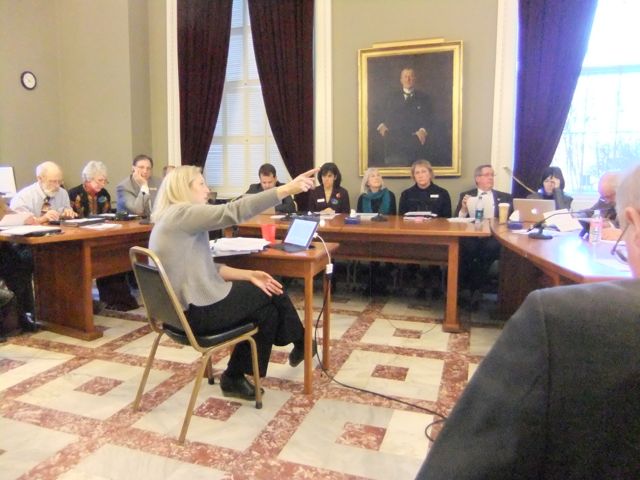
Sara Teachout of the Joint Fiscal Office, pointing to a large flatscreen display full of dispiriting numbers.

Sara Teachout of the Joint Fiscal Office, pointing to a large flatscreen display full of dispiriting numbers.

She began the session by outlining one of the little-known worms in the budgetary apple: cuts in spending would take effect on July 1, the start of FY 2016, but many of the potential revenue enhancements would not. For example: If the state eliminates a tax deduction on personal income, that revenue would not be realized until April 2016, when 2015 tax returns are due. That’s three-quarters of the way through FY 2016.

Much of Teachout’s presentation was a repeat of her tax-budget tutorial I heard at a recent Ways and Means meeting; I wrote three reports on the meeting, which can be found here, here, and here. (If you don’t want to wade through all three, do the last one first.) She did offer more detail at this joint meeting, including a very specific listing of the real costs of various tax expenditures and deductions. (All of her documents are posted on the Ways and Means webpage.)

There was some limited discussion after Teachout’s teach-in. Most significantly, Ways and Means chair Janet Ancel restated her support for a cap on tax deductions: “Speaking for myself, it’s the right thing to do if we’re looking for new revenue.” Rep. Mary Hooper, a member of the Appropriations Committee, noted that a cap on deductions “spreads out the impact, rather than zeroing in on specific exemptions or deductions.”

As I reported previously, Vermont’s tax rules allow the average million-dollar earner to claim hundreds of thousands of dollars in deductions. That’s why top earners pay an effective income tax rate of 5.1% instead of the statutory rate of 8.95%.

Two years ago, the House approved a cap on itemized tax deductions at 2.5 times the standard deduction; the measure died, mostly because of Governor Shumlin’s opposition. This year, he has signaled his openness to changing deductions and expenditures, even as he remains steadfast in opposing increases on his Big Three taxes: income, sales, and rooms & meals.

The cap would, IMO, greatly enhance the fairness of our state tax system. Currently, top earners pay a lower proportion of their earnings in state and local taxes than people in any other income group.

There was also some support in the room for looking at some of the sales-tax exemptions. For example, the state could impose a ceiling on clothing purchases — making them tax-exempt only below a certain dollar amount.

Rep. Mitzi Johnson, Appropriations chair, said her committee will “begin a conversaiton soon to lay out targets [for spending cuts].” She noted the importance of the joint meeting for gaining a clearer picture of “where the revenue could be coming from.”

The meeting was one more small step in what promises to be a long, grinding process leading to decisions that will make at least some constituencies unhappy. As one Statehouse observer told me — only half jokingly — “it might take until July” before they can work everything out.

The New Hampshire Chimera

See also previous post, “The Bag Man carries a heavy load.” 

The Monster of Jim Harrison's nightmares.

The Monster of Jim Harrison’s nightmares.

Previously in this space, I examined the various arguments against a proposed tax on sugar-sweetened beverages unleashed, helter-skelter, by Jim Harrison of the Vermont Retail and Grocers Association. But I saved the best for last: his frequent invocation of the great mythical devourer of Vermont businesses, the New Hampshire Chimera.

Yes, every time someone proposes a new tax or tax increase, its opponents summon the spectre of businesses shuttering en masse and countless jobs fleeing to the tax haven on our eastern border. There’s some truth in this dire outlook — just enough to keep the fear alive — but far less than its proponents would have you believe.

Let’s start with population. Fewer than 170,000 Vermonters live in the counties that border New Hampshire. Most of those people live close enough for major shopping excursions, which is why you see relatively few large malls or superstores on the Vermont side. That’s a tangible loss to our economy, but its true value is questionable: most of the jobs are low-quality, and we avoid the environmental costs of large-scale retail development. (Just look at the West Lebanon strip. Bleurgh.)

For more casual shopping, such as picking up a few groceries, filling your gas tank or getting a snack, a much smaller fraction live close enough to the border — say, five miles or so. Any more than that, you’re not going out of your way for a quick stop.

Now there’s the matter of crossing the border. There are long stretches where you’d have to travel five miles or more to access the nearest bridge.

Then you come to shopping availability on the other side. The scaremongers see a New Hampshire border bristling with retailers from Canada to the Massachusetts line. In fact, there are three major retail zones in western New Hampshire: Littleton, West Lebanon, and Keene. Otherwise, there are long stretches of Not Much.

Once again, the greatest impact of higher Vermont taxes is not on the mom-and-pop stores so dear to the rhetorical heart of Jim Harrison; it’s on the supermarkets, megamarts and strip malls that you can find in those three retail hubs. And nowhere else.

In sum, New Hampshire is a major draw for mega-shopping, but it’s a relatively minor threat to other economic activity. And border communities with some creativity, like White River Junction and Brattleboro, find ways to juice their economies even in the shadow of the New Hampshire Chimera.

(Harrison likes to throw in Massachsetts and New York as well, but they are no threat. Their taxes are also pretty darn high; relatively few Vermonters live near those borders; and there’s virtually no destination shopping within easy driving distance in either state.)

Given all of these factors, New Hampshire looks like a much smaller threat than it is in the mind of Jim Harrison. There is no reason for us to be a captive of our neighbor’s policies. We should set our tax policies on their own merits, not out of fear of New Hampshire.

Let’s take an example right out of the Jim Harrison playbook. Here’s one of his vague-on-details anecdotes:

Two years ago, the legislature needed some more money for roads and bridges. They increased Vermont’s gas tax. At that time, the gas tax was 13 cents more per gallon than it was in neighboring NH. Within months, four gas stations on the Vermont side of the Connecticut River Valley closed.

Wow. That’s an oddly specific and limited horror story. It raises a host of questions.

— Where, exactly, were these gas stations?

— Can a direct line be drawn between their closures and the gas tax hike?

— If they closed “within months,” were they marginal businesses before the gas tax took effect? It sure sounds like it.

— Had any of them been planning to close anyway? Small businesses do tend to come and go at a rather alarming rate under any circumstances.

— How many gas stations are there in that zone? I’m guessing several hundred. And while the closure of any business is a sad thing, four is a pretty small number by comparison.

— If the gas tax increase had that great an impact, I’d think the closures would have continued beyond “within months.” Did they, or was the damage limited to four?

And finally…

— Is Harrison saying we shouldn’t have raised the gas tax? If not, then what exactly is he arguing for?

He would probably reply that border convenience stores have already taken a hit, so we shouldn’t hit them again. That’s an arguable point, but how much of a gas station’s business consists of customers buying sugary drinks and nothing else? If the gas tax didn’t chase them across the border, why would a tax on sugary drinks, which represent a smaller slice of their business?

The more likely outcome, it seems to me, is that customers will pay the extra freight or switch to unsweetened beverages — diet sodas, iced tea, flavored waters. There’s quite a variety of drinks with no added sugar. Dairy drinks, even with added sugar, wouldn’t be covered by the tax. Coffee wouldn’t be, no matter how sweet you like it. (Smart retailers will load up on the non-sugary options and feature them in shelving and advertising.)

This is especially true for the typical convenience store stop: filling the tank, using the restroom, buying a drink for the road.  The drink is one small part of the equation. And again, if you’re not going to New Hampshire for the cheaper gas, you’re not going there because your Coke costs an extra quarter.

The bigger burden of a beverage tax would fall on — say it with me, children — Big Retail. Places you go when you want a 12-pack or a case or some two-liters at the lowest price. You wouldn’t drive an extra ten miles to save a quarter on a Mountain Dew, but you would to save a few bucks on a case as part of a big trip to the supermarket.

Which is the point I made in my previous post: the tax poses the biggest threat to Big Retail and Big Beverage, and they’re the ones providing the big money behind the opposition to the beverage tax. The mom and pops are the poster children, but their actual victimhood is significantly limited.

And if you’re worried about the loss of Big Retail in Vermont’s economy, bear in mind that the border regions are largely empty of Big Retail. They’ve already departed for the low-cost option.

In sum, there is a cost to the beverage tax. It should be considered as part of the equation. But the effect is nowhere near the monster that inhabits Jim Harrison’s dreams. And it should not be a decisive consideration in the coming legislative debate.

Tax deductions: the big kahuna

This is the third in a series of posts about the January 27 meeting of the House Ways and Means Committee, which explored the tax expenditures and deductions available under the state’s tax code. Part 1 concerned tax expenditures; part 2 focused on the tax deduction for medical expenses as an indicator of the widespread distress caused by our pre-Obamacare health system. 

It’s no secret that state lawmakers are looking for ways to raise some extra revenue without causing too much pain. One area under close examination is the tax code, and all the ways we allow people and businesses to limit their tax liability.

Some tweaks are possible in the tax expenditure side of things. But tax deductions actually offer a better opportunity to make our tax system fairer while giving the money tree a modest shake.

It’s an underreported fact that the wealthy actually get the best deal in our supposedly progressive tax system. According to the Institute on Taxation and Economic Policy, the wealthy pay the lowest per-capita share of state and local taxes combined, and they pay the lowest actual income-tax rate of any group besides the poor. Top earners are subject to an income tax rate of 8.95%, but the amount they actually pay is only 5.1%.

The single biggest reason for that disparity? Our generous rules on taxable income and tax deductions. A couple of examples from the category of Bet You Didn’t Know… (all information from the Joint Fiscal Office; tax figures are from the 2011 tax year)

— “Interest You Paid” is tax deductible. For most of us, that means mortgage interest. But it also applies to vacation homes — and boats. That chiefly benefits the wealthy. Renters, who tend to be at the bottom of the income scale, don’t benefit from the mortgage deduction.

— Property taxes are deductible. Including property taxes paid in other states. Again, that benefits those sufficiently well-off to own multiple properties.

— Charitable contributions can be deducted up to 50% of a taxpayer’s adjusted gross income. Only the wealthy can support anywhere near that level of giving. And, given the proliferation of ersatz foundations, it’s easy for a person of means to effectively launder money through a nonprofit. (For example, check out the nonprofit empire spawned by the Koch brothers.)

The power of this virtually unlimited allowance? Among Vermont taxpayers with incomes over $1 million, the average charitable deduction — the average — was $131,360. That’s a lotta stops at the Sally Army bell-ringer.

But here’s the biggest eye-popper of them all. If you add up all the average deductions for Vermont’s million-dollar class, you get $528,000.

That’s right: the average million-dollar taxpayer claimed deductions worth more than half their income.

And that’s how 8.95% turns into 5.1%.

The numbers for those earning less than $1 million are not quite so appalling, but the upper and upper middle classes clearly benefit from our current tax code. The primary reason: our permissive rules on tax deductions and taxable income.

Setting limits

The 2011 standard deduction in Vermont was $5,800 for a single taxpayer, $8,500 for a head of household, and $11,600 for a married couple filing jointly. Peanuts by comparison. I bring this up because Betcha Didn’t Know that 10 of the 50 states don’t allow itemized deductions. Everyone gets the standard — no more, no less.

That option could be on the table. It would bring the effective tax rate for top earners much closer to statutory levels. The resulting revenue could be used to cut taxes on the middle class, who get hit hardest by Vermont’s tax system; or they could be used to close the budget gap without sacrificing state services.

I’m not expecting anything that radical from our frequently timorous Legislature. But as recently as two years ago, the House passed a bill that would have capped itemized deductions at 2.5 times the standard. That bill died in the Senate, mainly because of Governor Shumlin’s opposition.

Yes, our Democratic Governor blocked the path to a fairer tax code. Wait, let me double-check… Yep, he’s a Democrat. Says so, anyway.

If that bill had passed, members of the Million-Dollar Club would have seen their deductions capped at $29,000 — a far cry from $528,000.

The situation may be different this year, as the state faces a large budget gap and Shumlin has deliberately soft-pedaled his anti-tax stance. During his budget address, he stated his opposition to “raising income, sales, and rooms & meals tax rates” — very deliberately emphasizing the word “rates,” which had not been part of his boilerplate in the past.

If that wasn’t signal enough, Shumlin’s budget proposed an end to the tax deduction for state income taxes paid in the previous year. And with that, as Ways and Means chair Janet Ancel told me, “He put the whole discussion about itemized deductions on the table.”

Ancel would not commit to revisiting the deduction-capping bill, but it’s clearly on her mind. “It [would have] made the tax system more fair,” she says. She may get a second bite at the apple this year, and thanks to our budget situation it might actually pass muster with the Governor. One can only hope.

The moral imperative for health care reform, revealed in a handful of statistics

At the January 27 meeting of the House Ways and Means Committee, Sara Teachout of the Joint Fiscal Office distributed three fairly simple charts that tell the story of our unfair state income tax system in bold relief. I’ll be examining those charts in an upcoming post, but right now I want to focus on a small slice: the deduction for medical expenses.

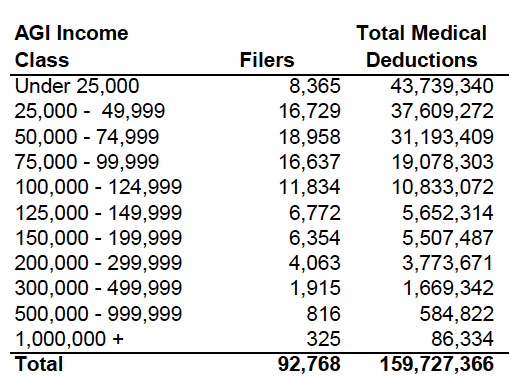
The first chart lists the most frequently claimed tax deductions across the top, and income classes down the left side. It tells a fascinating story about who benefits from which deductions, and how much. But today I’m concentrating on the first two columns, shown below:

Medical deduction chart 1

A couple of explanatory points. First, this data is from 2011, predating Vermont Health Connect and the Affordable Care Act. Second, I should explain the rules for deducting medial expenses. You can’t deduct health insurance premiums, just actual medical and dental expenses. You can only deduct medical expenses if they total more than 10% of your gross income, and only the portion above 10% is deductible. It’s a very high standard; you’ve gotta have some serious medical bills and no insurance (or really bad insurance) to qualify.

As you might expect, “Total Medical” is the outlier among deductions; it’s the only one claimed more often by the poor and working poor than by the wealthy. There are two simple reasons for this. The first is that the poorer you are, the less likely you are to have health insurance. The second, obviously, is the lower your income, the fewer bills it takes to qualify.

It’s no giveaway, though; if you’re making $25,000 a year, then medical bills over $2500 are enough to throw you into severe financial difficulties. A tax break on a portion of those bills won’t make you whole.

These columns reveal the hidden cost of our old health care system — the human and social cost, and the actual financial cost. Vermont is foregoing a large amount of potential tax revenue because so many people incur medical bills that eat up a significant portion of their earning power.

I don’t know if these numbers were factored into Gov. Shumlin’s calculations on single-payer. I sure as Hell hope so, because it’s a cost that’s every bit as real as a payroll tax.

As for the human and social costs, the top three lines indicate that more than half the total value of medical deductions was taken by those with incomes under $50,000. These are people who cannot afford a significant unplanned expense, because they’re barely making ends meet in good times.

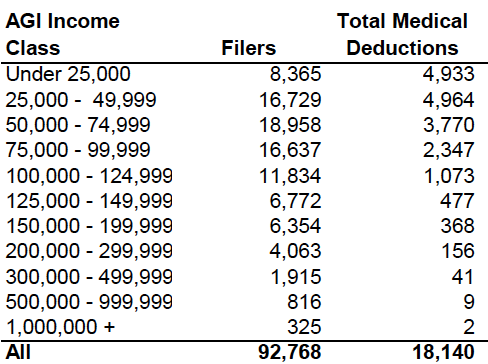
Here’s the same slice from a second chart that shows the total number of filers in each income class, and the number who took a medical deduction. This shows that more than 50% of those claiming a medical deduction earned less than $50,000, while virtually no wealthy people claimed one.

Medical deduction chart 2

Now look at that top line. More than half the low-income filers qualified for medical expense deductions. That’s nearly 5,000 individual stories of illness and deprivation, of life-changing financial crises, most likely including thousands of bankruptcies. How many people lost their jobs and their homes, and saw their lives go into a tailspin, because of an uncovered illness or injury in 2011 alone?

So far, health care reform has dramatically reduced the ranks of the uninsured in Vermont. These figures show how crucial that progress is, for the stability of our society and the very lives of our most vulnerable.

These figures are also a powerful argument that we need to keep it up. We shouldn’t have thousands of poor and working-class Vermonters qualifying for this deduction. There should be none, or very few at most. That’s the goal of, and the moral imperative for, universal health care.

Searching for revenue in all the right places

Warning: This post is full of public-policy geekery. You should not operate heavy machinery during or immediately after reading. Still, I hope you’ll stick around; you’ll learn some useful stuff.

I spent Tuesday morning at a hearing of the House Ways and Means Committee, as it conducted an item-by-item overview of tax expenditures and tax deductions. The subtext is the state budget situation, with its projected $100-million-plus gap. Committee members engaged in a lot of poking and prodding, in search of ways to goose income or reduce outgo.

“Tax expenditure,” for those not in the know, is the technical term for a tax exemption. “Expenditure” is a nice insightful term; in granting an exemption, the state is forgoing tax revenue. In essence, it is spending that money without ever receiving it. In granting a sales tax exemption on food, for example, we are “spending” the uncollected revenue for a social purpose — making food more affordable, and limiting the regressive impact of the sales tax. The Earned Income Tax Credit, given to the working poor, is a tax expenditure. It’s the largest one, in fact, accounting for 49% of the foregone revenue from expenditures. (The second-highest, at 32%, is the Capital Gains Exclusion, which almost entirely benefits top earners.)

As for the sales tax exemption on major equipment at ski resorts… Well, you tell me what social purpose that serves. Beefing up resort owners’ profits, is my guess.

I learned a lot of interesting stuff about expenditures and deductions. The most crucial stuff is about deductions, and I will write about them in a subsequent post. For now, some notes on expenditures.

(For those interested in a whole lot of detail, the Joint Fiscal Office’s 91-page report on state tax expenditures is available online.

Sen. Tim Ashe, chair of the Senate Finance Committee, has his eyes set on the ski-equipment exemption as part of a broader reconsideration of the financial arrangements between the state and resort operators. Auditor Doug Hoffer recently reported that Vermont’s leases of public land to the resorts are outdated and don’t generate as much revenue as they could.

Ashe agrees. “Circumstances have changed dramatically in the industry,” he told me. “The lease conditions haven’t kept pace.” He sees an opportunity to reopen the leases as part of a “recalibration” of the state/resort relationship. On the government side, that might include more lucrative leases and an end to the equipment exemption. On the resort side, it might include changes in state regulation.

The door seems to be open. But as Sen. Ashe puts it, “Is the legislature interested in recalibrating the relationship?” This, and many other taxation issues, may not be settled until the session’s closing days, when the House, Senate, and Governor try to agree on a balanced budget acceptable to all parties.

Ashe also told me that his committee “went through every tax expenditure in the tax code” last year. Some were eliminated, all others were more clearly defined. This year, Ashe has introduced a bill that would require a determination that each tax expenditure is achieving its intended purpose. That might touch on some of the corporate tax breaks, such as the exemption for research and development. At the Ways and Means hearing, it was said that large corporations can simply assign a portion of their entire R&D expense to Vermont, whether or not the work was actually done here. There was some sentiment on the committee to rein in that exemption — define it more narrowly, or tie it more directly to job growth in Vermont.

Most tax expenditures are relatively uncontroversial. Purchases of home heating supplies — oil, gas, propane, wood — are exempt from sales tax. This is a big item, but who’d want to repeal it?

There was surprise around the table that the sales tax exemption on food is very broadly defined. It includes soda, candy, and nutritional supplements. That’s a lot of foregone revenue for stuff that is either harmful to health, or whose benefits are questionable. And it’s ironic, at a time when we’re considering a tax on sugar-sweetened beverages. But it’s difficult to draw a hard and fast line. Is a CLIF Bar “candy”? Pop-Tarts? Yogurt-covered almonds? Kettle corn? Vermont Maple Syrup?

So that’s a can of worms that no one will likely want to open.

One item that might be revisited is the exemption on clothing sales. Vermont used to cap the exemption at purchases of $110 or less. That cap went out the window when the state adopted something called the Streamlined Sales and Use Tax Agreement, a mutually agreed-upon standard for rules on sales taxes that includes 44 states and the District of Columbia.

At the time Vermont adopted the SSUTA, it did not include limits on clothing purchses. It has since been amended, and Vermont could reimpose a limit so that, say, fur coats would be subject to sales tax.

However, Sara Teachout of the Joint Fiscal Office warned the committee that much of the potential revenue would be unrealized because so many clothing purchases are conducted online. And I’m sure brick-and-mortar retailers would scream if lawmakers considered limits on the clothing exemption.

The terms of some tax expenditures are outdated, or in imminent danger of becoming so. For example, there’s a sales tax exemption for newspapers. But does it apply to digital subscriptions? No one in the hearing room had a clue.

There’s an exemption for movie theaters’ purchases of films — on the grounds that ticket sales are taxed, so taxing the film purchases would be a form of double taxation. But these days, virtually all theaters are showing digital movies. They don’t get cans of film; they get a “black box” that contains a playable (but not reproducible) digital copy of the movie. That copy is set to expire and become unplayable at the end of a movie’s run. Can it be said that the theater is actually buying anything?

Mobile and modular homes have a partial tax exemption. But these days, almost all home building includes modular elements, pre-constructed at a factory. Has the tax code kept pace with the industry?

Those were the most interesting tidbits about tax expenditures, at least to my eyes. The JFO’s report includes a wealth of information; for each expenditure, there are figures for the total estimated cost, the number of taxpayers who take advantage, and a short explanation of the reasons for the expenditure.

Coming in the near future: tax deductions — the #1 creator of unfairness in Vermont’s income tax system.  This may become the battleground over how, or whether, to raise additional revenue and limit the scope of necessary budget cuts.