Category Archives: Public health

Here’s an interesting fact about vaccines

Earlier this week, we had the honor of hosting a real live ***KENNEDY*** right in our very own Statehouse. Yep, RFK Jr. regaled us with his scare stories about the evils of Thimerosal, a vaccine additive containing (a harmless type of) mercury. It seemed a stretch at the time because (1) the autism/Thimerosal “connection” has been thoroughly debunked, and (2) Thimerosal was eliminated from all but one vaccine years ago, and yet autism rates have continued to climb since then.

But here’s something I didn’t learn until today:

The one vaccine containing Thimerosal is not on Vermont’s list of required vaccines.

That’s right. You don’t need a philosophical exemption to avoid the imaginary taint of Thimerosal. Which means that Kennedy’s argument was completely irrelevant to our current policy debate.

In any event, Kennedy seems to have done his cause no good. There’s no sign he moved the needle (sorry); in fact, he may have turned off some undecideds with his overheated rhetoric. Like, for instance, the editorial board of the Times Argus and Rutland Herald:

Kennedy’s strident language added nothing to the debate. He had discredited himself even before he arrived in Montpelier by furthering the damaging and discredited notion that there is a connection between vaccines and autism. The author of the paper asserting that connection has himself admitted to scientific fraud.

But I think it’s worth noting for the record that Kennedy’s bugbear, Thimerosal, has no bearing at all on the philosophical-exemption issue.

Shunned by the vaxxers

Was it something I said? Yes, I’m sure it was.

Sometime today, the Twitter voice of Vermont Coalition for Vaccine Choice cut me off. They blocked me from reading their Tweets.

Let me mark the occasion by reproducing the last Tweet I ever got from them.

Stay classy, folks. As your lobbyist Keith (my mistake, his name is Kevin, I know that, I’ve spoken with him often and have a lot of respect for him) Ellis is probably trying to tell you, you’ll attract more flies with honey than vinegar. Or as I Tweeted in response to the above:

And that’s when they cut me off.

Methinks the vaxxers are feeling the heat. The last rounds of the vaccine saga are playing out at the Statehouse this week and next. There’s one more day of testimony before the House Health Care Committee — including a long-awaited appearance by Dr. Harry Chen, Vermont’s Health Commissioner. After that, it remains to be seen whether H.98, a bill that would remove the philosophical exemption, will be heard on the House floor.

From what I hear, the votes could be had; but House leadership might decide to put it on ice for the year. They have the always-plausible “out of time” excuse in their back pockets, and Governor Shumlin has reportedly said he doesn’t expect the bill to reach his desk.

In which case, we’d wait till next year. Between now and then, either of two events would absolutely tip the balance against the philosophical exemption: a breakout of a vaccine-preventable illness, or a continuing decline in childhood vaccination rates. We’ll hope it’s the latter, not the former.

The circus came to town

The corridors of the Statehouse were abuzz Tuesday. Seems that all and sundry were talking about the appearance of a real live Kennedy — RFK, Jr. to be precise. He was in Montpelier to testify about the evils of vaccines and the necessity for parental choice as the last line of defense against the predations of Big Pharma and the corrupt regulators in the industry’s pocket, all conspiring to strap ’em down and shoot ’em up.

I believe that’s the mission statement of the Centers for Disease Control. You know, the secret one they chant before their confidential off-site meetings with their Big Pharma masters. Yeah, them.

But I digress. Kennedy, a widely respected environmental activist turned vaccine truther crank, testified before the House Health Care Committee and also held a media briefing. Both attracted overflow crowds. I contented myself with a quiet afternoon at House Government Operations, listening to embattled liquor control chief Mike Hogan defend his honor. Well, not really, but more on that another time.

I decided it wasn’t worth the effort to cram myself into the Son Of A Great Man’s presence because when I heard he was coming to Vermont, I did some reading to find out what he was going to say.

Continue reading

The case for vaccination

As the legislature moves ever closer to adjournment (still scheduled for Friday the 15th), one of the unanswered questions is, Will the House take up a Senate-passed bill that would eliminate the philosophical exemption to childhood vaccinations?

If you ask me, I suspect the House will leave it hanging till next year. Lawmakers could plausibly argue that the issue hasn’t gotten a full airing this time around, since the Senate passed the provision as an amendment to a barely-related bill.

Although, on the other hand, no amount of discussion and airing will satisfy the anti-vaxxer crowd, so why not just lance that boil?

We’ll see. But while the issue is still pending, I thought I’d present a short-form version of the argument for vaccination.

Vaccines work.

Well, maybe a slightly longer-form version.

Continue reading

A good cry on the Senate floor

So David Zuckerman gave an emotional speech today.

Two days after the Vermont Senate voted to end the philosophical exemption for parents who don’t want their kids vaccinated, a senator opposed to the change delivered a tearful address about being attacked online, his father’s death and how scientific uncertainty led him to his decision.

… “I have been attacked as being anti-science, not caring for those who are less able to protect themselves and mocked for my profession as being unqualified to make informed comments,” he said.

His reference to “being attacked online” almost certainly included me. After the Senate vote, I criticized Zuckerman’s tactics in trying to derail the bill in question. I said “scientists must be laughing their asses off” at his notion of genetic testing for potential vaccine allergies. I belittled his argument that schools would lose large numbers of students, and said that Zuckerman and his allies were “grabbing at any pretext, no matter how absurd, to preserve the philosophical exemption.”

And you know what? I’m not sorry.

My language regarding the Senator doesn’t hold a candle to the rhetoric used by anti-vaxxers, who’ve accused me and other vaccine supporters of being fascists and tools of Big Pharma, among many other things. They’ve accused doctors who support vaccination — the vast majority of doctors — of being either fools or sellouts. My posts on vaccines have been written in an environment inflamed, in large measure, by those on the other side.

Also, while I’m very sorry for Zuckerman’s loss and respect how it informs his beliefs, (a) I didn’t know any of that at the time, and (b) he’s not the only one who’s suffered devastating personal losses. It happens to a lot of us. My brother would have turned 55 today if he’d lived that long. The circumstances of his death have informed my views on some current issues, but I haven’t played that card in a political debate. (Not that I blame Zuckerman for doing so; there’s a time and place for everything, and he hit his time this afternoon.)

All I could see was Zuckerman’s political effort to preserve the philosophical exemption. I thought his tactics on Wednesday were transparent and not terribly coherent. I still do.

Bad day to be a pro-science liberal

As reported earlier, the State Senate has passed a bill that would strike the philosophical exemption for childhood vaccines. And unfortunately for my faith in Senate liberals, opposition to the measure was led — on the flimsiest of grounds — by some of the chamber’s leading lefties. To wit, David Zuckerman, Anthony Pollina, and Ann Cummings.

The bill itself faces an uncertain future. The House briefly considered ending the philosophical exemption earlier in the session and did nothing; supposedly, House leadership is disinclined to stop doing nothing, so this whole thing might have been an elaborate shadow play produced, God knows why, by Senate President Pro Tem John Campbell.

(It was he who raised this idea from the dead and allowed it to be attached to H.98, a “housekeeping” bill enacting a bunch of minor changes to various parts of state government including the vaccine registry. Thus the justification for grafting the philosophical exemption ban, Frankenstein-style, to a wisp of a bill. Kind of a crappy way to change the law, but not exactly unusual in the annals of lawmaking. Why Campbell went out of his way to do this in a very busy session, I have no idea.)

The bill passed on a very one-sided voice vote. Before that, there was a standing vote on adding the amendment to the bill; the tally was 18 yes, 11 no.

The “noes” brought together some strange bedfellows: some of the most liberal solons joined some of the most conservative in opposing the amendment.

Preceding the vote was about a half hour of rather weird debate in which some folks I usually admire came up with flimsy pretexts for their opposition. Leading this parade was Zuckerman, who offered a science-free amendment to the amendment.

On the grounds that some children may be genetically predisposed to allergic reactions to some vaccine ingredients, he proposed requiring “quick genetic tests” to screen out the allergic.

My scientist readers may be laughing their asses off right now. A “quick genetic test” to screen for allergies to the, what, hundreds of ingredients in various vaccines? As I understand it, such testing is in the very early stages of development. But even if it were well-established, I doubt it would be “quick.”

Thankfully, the Zuckerman Amendment was shot down on a voice vote.

Cummings then raised the specter of uncounted Vermont schoolchildren being forced into “truancy” because their parents refused to let them be vaccinated. She argued that in a time when student counts are in decline, we shouldn’t do something that might mean more kids are “forced out of school.”

Uh-huh. I can just imagine the legions of parents who would actually take their kids out of school rather than allow them to be vaccinated.

Zuckerman followed the same line, predicting lower student enrollments, higher taxes, and even widespread school closures because so many refusenik parents would keep their kids home.

Pollina doubled down, arguing that we shouldn’t require vaccinations because “people might move out of state” rather than see their kids vaccinated.

Okay, let’s see now. First, all our neighboring states — Massachusetts, New York, and “Live Free Or Die” New Hampshire don’t allow philosophical exemptions. So the claptrap Pollina is peddling is that legions of vaccine refuseniks will uproot their lives and move to a distant state that offers a philosophical exemption. (There are only 18 others that do.)

One of the primary arguments made by exemption supporters is that it doesn’t hurt anybody because so few people actually seek an exemption; less than four percent of Vermont parents have done so. How many of them would take the extreme step of dislocating their lives or home-schooling their kids rather than let them be vaccinated?

It wouldn’t be a mass exodus, let’s put it that way.

Zuckerman produced a map, showing that some small districts have high rates of philosophical exemptions. He said that those schools would be especially vulnerable if exemptions were limited. He contradicted himself, of course, when he argued against the idea that those districts are also especially vulnerable to outbreaks of vaccine-preventable diseases.

Which is it, Senator? No harm (from contagious illness), or catastrophic consequences (in enrollment)?

The three Senators were desperately grabbing at any pretext, no matter how absurd, to preserve the philosophical exemption — without coming right out and saying that they are anti-vaxxers themselves. Or worse, that they support vaccination and are merely placating the anti-vaxxers in their constituencies.

If they’d come irght out and argued against vaccination, at least they would have been intellectually consistent. The closest any of them came to such an argument was when Zuckerman asserted that “there is disputed evidence” on both sides of the issue. Which is the kind of thing we usually hear from the anti-climate change crowd: “There are arguments on both sides, and who am I to judge?”

These are people I usually admire and agree with. Today, I saw a completely different side to them — a desperate, evasive, rhetorically bankrupt side. It wasn’t pretty.

A festival of preconceived notions (UPDATED)

Update: The full Senate has approved H.98 as amended, to end the philosophical exemption. Details below.

Well, the Senate Health and Welfare Committee held a purely-for-show hearing this morning on whether to remove the philosophical exemption for vaccinations. The anti-vax crowd got an hour, and the pro-vax (I call it “science”) crowd got one.

No one’s mind was changed. And the schedule clearly indicated that “changing minds” wasn’t the purpose of the hearing: the committee held a very brief discussion immediately afterward, expressed its sentiment in favor of removing the philosophical exemption, and sent it to the Senate floor for action — immediately after lunchtime. Talk about your fast track: Committee chair Claire Ayer (good to see her back at work, BTW) had barely enough time to grab some lunch and formalize the committee’s findings for presentation to the Senate.

The committee didn’t take a formal vote because technically, all they were doing was reporting to the full Senate on a couple of key questions:

— What are the benefits and/or risks of immunization?
— How does the philosophical exemption affect the efficacy of vaccination?

Although there was no vote, each member stated their positions. Four were in favor of ending the philosophical exemption (Ayer, Jeanette White, Brian Collamore, Dick McCormack) and one was opposed (Anthony Pollina).

It’s widely believed that the full Senate will approve the measure on a pretty one-sided vote this afternoon. But the debate should be interesting, and the “No” votes may include an unusual coalition of the very liberal and very conservative.

The real action will come after today, when the House and Senate will have to resolve their differences. The original House bill did nothing to the philosophical exemption. Which chamber will carry the day? And how vociferous will the anti-vax lobbying effort be?

More on the Senate vote later.

UPDATE. The Senate has approved the amendment to H. 98 ending the philosophical exemption for child vaccinations. The vote on the amendment was 18 for, 11 against, and managed the neat trick of uniting some of the most liberal and conservative members of the body.

The issue now goes, presumably, to a House-Senate conference committee, since the original H.98 didn’t include the philosophical-exemption language.

More on all of this coming later. I think.

The barely concealed extremism of an anti-vaccine group

We’re gearing up for another round of the philosophical-exemption debate at the Statehouse. As you may have heard, a State Senate committee is considering a bill that would remove the philosophical exemption for childhood vaccinations. Which has the anti-vaccine community’s knickers in a knot.

Well, they don’t call themselves “the anti-vaccine community,” but that’s exactly what they are. Vermont’s primary anti-vaxx group is the Vermont Coalition for Vaccine Choice (VCVC). It publicly presents itsels as entirely focused on parental choice. From its website:

We are not “anti-vaxxers”… We are dedicated to preserving health choice and informed consent for parents and all Vermonters.

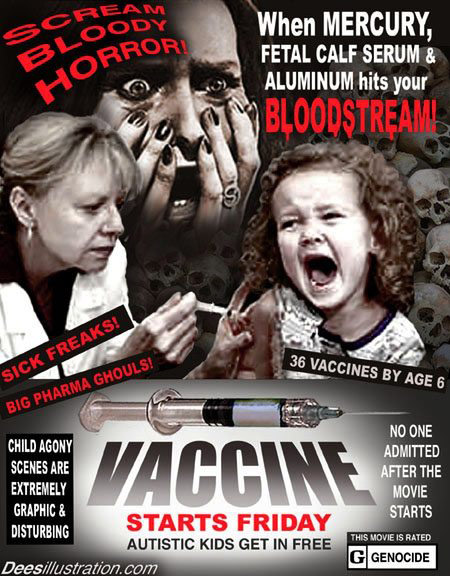
Vaccine movie posterProblem is, the leaders of VCVC just can’t help themselves. Their website prominently trumpets the work of, among others, Robert F. Kennedy, Jr., an anti-vaxxer who promotes the discredited vaccine/autism canard and who has called vaccination “a holocaust.”

But if you want to see the real scope of VCVC’s nutbaggery, you ought to follow its Twitter feed. You’ll find links to every scattered anecdotal report of alleged vaccine harm, every fringey “scientific study” attacking vaccine efficacy or safety, every alternative-medicine type promoting their own agendas, and every rhetorical excess about vaccination, doctors, nurses, government, and science.

Here are a few choice examples. Reminder: these are communications from a group that claims NOT to be “anti-vaxxers.”

Let’s start with a ham-fisted attack on Vermont media for the unforgivable sin of reporting the science on vaccines, which is fully as probative as the science on climate change and evolution:

They’d probably call me a sellout too. Problem is, I haven’t seen a dime from Big Pharma. I just happen to believe the massive preponderance of scientific evidence. VCVC, on the other hand, searches through the flotsam and jetsam of junk science.

The study was published in the Open Journal of Pediatrics, one of many “open journals” created by Scientific Research Publishing (SCIRP), which offers “244 English language open access journals.” SCIRP is based on Wuhan, China, and has been accused of being a predatory open access publisher.

Predatory open access publishers don’t provide the editorial oversight of real scientific publishers; they aggressively solicit papers, publish them with little or no review, and then try to bill the authors for publication costs. In other words, their articles are not to be trusted. But if an article calls vaccination into question, VCVC is happy to accept it at face value and promote it.

More… after the jump. Continue reading

New vaccine poll probably accurate, but deeply flawed

A new survey shows strong support for new limits on a parent’s ability to opt out of childhood vaccinations, but it probably won’t do much to move the debate.

The poll was commissioned by Every Child By Two, a national nonprofit that supports vaccinations. It found that 68% of Vermonters do not believe there should be a philosophical exemption available to parents, and that 73% of respondents support changing state law to eliminate the philosophical exemption.

The poll results are probably an accurate reflection of public sentiment (the anti-vaxxer crowd is a noisy minority), but the poll’s value is greatly diminished by the wording of the questions. They almost constitute a push poll — a series of questions designed to elicit a predetermined response.

The first question is objective: “Do you believe that parents should be able to opt out of vaccinating their children for school for philosophical reasons, also known as personal belief exemptions?” 68% say no, 20% say yes, and the rest are unsure. That result is almost certainly valid.

But then the survey grabs respondents by the nose and leads them down a preset path. It brings up the recent measles outbreak centered in California and raises the possibility that it could spread to Vermont. It then highlights the danger to “people with compromised immune systems… for lack of a vaccinated population.”

Then, a leading question, “Now that you are aware that people with cancer and other medical disorders are at risk, are you more concerned about a person’s decision to vaccinate?”

After that comes the clincher: “Should children whose parents have opted not to vaccinate be allowed to attend public schools and licensed daycares, potentially putting other children at risk?” (Emphasis mine.)

The final question asks if you would now support a bill that would allow exemptions for medical reasons only, “and keep the same vaccination requirements as most other states“. (Emphasis mine.)

After all that, support for limiting the exemption rises from 68% to 73%, while opposition falls from 20% to 13%.

I agree with those who sponsored the survey: Vermont’s vaccination rates are falling, the bulk of scientific evidence supports the safety and efficacy of vaccines, and the potential loss of herd immunity poses a serious threat. In these circumstances, I believe we should end the philosophical exemption.  But this deeply flawed poll won’t help the cause.

The Bag Man carries a heavy load

Listening to Jim Harrison on VPR’s Vermont Edition last Friday led me to one inescapable conclusion: as a public debater, he makes a mighty fine bagman.

Harrison, for those with a bliss-inducing level of ignorance about Statehouse matters, is one of the most effective lobbyists in Montpelier. Harrison heads the Vermont Retail & Grocers Association, and his current bête noire is the proposed two-cents-per-ounce tax on sugar-sweetened beverages.

The recommended daily allotment of sugar is 8 teaspoons for a male adult, 6 for a female adult, and 2-3 for a child.

The recommended daily allotment of sugar is 8 teaspoons for a male adult, 6 for a female adult, and 2-3 for a child. So go ahead, kids: Enjoy your daily two ounces of Coke!

Harrison appeared on VPR with the chief pro-tax lobbyist, Anthony Iarrapino of the Alliance for a Healthier Vermont. Harrison’s presentation was pretty much all over the place: he’d shift from one prehashed talking point to another with not even an attempt at segue, he pulled trusty (and rusty) anecdotes out of his back pocket; he’d throw multiple talking points into a single answer, making it impossible to examine them closely. His overall approach could be summarized as, “Throw everything at the wall and hope something sticks.”

If you summed up all his various statements, it’d go something like this:

— The tax will do nothing to change behavior.

— The tax would be the death knell for countless independent businesses.

— Soda consumption is already trending downward, so we don’t need a tax.

— The tax won’t work because people will just shop where the beverages are cheaper (i.e. New Hampshire).

— There is “no comparison” between tobacco and sugary drinks. So the success of the tobacco tax at reducing smoking says nothing about the potential impact of a beverage tax.

Is your head swimming from all the contradictions? It should be. But I feel for Harrison, because he’s basically defending the indefensible: the right to sell grossly unhealthy drinks at the lowest possible price. When, in reality, sugary beverages are artificially low in price because the corn and sugar industries benefit vastly from federal handouts and favorable tax policy.

Harrison’s favorite argument boils down to “We’ve got to compete with New Hampshire.” There’s so much to say about that old canard, I’m going to tackle it in a separate post. For now, let’s focus on Harrison’s other recurring theme: It Won’t Work.

“This is a social experiment. No other state has done anything like this.” True enough, but we do happen to have a wonderful example of a sugary-beverage tax at work. On January 1, 2014, Mexico imposed a one-peso-per-liter tax (about 7 cents) on sugary drinks. The move came in response to rapidly climbing rates of obesity and diabetes. The results? A University of North Carolina researcher is working with Mexican officials on that question, and here’s what they found:

… preliminary results show that during the first three months of 2014, purchases of sodas and other taxed beverages declined by 10 percent compared to the same time period last year.

Meanwhile purchases of untaxed drinks, like 100 percent fruit juice and milk, went up 7 percent, and purchases of bottled water went up 13 percent.

If that’s not enough, the Wall Street Journal reports that a survey of Mexicans found that they are drinking fewer soft drinks, and are more aware of the link between sugary beverages and health problems since the tax was imposed. Another survey indicated that more than half of all Mexicans had cut back on sugary drinks.

Also, Coca-Cola’s biggest Mexican bottler reported a 6.4% sales drop in the first half of 2014 compared to the same period in 2013.

Those are impressive results for the early days of a relatively small tax. Vermont’s would be eight times as large. Imagine the impact it would have on sales of sugary drinks. (Again, I’ll deal with the cross-border argument in a later post.)

As for the comparison with the tobacco tax, Harrison really didn’t have an answer. The tobacco tax has, indeed, helped to drive down smoking rates. He didn’t try to argue that point; he simply bristled at the notion that tobacco and sugary drinks are in the same category.

Well, obviously, they’re not. They’re closer than Harrison would like to admit, but tobacco is clearly a bigger health threat. However, the real comparison isn’t “how bad is it for you?” It’s “Will a tax reduce demand?” On that question, the success of the tobacco tax is strong evidence that a beverage tax will work. Just in case Mexico isn’t enough for you.

Whenever Harrison is fighting a fee, tax, or regulation, he brings out the mom-and-pop types who are, as he puts it, constantly teetering on the brink of oblivion. “Most of our members are smaller, independent stores,” he says. That’s true if you count every store as one. But if you count total sales, the supermarket and megamart chains far outweigh the small independents.

And it’s not the moms and pops who put up the $600,000-plus spent on defeating a sugary-beverage tax in 2013, and are spending hundreds of thousands more this year. No, that money comes from Big Retail and Big Beverage. The moms and pops are politically convenient props.

Harrison also cited some statistics showing that soda sales have trended downward in recent years, and used that fact to question the link between sugary drinks and rising rates of obesity and diabetes. The problem there is, not all sodas are sugary (DIet Coke, et al.) and not all sugary drinks are sodas. And while it’s true that soda sales are dropping, sales of non-carbonated sugary drinks are through the roof: energy drinks, sports drinks, “juice” drinks containing very little juice, sweetened iced tea, etc.  It’s not just soda that represents a public-health threat; it’s the vast cornucopia of sugar-laden beverages on the market.

There were many more points in Harrison’s presentation. Each of them sound plausible when presented in a rapid blur of talking points, but all are full of holes when inspected more closely.

Coming soon to this space: “The New Hampshire Chimera.”