Category Archives: Politics

The Emily Post Guide to Gubernatorial Seating Arrangements

There’s one unobserved aspect of Gov. Shumlin’s white-flag presser on single payer health care that I’d like to mention before the event is any farther in our rear-view mirrors.

Because the Governor was announcing his single payer reversal not only to the media, but also to his two big Advisory Councils on health care reform, the event was moved from his ceremonial office to Room 11, one of the larger conference rooms in the Statehouse (which is notorious for small, cramped, unphotogenic rooms). Room 11 is on the first floor, to the left of the Abe Lincoln bust that dominates the central hallway.

It’s a long rectangle; the east and west walls are the long ones. There’s a big wooden conference table along the west wall. Directly in front of this table is a rather narrow open area; along the east wall are three long rows of chairs.

The south wall (closest to the front of the building) is kind of an open area. In front of the north wall are several rows of seats.

The lectern for the news conference was set up on the south end of the room. The seating area on the east wall was filled with members of Shumlin’s Business Advisory Council and miscellaneous others. The conference table opposite was where most of the media sat. (Yeah, we grabbed the comfy chairs.)

In the open area between east and west walls, the TV cameras were set up.

The seating area near the north wall was where Shumlin’s Consumer Advisory Council sat.

Now, it’s well known in government circles (and probably the private sector as well) that proximity equals influence. Presidential staffers clamor for space in the White House instead of the Executive Office Building, for instance.

Well, in this case the Business Advisory Council got the prime seats. The Consumer Advisory Council was in the Siberia of Room 11. Their view of the lectern was blocked by all the TV tripods.

You don’t think that was an accident, do you?

Oh, and also languishing in the cheap seats was a rather forlorn looking Mark Larson, who still holds the title (and draws the salary) of Vermont Health Access Commissioner, even though he was sidelined months ago in a staff shakeup. He may still be a top Shumlin health care executive, but he was nowhere near the front of the room where all his, ahem, colleagues hovered closely behind the governor.

After remarks from Shumlin and others, he opened it up for questions. He sought to go back and forth between the media and members of his two Councils.

Who do you think dominated the Q&A period? Well, the media did, but aside from that it was all Business Advisory Council. Only one voice emerged from the back of the room: CAC chair David Reynolds made a brief and forgettable statement about how much hard work had been done. Not a peep was heard from CAC members like Peter Sterling, James Haslam, and Dr. Deb Richter — three of Vermont’s leading advocates for single payer. Maybe they were in shock, or maybe they couldn’t be seen from the lectern because of all the TV guys.

Several members of the BAC spoke. All were vociferous in their praise for everyone’s hard work, and all credited Shumlin for his hard work and his wisdom in scuppering single payer. Yeah, right: some of these guys were against single payer from day one. A couple of them were harshly critical of the media for being mean to the governor, when in fact we were only doing our jobs, and Shumlin gets worse than that in his regular news conferences.

The business community, up close and with a clear view of the Powers That Be. The consumer representatives, exiled to the back of the room where they’d have to jump and shout to be recognized.

Given the content of Shumlin’s announcement, that all seems about right.

How deep is the Milne/VTGOP split?

Ever since the election, there’s been a clear oddity about the public relationship between gubernatorial candidate Scott Milne and top Republicans. Which is basically this: They’re never, ever seen in public together. Not even when said Republicans were advocating for Milne’s election by the legislature.

Both sides denied any rift, sometimes with a cutting subtext. Like this, from Milne:

I think I helped the Republicans statewide about as much as they helped me. I’m not indebted to them, they’re not indebted to me. …I don’t owe the Republican Party anything in the state of Vermont. I clearly don’t owe the national Republican Party anything.

Yeah, that’s real warm and friendly-like.

But now, here’s a choice bit of evidence for my theory, courtesy of VTDigger’s Laura Krantz.

Bartley in 2014 served as a field director for the Republican party. The Colchester resident worked part-time out of Milne’s South Burlington office, where Milne’s campaign manager said he rarely interacted with him.

“He was perceived as a spy by his own party’s candidate for governor,” said Milne campaign manager Scott Fletcher.

Bartley denied being a spy, natch. But whether or not he was a spy, Fletcher’s statement tells me all I need to know about the state of candidate/party relations. If the campaign manager believes that the party planted a spy in his organization, there’s clearly no love (or trust, or respect) lost between the two.

Is the VTGOP going forwards or backwards?

Or, possibly, both at the same time?

VTDigger’s Laura Krantz dug up (yes, I did it) quite a few tasty tidbits about recent changes in the Vermont Republican Party in a story posted on Monday. Most of which concern the installation of Jeff Bartley as VTGOP Executive Director.

Before I go on, I’d like to note that just as Bartley was getting the job, his father was rushed to the hospital with lung cancer, and things aren’t looking too good. (I’m not disclosing a secret here, because Bartley himself has been Tweeting about it.) That really and truly sucks for Bartley; on a personal level of course, but it’s gotta be taking his attention away from his new and very challenging position. I can’t say I respect Bartley’s political skills, but as a fellow human being, I feel for his plight.

Still, back in the salt mines of politics, life goes on. And, per Krantz, Bartley’s nomination created some hard feelings within the party.

Bartley was chosen in a last-minute election announced slightly more than 24 hours before the Dec. 1 meeting. Insiders say the decision was rushed to leave no time for other candidates to come forward or for a search process to take place.

Would this be the same party that often hits on Gov. Shumlin over transparency? Yeah, thought so.

Bartley’s nomination was met with ambivalence at best, hostility at worst, and led to an unusually close executive committee vote on his hiring: six votes in favor, four against. Not exactly a stirring mandate.

The four “no” votes included three very prominent conservative Republicans who have been openly skeptical of Phil Scott’s party-broadening initiatives: outgoing treasurer Mark Snelling, Wendy WIlton, and Randy Brock. The fourth, Kevin Beal, was last seen in the blogosphere in  November 2013 when he ran for the “Chair of chairs” post (basically, a liaison between county chairs and the state party) against… wait for it…

… Jeff Bartley.

Okay, then.

I don’t think I’m overreaching to interpret the 6-4 vote as a defeat for the conservative wing of the party. Especially in light of this note from True North Reports’ Robert Maynard in my comments section:

Jeff Bartley is not a conservative and it should come as no surprise that conservatives would not het (sic) behind him as their candidate for party chair. He burnt a lot of bridges with consertavives (sic) and Tea Party types during the Len Britton campaign by telling the that his model for a Republican office holder was Maine’s Senator Olympia Snowe. (At least that is what I am told by the Tea Party members who worked on the campaign)

And if we know anything about “consertavives,” it’s that they have long memories for political slights.

According to Krantz’ article, Bartley was seen as party chair “Super Dave” Sunderland’s pick for the job. As for the rushed and secretive nature of Bartley’s hiring, it looks designed to forestall organized opposition and perhaps even prompt a walkout by top conservatives. Like Snelling, for instance.

And even Bartley backers were, uh, kinda lukewarm about it. Jackie Barnett and Stephen Webster, who both supported the hire, basically laid it at the feet of Sunderland.

Barnett: “My personal feeling is the chair (David Sunderland) should have whomever they want working for them.”

Webster: “This is David’s choice, and I’ve been supportive of David.”

Neither committee members had anything to say about Bartley’s political acumen.

It’s not exactly an ideal situation. Bartley is taking the helm of a party that, November gains notwithstanding, still has a hell of a long way to go. Quite a few influential party members, and perhaps an entire wing of the party, view him with suspicion if not hostility. Given his record, there are legitimate questions about his preparedness for the job. And he’s doing it all while his dad is in the hospital with a life-threatening illness.

I can’t say I have high expectations for Bartley, but I wish him luck.

Shumlin’s Newsdump-a-palooza rolls on

If you regularly read this page, you don’t need to be reminded what a newsdump is. But just in case: it’s the popular maneuver of unloading bad news when the media and the public are least likely to notice. Friday afternoons are the most common times. The final working day before a holiday weekend is ideal.

The Shumlin administration has been making a habit of this lately, and now there are two more newsdumps on the horizon. The first, regarding budget cuts, and the second, Shumlin’s long-awaited big reveal on single-payer health care.

The administration hit a two-fer on the Wednesday before Thanksgiving, ensuring minimal and shallow coverage of its planned $17 million in budget rescissions, and little to no coverage of its plan to make two-thirds of the cuts in Human Services, an agency already said to be underfunded and understaffed.

Shumlin.NewsdumpWell, there’s a sequel to the rescission newsdump. All affected agencies are supposed to submit their proposed cuts by December 5. Hey, what do you know — it’s a Friday!

This should ensure that news about specific cuts will leak out slowly. Or, will perhaps be dumped all at once in a news release issued around 5 p.m. Friday.

It’s also worth noting that the administration gave its agencies less than one business week to make these tough decisions. Its call was issued on Thanksgiving Eve, which meant that the work couldn’t commence in earnest until Monday, December 1.

But wait, you might be thinking. Didn’t the Administration decide not to pursue immediate cuts?

That’s right. Rather than risk a confrontation with the Legislature, it opted to hold off on rescissions until January.

However, the December 5 deadline remains in effect. So state agencies are being rushed into critical budget decisions, even though no action will be taken until more than a month later.

Curious. Methinks the administration might get an early start on those cuts, despite its abnegation of unilateral action.

As for the second newsdump… the Governor announced Wednesday that he would unveil the proposed benefits offered by a single-payer health care system by mid-December, and that his financing plan — the real bone of contention — will come out on December 29 or 30.

What, does he have plans for New Year’s Eve? Or would that be just too damn obvious?

Well, I guess it was too damn obvious anyway. Paul Heintz:

…he swears he’s not trying to bury the news in the lull of the holiday season.

“That’s exactly why I wanted to give you the date now,” Shumlin said during a wide-ranging discussion with reporters at Burlington’s Hotel Vermont. “Because I didn’t want to wake up on December 31 and [read], ‘It was a late-night news dump.'”

So I guess I’m helping out by labeling it a newsdump well before New Year’s Eve Morning. Wouldn’t want to spoil the last cappucino of 2014. (Or maybe I shouldn’t assume he drinks Gucci coffee. Folger’s?)

He claims that he wants to get the plan out early to “get it to the legislators before they’re sworn in.” But the specificity, to use a grand old Watergate word, is a little strange. His team, he says, “is working really hard to get this together.” A task involving that much intensive work with a bunch of people would seem, by its nature, to be somewhat open-ended. And the Governor has particularly avoided deadlines in the health care reform process because so many have been flouted in the past.

And yet he can predict, with certainty, that it will all come together on the 29th or 30th.

Somehow I doubt an extra week or so, including a long holiday weekend, will make a whole lot of difference for lawmakers. If the early release isn’t a newsdump, it will certainly have the effect of one: limiting coverage and blunting immediate reaction to the plan, allowing the Administration to prepare counter-arguments and perhaps even refine the plan before it’s formally submitted.

To me, it looks like a newsdump, walks like a newsdump, and quacks like a newsdump.

Sue Minter is building herself quite the resumé

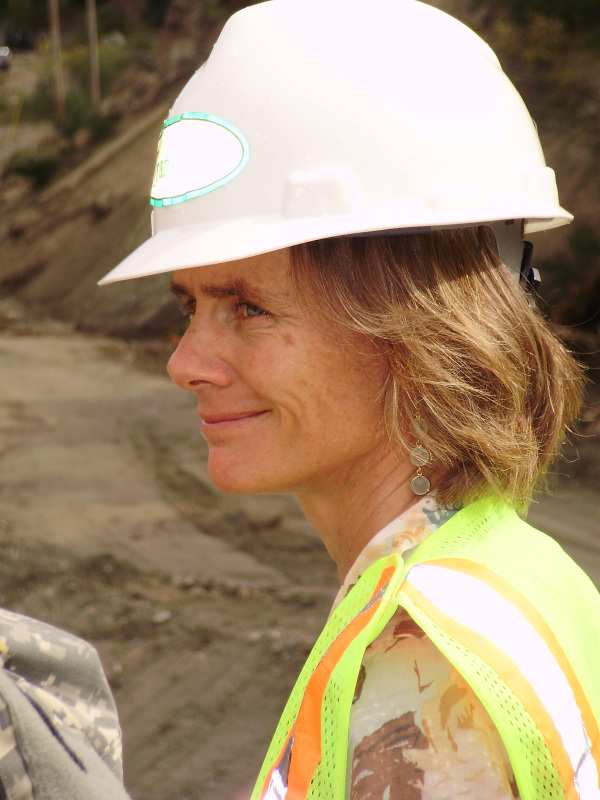
Rockin' the hard hat.

Rockin’ the hard hat.

Deputy Transportation Secretary Sue Minter is usually the first female in otherwise male-dominated lists of Democratic politicos on the rise. (ANR Secretary Deb Markowitz, who finished a strong #3 in the 2010 gubernatorial primary, deserves mention as well; but the grapevine says she’s unlikely to make another run for elective office. That could change, of course.) She briefly broke through the GruberGruberGruber wall of news noise this week, with the announcement that AOT Secretary Brian Searles is retiring and Minter will take his place.

This is notable enough. But what I hadn’t realized until I read media accounts of her promotion is that she is building a very strong political resumé, putting her in a good position for a future run at statewide or Congressional office. Let’s look at some highlights, and my apologies if I missed anything:

— Four-term state representative who served on the Appropriations Committee as well as the Transportation Committee. Generally considered a key member of the Democratic caucus. That’s eight years of legislative experience.

— Named Deputy Transportation Secretary at the onset of the Shumlin Administration, so there’s four years of administrative experience in a big, sprawling, crucial agency. Plus, since a lot of transportation funds come from the feds, four years of experience dealing with our Congressional delegation and the D.C. crowd.

— Named Irene Recovery Officer in December 2011, replacing Neale Lunderville. Had to deal with the tough slog of rebuilding infrastructure — which also involved a lot of work (and facetime) in Washington, D.C.

— Member of the White House Task Force on Climate Preparedness and Resilience. More credibility and connections in Washington.

— Now being elevated to full Cabinet status, and a high-profile Cabinet post at that. Speaking purely politically, lots of opportunities for ribbon-cutting and other feel-good news, making connections with local officeholders, and looking tough and managerial when something bad happens. (AOT is much better for this kind of stuff than, say, Human Services.) Nothing like wearing a hard hat and reflective vest to counteract stereotypes about women in politics.

Transportation’s mission also enjoys broad tripartisan support: nobody’s against roads and bridges.

— Married to David Goodman, writer, broadcaster, and brother of progressive radio icon Amy Goodman. I’m not falling back on the tired trope of defining a powerful woman by her marriage; in this case there’s some relevance.

(Also, her teenage son Jasper is a sportswriter for the Times Argus and sportscaster for WDEV Radio. Good grief.)

That’s an extremely impressive list in a period of about ten years. It’s a crying shame there aren’t more Vermont women moving upward in liberal politics, but if we only get one, Sue Minter’s a damn good one.

How long will our pickle party go on?

For a very liberal state, Vermont’s got a surprisingly lousy record on electing women to our highest offices. We’ve got the #1 state legislature for gender equity, but there’s a distinct glass ceiling above that. A recent survey ranked Vermont a dismal 39th in the nation on gender equity in political office, thanks to women’s under-representation from the state Senate and top mayoralties, their almost complete absence from statewide offices, and their complete absence from our Congressional delegation.

Dismaying, then, to read the recent words of Seven Days’ Paul Heintz in speculating on the “next generation” of Democrats who might seize the next opportunity to move up the ladder should, say, Sen Patrick Leahy retire from office:

The most obvious contenders would be Congressman Welch, 67, and Gov. Shumlin, 58, though both men feign disinterest, perhaps out of respect for Leahy. If either was to leave his current job to run for Senate, that would provide openings for the next generation of Vermont politicos — including, presumably, Speaker Smith, Chittenden County State’s Attorney T.J. Donovan, Sen. Tim Ashe (D/P-Chittenden) and Burlington Mayor Miro Weinberger.

No offense to any of those worthies, but four names, four men.

Sigh.

I checked in with Heintz to see if his list was meant to be comprehensive in any way, and he responded thusly:

That list definitely wasn’t meant to be comprehensive. I included a few up-and-coming officeholders whose names are frequently mentioned as potential statewide candidates. But there are plenty of others who would be equally strong candidates, including a number of women.

There’s no question that Vermont has elected too few women to statewide office. It’s pretty shocking that we’re one of just four states to have never sent a woman to Congress. I would certainly hope that Vermont’s next crop of congressional candidates is more reflective of our population than the current crop of incumbents.

Unfortunately, when you get down to it, the longer list of ambitious Democratic politicos is almost entirely male as well. The most prominent woman on the list, and just about the only one, is former State Rep. and current Deputy Transportation Secretary Sue Minter, while the amount of testosterone on that longer list would be enough to gag a goat.

Not sure what that means, but I’ll carry on.

When that gender equity report came out, Sarah McCall of Emerge Vermont, a group trying to encourage and train female candidates, expressed concern that the next few years are a critical time. If the upcoming round of political retirees are replaced by more men, she noted, we might have to wait another generation for female leaders to take their rightful place. And we’ve already lost a generation since Madeleine Kunin was our one and only female Governor.

In response to Heintz’ list — and really, to the unbalanced reality behind it — McCall offered these comments:

…this is certainly a conversation that Vermont politicos will be having frequently between now and 2016. In Vermont, we are lucky to have such strong leaders in our federal delegation and statewide offices; and whoever follows in Senator Leahy’s footsteps has some very big shoes to fill.

… I have no doubt that there are qualified female leaders in this state who aspire to serve our state in Washington, DC and Emerge Vermont will continue to train female leaders so that women running for public office at all levels of government becomes more commonplace.

It’s a hard thing to ask a qualified male to limit his own ambitions for the sake of equity. But breaking Vermont’s glass ceiling is long overdue. And I’d ask this of Vermont Democrats: Do we have to depend on the Republican Party, which might very well feature Heidi Scheuermann on its 2016 ticket? Or are you going to actively seek to remove the glass ceiling instead of simply bemoaning its existence, while allowing Business As Usual to continue?

The limits of introspection

It sounds like Governor Shumlin has reached the end of his post-election navelgazing after ten entire days, and he has found that the reasons for his shocking near-defeat are largely external. Yes, he accepts responsibility for failing to listen to Vermonters and he promises to do better on that score. But as for the widely-held notion that there was a personal message in the election results? Not so much.

You talkin' to me?

You talkin’ to me?

Shumlin appeared on WDEV’s Mark Johnson Show this morning (podcast should be up shortly), and Mark opened the hour with a pretty solid grilling of the Governor about the whys and wherefores of the gubernatorial election.

When asked what messages he took from the returns, Shumlin named two:

— On policy, “there’s a feeling that folks are frustrated” on pocketbook issues, school spending, and continuing wage stagnation for middle- and working-class people. Which is not just a Vermont problem, he was quick to point out, but a national trend, for which he can bear no special responsibility.

— A vaguely-defined brace of regional and local issues. The Vermont Gas pipeline may have cost him votes in Addison County, and his support for ridgeline wind was a problem in the Kingdom. Aside from those two examples, no specifics.

I can accept that Shumlin was confronted by local concerns as he campaigned around the state, but I haven’t seen any evidence for a localized rejection of him. When I looked at four state senate districts, in different parts of the state, I saw a very clear trend: the Governor polled consistently behind Democratic senate candidates, by a similar margin in each of the four counties.

The general message, he said, was “You’ve got to listen more… Don’t get too far out in front of the troops.”

And then Mark tried to explore the personal dimension. Was the election about policies, or about Shumlin personally?

Safe to say he didn’t want to touch that with a ten-foot pole. “I’ll leave that to the pundits,” he said.

Mark followed up with a direct reference to the Jeremy Dodge land deal, which seemed to resonate with a lot of voters. And not in a good way. Shumlin pivoted immediately to generalities: “I’ve got to do my job better going forward.”

Mark: Was this all about policy, then?

Shumlin: I’ll  leave that to the pundits.

Earlier in the interview, Shumlin had said he fully expected a close election because of what he heard on the campaign trail, and his own campaign’s internal research (which he wouldn’t give any details about). At this point, Mark returned to that idea: Didn’t you hear anything from Vermonters about your own style, your personality? Why not talk about it?

Shumlin: “I have talked about it.” Back to generalities: “There were lots of messages in this election.” And then it was eyes forward to the “tough decisions” that lie ahead. “I’ve got to roll up my sleeves and get back to work.”

A bit later, Mark noted that while Vermont Gas might have cost him votes in Addison County, that didn’t explain Shumlin’s troubles in the Burlington suburbs, where he polled poorly and the Dems lost multiple House seats. His only response was another reference to general “economic frustration.”

All in all, he made it pretty clear that he’s closed the book on the past and is ready to “roll up his sleeves and get back to work.” Nothing more to see here folks, move it along.

I can’t say I’m surprised by the lack of personal introspection, but I am disappointed.

If this election was about policy not personality, then I’m left wondering why one individual so badly underperformed the rest of the Democratic ticket. Why the Governor was almost thrown out of office, while his party retained a strong grip on the legislature?

He did admit that he’d gotten a bit distant, that he was listening to the same small group of people too much. And he committed himself to getting around the state more, and holding open public events (of an unspecified kind) that would get him in touch with a broader variety of viewpoints. And that’s a good thing, as far as it goes (and if it really happens).

But clearly, there are dysfunctional elements in his administration and his own conduct, and it sounds like he’s unwilling to go there. Which, in my view, is a huge opportunity missed.

Lower your expectations, good people

It didn’t sink in until after I’d written my previous post about Governor Shumlin’s news conference, but there was a clear theme running through it all.

Don’t expect much.

Especially you liberals out there.

It seems the Governor was determined to extinguish whatever hopes might still have existed for a small-p progressive administration. Some have argued, like Yours Truly and nanuqFC at Green Mountain Daily, that the real message of last week’s election is that Shumlin lost his liberal base. If he’d simply polled as well as Senate Democratic candidates, he would have sailed to re-election.

But nope. His takeaway was that we need more triangulation, more compromise, and no big new initatives.

On health care, clear signs of a retreat from single-payer. On the budget, admission that a perpetually sluggish economy will force draconian changes. On school finance, crafting a cheaper system will be job one. He gave a preliminary thumbs-down to environmental groups’ expected call for a carbon tax. And, although he personally favors legalizing marijuana, he’s going to defer to legislative leadership on the issue.

Overall, a constant refrain of cooperation, consultation, consensus, listening and learning. (No mention of “leadership.” Or “liberal.”) And do you think the ever-cautious Democratic legislative majority will be in any way emboldened by the loss of ten colleagues? I think that’s a big fat no.

I can’t say this is a surprise. Shumlin’s own instincts and his financial base, if not his electoral one, lead him in a centrist direction. And as a purely practical matter, he emerges from the election in a significantly weakened position vis-a-vis the legislature; he is in a bad position to make demands when he did so much more poorly than they did.

But if anybody was holding out hope that Shumlin would respond to crisis with a new burst of energy and a determination to cement his legacy? There’s no sign of that so far. This could drive a wedge into the already fractious relationship between Shumlin and the liberal base.

2016 might be a good year to be a Progressive candidate.

Maybe Vermont Republicans have forgotten how to handle success?

Confusing little presser the Republicans held at the Statehouse Friday. Confusing in a couple of fundamental ways. They’re already well on their way to a fatal overdose of hubris; they’re toying with an ill-considered attempt to grab the governorship, or at least undercut Peter Shumlin; and they still don’t know what the hell to do with Scott Milne.

I wasn’t there, but I’ve been told that Milne was actually in attendance, but wasn’t invited to speak.* Indeed, even as they slapped each others’ backs over a relative handful of legislative victories, they “didn’t mention Milne until prompted by reporters,” according to VTDigger’s Laura Krantz.

*Note: Per the Comments below, multiple attendees say that Milne was not present. I’ll accept their word for it.

They “didn’t mention Milne,” the man who might still become their leader, not to mention the state’s.

What… the… hell.

Also, even as they were ignoring the Miracle Man, they were boldly announcing their plans for legislation to dump Vermont Health Connect.

(Let me just pause and note what a Boehnerian idea that is: promising a bill to kill a Democratic reform, a bill they know will never pass, just for the sake of some political posturing.)

Uh, fellows, d’ya think maybe it’d be a good idea if you’d, oh, consult Scott Milne before you make your big plans? Especially since some of you, at least, are going to do what you can to overthrow historical precedent and install him as our next governor?

Presumably, if legislative Republicans get their way, it ought to be Scott Milne setting the agenda, not them. But what do I know.

In fact, according to Seven Days’ Mark Davis, there’s been virtually no communication between Milne and top Republicans since Tuesday. Or before Tuesday, either, since they gave him damn little help during the campaign, believing (like everybody else) that he was a radioactive loser.

As for overthrowing historical precedent, take a bow, top House Republican Don Turner and top Senate Republican Joe Benning. Both of them indicated that they would vote for Milne if the race goes to the legislature, in spite of 161 years of precedent that says the legislature always installs the top vote-getter, whether it’s a Republican (Jim Douglas, 2002) or a Democrat (Peter Shumlin, 2010).

And as I wrote earlier, the last time the #2 vote-getter was installed as governor, it was the result of a dirty backroom political deal between the #2 and #3 parties to take down #1. Kinda like if the Democrats and Progressives united to block a Republican who’d won a plurality. So I don’t think the stolen election of 1853 is the kind of precedent anyone should want to emulate.

While we’re on the subject, Mr. Turner: when the governorship was decided by the legislature in 2010, did you vote for Peter Shumlin? If so, you are a hypocrite and an opportunist.

On the other hand, there was the current top Republican officeholder in the state, Phil Scott, saying that he’d obey precedent and vote for Shumlin if he had to choose. Leadership, boys.

Milne and Turner and Benning have devised a new interpretation of the legislature’s role, by saying that each lawmaker should follow the electoral results in his or her district. Which is a brand-new idea that happens to coincide with their own short-term interests. Statesmanship, boys.

Tuesday was the first taste of victory the Republicans have enjoyed in quite a long time. It’s been more than a decade since they gained seats in the legislature, and six since they won the governorship. This sudden burst of success must be terribly disorienting. It’s obviously gone to their heads, and not in a good way.

Hopefully they can regain their balance and learn to use their hard-won scraps of political power in a positive way.

The biggest winner of the Vermont election

You can probably guess. It’s Lt. Gov. Phil Scott.

Not just because he cruised to an easy victory over Dean Corren. Not just because he leaves the campaign with almost $100K in cash on hand for whatever he wants to do next.

Not just because the decks are clear for him to be a very dangerous candidate for Governor in 2016.

No, on top of all that, there’s this: the results of the election ought to cement his control of the Vermont Republican Party. The true believers ought to be marginalized by the impressive success of Scott Milne as a moderate Republican candidate and the dismal failure of their pet project, Dan Feliciano.

Hey, remember when two of the VTGOP’s top four officers, Brady Toensing and Mark Snelling, openly supported Feliciano in the Republican primary? Brady Toensing and Mark Snelling were the two holdovers from the Jack Lindley era who retained their offices last fall in a patched-together compromise with the Phil Scott people.* At the very least, their views ought to take a back seat. At the very most, Scott and party chair “Super Dave” Sunderland ought to feel free to replace them with more like-minded people.

*Correction: I mischaracterized the VTGOP’s leadership race last fall. Toensing was not a holdover from the previous admin; originally, according to Paul Heintz, the conservatives wanted Toensing as chair and David Sunderland as vice chair, while the Phil Scott camp wanted them switched. In the end, the party unanimously went with Scott’s pairing. 

And, lest we forget, prominent conservatives Wendy Wilton and John McClaughry also jumped into the Feliciano lifeboat, only to see the S.S. Milne sail on blissfully without them.

And if there’s any justice, this ought to be the death knell for Darcie “Hack” Johnston as a serious political voice. She piloted Feliciano’s campaign straight into the Randy Brock Memorial Iceberg. As far as I can tell, she represents nobody but herself. Her true-believer approach to politics is a proven loser, a dead end for the VTGOP. She might keep on being quoted in the media because she’s an easy get, but as a political strategist? Nope.

For all his faults as a campaigner, Scott Milne succeeded where nobody has since Jim Douglas: he convinced a lot of centrists, independents, and even Democrats to abandon their standard bearer. Part of that is circumstance; a lot of it is a loss of faith in Governor Shumlin; but it also had to do with a Republican candidate who was not an ideologue, who even entertained the notion that some Democratic ideas might be acceptable.

Future Republican candidates would do well to learn the art of public speaking better than Milne, but they would also do well to follow the moderate Republican playbook.

And that’s the biggest win of all for Our Lieutenant Governor.