Category Archives: Health care reform

The moral imperative for health care reform, revealed in a handful of statistics

At the January 27 meeting of the House Ways and Means Committee, Sara Teachout of the Joint Fiscal Office distributed three fairly simple charts that tell the story of our unfair state income tax system in bold relief. I’ll be examining those charts in an upcoming post, but right now I want to focus on a small slice: the deduction for medical expenses.

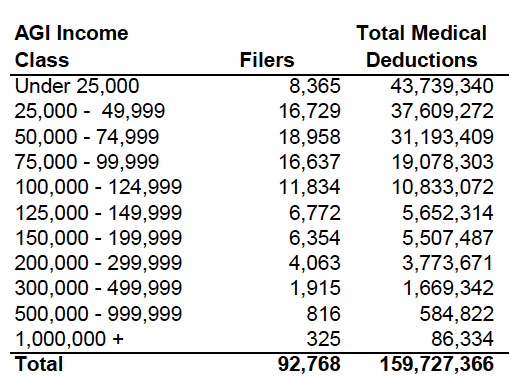
The first chart lists the most frequently claimed tax deductions across the top, and income classes down the left side. It tells a fascinating story about who benefits from which deductions, and how much. But today I’m concentrating on the first two columns, shown below:
Medical deduction chart 1

A couple of explanatory points. First, this data is from 2011, predating Vermont Health Connect and the Affordable Care Act. Second, I should explain the rules for deducting medial expenses. You can’t deduct health insurance premiums, just actual medical and dental expenses. You can only deduct medical expenses if they total more than 10% of your gross income, and only the portion above 10% is deductible. It’s a very high standard; you’ve gotta have some serious medical bills and no insurance (or really bad insurance) to qualify.

As you might expect, “Total Medical” is the outlier among deductions; it’s the only one claimed more often by the poor and working poor than by the wealthy. There are two simple reasons for this. The first is that the poorer you are, the less likely you are to have health insurance. The second, obviously, is the lower your income, the fewer bills it takes to qualify.

It’s no giveaway, though; if you’re making $25,000 a year, then medical bills over $2500 are enough to throw you into severe financial difficulties. A tax break on a portion of those bills won’t make you whole.

These columns reveal the hidden cost of our old health care system — the human and social cost, and the actual financial cost. Vermont is foregoing a large amount of potential tax revenue because so many people incur medical bills that eat up a significant portion of their earning power.

I don’t know if these numbers were factored into Gov. Shumlin’s calculations on single-payer. I sure as Hell hope so, because it’s a cost that’s every bit as real as a payroll tax.

As for the human and social costs, the top three lines indicate that more than half the total value of medical deductions was taken by those with incomes under $50,000. These are people who cannot afford a significant unplanned expense, because they’re barely making ends meet in good times.

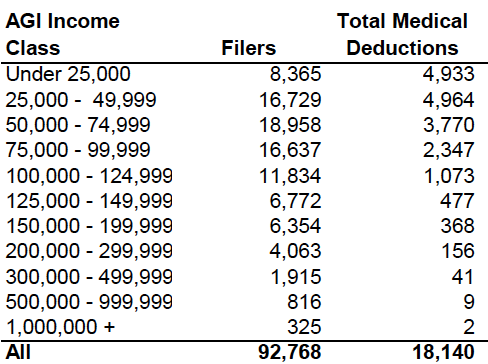
Here’s the same slice from a second chart that shows the total number of filers in each income class, and the number who took a medical deduction. This shows that more than 50% of those claiming a medical deduction earned less than $50,000, while virtually no wealthy people claimed one.
Medical deduction chart 2

Now look at that top line. More than half the low-income filers qualified for medical expense deductions. That’s nearly 5,000 individual stories of illness and deprivation, of life-changing financial crises, most likely including thousands of bankruptcies. How many people lost their jobs and their homes, and saw their lives go into a tailspin, because of an uncovered illness or injury in 2011 alone?

So far, health care reform has dramatically reduced the ranks of the uninsured in Vermont. These figures show how crucial that progress is, for the stability of our society and the very lives of our most vulnerable.

These figures are also a powerful argument that we need to keep it up. We shouldn’t have thousands of poor and working-class Vermonters qualifying for this deduction. There should be none, or very few at most. That’s the goal of, and the moral imperative for, universal health care.
Don Turner phones it in

House Republicans have apparently decided it’s time to pay some lip service to the idea of health care reform.

Emphasis on “little.”

Under the very generous headline “House Republicans Develop Alternative to Shumlin’s Payroll Tax Proposal,” VPR’s Bob Kinzel outlines a half-assed Republican idea that would, at best, produce a fraction of the benefits of Shumlin’s plan. At worst, it’d be a huge step backward for health care access in Vermont.

The Governor has proposed a payroll tax of 0.7%, with the proceeds going to shore up Vermont’s embarrassingly low Medicaid reimbursement rate. Since Medicaid services are now indirectly subsidized through higher charges to non-Medicaid payers, increasing the state’s reimbursement rate should lead to lower insurance premiums for everybody else. Shumlin says the net drop in premiums would more than make up for the new tax, and he would task the Green Mountain Care Board with making sure the premiums go down.

Also, the reimbursement system would be, y’know, fairer.

House Minority Leader (and king of the kneejerk conservative response) Don Turner isn’t buying it. Funny thing: he doesn’t argue against the tax itself. Instead, he invokes the long-discredited Domino Theory.

“It seems like a little number, but you’ve opened the door,” Turner says.

So he’s not arguing against the tax, just the imaginary consequences of the tax.

His big idea? The state should ditch Vermont Health Connect and opt for the federal exchange. Turner figgers we could save $20 million, which could go toward raising Medicaid reimbursements. Even by his perfunctory standards, this is awfully lame. Transparent, even.

Three problems (at least).

— His $20 million estimate is contested by administration officials. And, as I understand it, a lot of the money spent on VHC is actually federal money. How much of Turner’s reputed $20 million is actually Vermont’s money?

— Shumlin’s tax plan would raise $90 million annually, enough to close the Medicaid reimbursement gap by half. Turner’s $20 million would accomplish slightly more than Jack Diddly Squat.

— Worst of all, the US Supreme Court is considering a case that could end federal health care subsidies for states that use the federal exchange. Turner doesn’t give a rat’s.

“We understand there may be a potential for Vermonters to lose federal subsidies,” Turner says. “However, 35 other states are in the same boat.”

We’ve cut the number of uninsured Vermonters in half, and Turner’s response? “Ehh, easy come, easy go.”

Also, about one-third of the payroll tax revenue would allow the state to expand Medicaid to 20,000 more Vermonters. There’s nothing like that in Turner’s “plan,” and he couldn’t care less. As Kinzel reports, Turner “says he’s not convinced that this expansion is a good idea.”

I guess he’s fine with tens of thousands of Vermonters having no health insurance. Or at least he’d rather have that, than a small payroll tax hike that would be more than compensated for by lower insurance premiums.

Shumlin Administration Dumps Ballast

Frontrunner for Least Surprising Personnel Move of the Year:

Department of Vermont Health Access Commissioner Mark Larson is stepping down from his post in March and will be replaced by Deputy Commissioner Lori Collins on an interim basis, the Shumlin administration announced Tuesday.

First of all, I don’t know how much blame Larson deserves for the disastrous rollout of Vermont Health Connect, or in the fundamentally flawed oversight of its development. What I do know is that last September, when the VHC website was finally taken offline so it could be patched together, Larson was the only administration official to pay a price. He was benched from any involvement in VHC, but allowed to keep his job and perform other, undefined duties.

And as you may recall, when Gov. Shumlin announced his abandonment of single-payer in December, Larson was relegated to a seat across the room from the phalanx of officials backstopping the governor. Didn’t want him appearing in any press photos, I guess.

Either he was a scapegoat, or he failed. In any case, he got to keep his job and his salary, even though one of DVHA’s chief operations was no longer in his control. Nice work if you can get it.

Shumlin issued a statement on Larson’s departure, praising the soon-to-be-former Coffee Boy.

“Mark has worked as hard as anyone on my team over the last four years,” Shumlin said. “Mark led the Department through some challenging times, but no one cared more or tried harder to overcome those challenges so Vermonters could access affordable health care than Mark.”

I don’t doubt that he cared deeply or tried hard. The question isn’t how dedicated he was — it’s how effective he was. From all outside appearances, the answer is “not very.”

And yet, by the time he leaves, he will have occupied his position and drawn paychecks for a full six months after one of his primary responsibilities was removed.

One of Governor Shumlin’s best qualities is his loyalty. He builds a team, relies on them, and rewards them for their service. It’s also one of his worst qualities: he sticks by his people whether they objectively deserve it or not. Failure rarely results in punishment or removal; at most, there’s a mutually agreed upon parting of the ways. Shumlin’s been in office for four years now, and I believe the only high-profile person he’s ever fired is Doug Racine — his longtime #1 political rival, and definitely not a Shumlin insider.

In announcing Larson’s departure, both he and the governor noted that, during his tenure, the number of uninsured Vermonters has dropped by half. Which is true; but is that a matter of causation or correlation?

Available evidence suggests the latter.

The Shummy Shimmy

Before the November election, I’d planned to write a post-election piece offering my services to the Shumlin administration for the newly-created position of Shitkicker-In-Chief. The duties would include pointing out the flaws in administration reasoning, deflating egos when necessary, and the occasional loud guffaw.

The idea was based on my belief (hahahaha) that the election wouldn’t be close. When Shumlin won by a shoestring, I thought my idea was irrelevant. The election was a more effective shitkicker than I could ever be.

Seems I was wrong, because the Governor has quickly fallen back into to some bad habits. One of his worst is his almost-complete inability to admit that he was wrong about something — even if it’s something trivial. It makes him appear small-minded, overly defensive, duplicitous, and condescending.

This habit is again on display in the foofaraw over releasing documents related to single-payer health care.

For those just joining us, when the governor announced in December that he was ditching single-payer, WCAX’s Kyle Midura asked a provocative question. Here’s the exchange, as reported by Seven Days’ Paul Heintz:

“Will you waive executive privilege for all backdated documents at this point related to this question so we can see what you knew when?” Midura said.

“There is nothing to hide on what we knew when, so we’d be happy to show you any documents you wish to look at,” the governor responded.

Emphasis: “any documents you wish to look at.” And Midura’s use of “this question” is generally seen as referring to Shumlin’s decision on single-payer.

Naturally, multiple media outlets made public-records requests for any related documents. And that’s when Shumlin backtracked: the administration withheld “hundreds of pages of documents related to single-payer,” reports VPR’s Peter Hirschfeld.

Shumlin never wrongShumlin says he never intended for him comments on Dec. 17 to mean that he’d release all internal communications related to single-payer.

“Now no governor ever divulges inter-staff conversations, but what we did divulge was all the data that led us to the conclusions that we came to,” Shumlin said.

Okay, I can see that point of view. But why did he promise, on Dec. 17, to release everything?

Evasive maneuvers, Mr. Sulu!

So far, we’ve heard two different explanations.

In an email to Heintz, the Governor’s legal counsel Sarah London asserted that Midura’s question referred narrowly to “the specific question of Medicaid reimbursement rates.”

On the other hand, Shumlin told Hirschfeld that he thought the question referred only to documents involved in a lawsuit by Rep. Cynthia Browning.

“Well as you know we had a fairly well-publicized court case … where we were asked to divulge all the data, studies and information about every detail that led us to the disappointing conclusions that we came to about public financing,” Shumlin said. “I assumed that his question was simply, are you going to continue to withhold that data? Or are you going to share it?”

It got even worse when Shumlin tried to clarify his position at a news conference yesterday:

“If you listen to the entire question, I answered it very clearly. And what I said was, the question I understood — I had it played back to me, so I think I got it — was, ‘Are you going to release the documents that, frankly, hadn’t been released before?’ You may recall Cynthia Browning requested them and we went to court and the court ruled in our favor. ‘Are you now going to release those documents? The documents that give us the data, all the dates, what you’ve done, all the studies?’ And I said, ‘Of course, we are. We want Vermonters to have that information.’ If you took the question as something else, you should’ve asked it that way. You didn’t.”

The Shummy Shimmy.

It’s one of his worst features: ducking and diving in a transparent effort to avoid admitting he was wrong.

I guess they could still use a Shitkicker-In-Chief.

Here’s a little free advice. Or consider it part of my S-I-C job application. Here’s what he should have said — and it’s not much different from what he did say.

“I apologize for misspeaking on Dec. 17. I should not have promised to release ‘all documents,’ because every administration needs some measure of privacy in its internal policy discussions. Any chief executive would agree with that.

“We have provided as much documentation as we can. The information we have released should be more than adequate to understanding how we arrived at our decision. I hope you, and the people of Vermont, can appreciate our position.”

There. Was that so hard?

The occasional apology would go a long way toward changing Shumlin’s image for the better. The long-term benefit would far outweigh the immediate discomfort.


Fear and loathing under the Golden Dome

Funny thing. The more time goes by since last Thursday’s inaugural protest, the more fearsome and dangerous it seems to become.

We haven’t had any single item more outrageous than Sen. Dick McCormack’s employment of that fine old epithet “fascist.” What we have had is a proliferation of exaggerated characterizations and inconsistent rationales for why the Vermont Workers’ Center went too far.

At first, the ire was mainly concentrated on a single incident, in which a lone protester entered the chamber singing and chanting over the benediction. Regrettable and stupid.

But apparently Our Elected Leaders realize that that one incident fails to justify their reaction, because they’ve been using their creative powers to devise new ways the protest crossed some invisible boundary. I suspect that by the end of the month, the protest will be described as a cross between the Chicago riots, the nude scene from “Hair,” and the supercharged zombie attacks from “World War Z.”

The Inaugural Protest. (Not exactly as illustrated.)

The Inaugural Protest. (Not exactly as illustrated.)

Anyone who’s experienced real political turmoil would have to admit that the VWC was remarkably restrained. They did not, as many media outlets have reported, “disrupt” or “interfere with” the proceedings.

I listened on the radio, and I heard very little of the protesters — and I heard no interruptions in the proceedings. If those in attendance couldn’t hear, they could have asked that the sound system be turned up.

Recently, we’ve heard that some lawmakers felt uneasy about proceeding into the House chamber through a crowd, even though police officers lined their path. (And even though there was no hint of any violent intent by the protesters.) Indignant lawmakers have stopped referring to the benediction incident in favor of overly-broad depictions of the protest as loud or disruptive, which is only true if the expectation is library-standard quiet. We’ve heard references to possible fire-code violations — in a building whose last major fire was, I believe, in 1857. (We haven’t heard a peep from the police or the Sergeant At Arms about the fire code; that’s all come from opportunistic Republicans.)

Today we had the unedifying spectacle of Republican lawmakers threatening to walk out of the Governor’s budget address on Thursday should the protesters return, on the transparently specious grounds that they fear a stampede in case of a fire. Hell, those protesters are probably better organized than the assembled dignitaries. I suspect they’d be fully capable of calmly proceeding to the nearest egress.

We’ve also heard a whole lot of blaming the protest for potential security upgrades at the Statehouse. Which is ridiculous. First, because the protesters did not pose a threat to anyone with an ounce of common sense. And second, because enhanced security has been on the table for quite a while now — and will inevitably penetrate the hallowed halls. Because that’s just the way the world is these days. To blame it on that protest is utterly disingenuous.

Most of all, we’ve heard repeated appeals to respect and dignity and civility.

What this is really about is a set of crusty old traditions about the Statehouse. Voices are generally lowered, at what might be termed a “power mumble.” (It’s hell for old radio guys like me, with moderately compromised hearing.) There’s an unspoken expectation that men shall wear button-down shirts and ties. VWC members have one strike against them from the gitgo, since they dare to wear red T-shirts while roaming the sacred halls.

Playing by the unwritten rules is important to Statehouse regulars. The longer they’ve served (McCormack, a total of 22 years), the more wedded to Statehouse mores they become. And the more they resent it when the outside world dares to intrude.

They call it the People’s House, and accuse the protesters of disrupting the People’s business. But they themselves want everyone to treat it like a cross between a museum and a mausoleum.

It’s too bad when democracy — the People’s real business — gets a little messy and intrudes on what some consider sacred space. But I don’t feel sorry for them, not at all.

And those traditions? Throw ’em out with the trash, if you ask me.

Don’t expect the Vermont Workers’ Center to go away anytime soon

Those dirty hippies who made Joe Benning walk the gauntlet on Inauguration Day are most likely in this for the long haul. I say this because the Vermont Workers’ Center is a rapidly-growing organization with surprising financial muscle.

According to the nonprofit’s most recent IRS filing, VWC had revenue of nearly $680,000 in the year 2013. VWC head James Haslam told VTDigger’s Morgan True that this year, the figure will be around $800,000. As recently as 2009, its intake was less than $200,000; you do the math.

That’s pocket change in Koch World, but in Vermont it makes VWC a power to be reckoned with, beyond its ability to draw a crowd to the Statehouse.

Aside from money, it’s also tapped into a deep vein of dissatisfaction with/alienation from politics as usual. Its members are committed enough to turn out large numbers for a demonstration or flood the Statehouse hallways when needed. They are also willing to financially commit: VWC charges membership dues, and pulls in about 30% of its budget from members without much apparent effort.

My big question, when I saw VWC revenues in the high six figures, was: where is it all coming from?  Haslam:

That work is supported by a combination of foundations which, typically, is about half of our support or maybe a little bit more. The other half is from our base, which is individuals and trade unions. I think it’s something like 20% unions, 30% individuals. It fluctuates year to year, but that’s about right.

I didn’t ask him for a list of foundations; as a nonprofit, VWC is not obligated to release donor information. VTDigger’s Morgan True reports that the Ben & Jerry’s Foundation is its largest nonprofit donor, having given $50,000 this year and a total of $160,000 since 2010. True also reports that VWC has strong ties to a national network of progressive organizations; “We’re part of a broader people’s movement to turn things around for working people,” Haslam told him. Well, if its largest foundation gift was 50K and they’re pulling in 400K from foundations, then they’re drawing from a large donor pool.

One other note from Thursday’s protest. It’s been reported that five of the 29 people arrested that day were paid by VWC, which has raised some hackles. Haslam says the five are members of VWC’s ten-person staff. He says they did not receive any remuneration beyond their regular pay for taking part in the protest or for being arrested.

At a planning meeting before the protest, Haslam told me, people were asked whether they would be willing to be arrested if necessary. “We were hoping that nobody would be arrested,” he said, “but our members felt that it was important for us to take a bold stand.”

Those who volunteered for arrest, he said, “were all people who had had first-hand experience with the health care crisis.” Five of them happened to be VWC staff. “That was a voluntary act for sure,” he says. “We have a number of staff people who didn’t do it.” Including, as it happens, Haslam himself.

With a committed membership and a growing financial base, VWC shows no signs of being a flash in the pan, or some sort of Occupy movement that will burn brightly for a brief time and then flame out. They look to be in this for the long haul, on a broad variety of issues. Whether or not they continue to declare themselves at big political events, they’ll be around, promoting their causes and making it harder to ignore their issues.

Here’s something Governor Shumlin should stop saying

Ever since last Thursday’s inaugural ceremonies, Gov. Shumlin has been telling anyone who will listen that he was “saddened” by the presence of protesters. Like other Democrats, he singles out the one protester who crossed the line by singing during the benediction.

He has to highlight that one moron because otherwise, the demonstrators were not disruptive or offensive. They followed the rules of civil protest. The inauguration proceeded as scheduled until the very end.

Of course, what really offends the governor is that they dared to crash his coronation. The Vermont Press Bureau:

“The inauguration is an opportunity where we all say, ‘Let’s roll up our sleeves, cut out all this party stuff and get to work,’” the governor said. “And I just don’t think that they did their cause… much good by the kind of tactics they employed…”

Or in Brill Building terms: “It’s My Party and I’ll Cry if I Want To.”

The whingeing is excessive and self-centered. But I’d like to focus on one thing the Governor is saying, over and over again, that hurts his credibility. It goes something like this:

“I was really saddened by what happened yesterday, because I’m as frustrated as anyone with our health care system, and there’s no one that wants to see the goal of universal access as much as I do,” he said.

That’s from Saturday’s Burlington Free Press, but he’s been spouting variations on that theme in other outlets.

And he needs to stop. Now.

For one thing, it’s false. For another, it’s a two-sided statement: Shumlin is trying to emphasize his own political pain and loss — but at the same time, he’s downgrading everyone else’s.

Is there really no one who is more frustrated by Shumlin’s abandonment of single-payer? Is there really no one who more ardently wants to see universal access?

Of course there is.

Start within the administration itself. Are Robin Lunge or Mark Larson less disappointed than Shumlin? How about Anya Rader Wallack? Or Jonathan Gruber, who’s become a national laughingstock and has now lost his best chance to enact single-payer? There must be, at minimum, dozens of staffers and contractors who’ve put their heart and soul into Vermont’s single-payer initiative. That’s not to mention the single-payer advocates like Deb Richter and Peter Sterling, who served on the Governor’s Consumer Advisory Council and had the rug pulled out from under them.

Widening our scope, how about the entire Progressive Party, which put its own gubernatorial ambitions on hold for three straight election cycles in order to give Shumlin a free hand on single-payer? Might they be more frustrated than the Governor?

Which is not to overlook Democrats who’ve fought for single-payer. Maybe ex-Rep. Mike Fisher feels a bit of disappointment after losing his bid for re-election and then the cause he’d worked so hard for.

Finally, let’s not forget the tens of thousands of Vermonters who still don’t have health insurance, and the additional tens of thousands who still struggle to pay their premiums, in spite of the Affordable Care Act’s advancements. They are directly impacted by Shumlin’s decision in ways that he will never, ever be. He’s a millionaire who can afford any kind of health coverage he wants, up to and including concierge medicine from the Mayo Clinic.

That’s a partial list, but a substantial one. I think it’s safe to say that there is at least one person more frustrated and more disappointed than Governor Shumlin.

Whether he intends it or not, the Governor slights the feelings and experiences of all those people  when he claims special status as the number-one victim of single-payer’s demise.

As for what he should say instead, here’s a suggestion:

“My decision not to pursue single-payer health care has caused a lot of anger and frustration, and disappointed a lot of people, including many who have supported me politically. Our inability to move forward on single-payer has brought pain to thousands of Vermonters who are still without health insurance. 

“I apologize to each and every one of them. My commitment to universal access is as strong as ever, and as long as I am Governor, I will strive to advance the cause of universal access to the best of my ability.” 

There. That’s not too hard, is it?

A passel o’ peevishness on Inauguration Day (Part One)

Many a knicker was tightly knotted yesterday, judging by some of the statements made and actions taken at the inaugural ceremony.

Most of the collywobbles arose from the protest by advocates of single-payer health care. Many politicians were vocally incensed at such goings-on. And some of the protesters were shocked — shocked — that they might be handled roughly by police.

The rest of the peevishness came from Republicans reacting, even more childishly than usual, to Gov. Shumlin’s inaugural address. I’ll cover that in a separate post.  Back to the demonstration.

The folks from the Vermont Workers Center went a bit too far when they disrupted the closing benediction. Otherwise their protest was peaceful if occasionally intrusive.

The assembled dignitaries, however, just couldn’t stomach this disturbance of their sacred space. Sen Dick McCormack wins the honor for Biggest Overreaction; he called the protest “fascist.” Protip for public figures: never ever ever ever ever use the word “fascist” unless you’re talking about a violent, oppressive, murderous regime.

Sen. Bobby Starr, D-Hicktown, resorted to the “You Kids Get Off My Lawn” meme: “I think they should get a job.” Dirty hippies!

Senate Penitent Pro Tem John Campbell was among several lawmakers who told protesters they were hurting their own cause.

Snort. As if.

Two points. First, single payer is dead for the foreseeable future. Second, any lawmaker who casts a future vote because of yesterday’s demonstration is failing his/her duty.

And the Governor, speaking today on WDEV’s Mark Johnson Show, said the protesters had “hurt the cause” by showing a “lack of respect for the process.”

Awww. Would that be the same process (and the same governor) who built up their hopes and expectations for years, only to dash them all in a single moment? Shumlin reaped the benefits of single-payer advocates’ support through three election cycles, and then abruptly trashed it all.

Advocates are understandably upset about that, and the inauguration of Peter Shumlin was an appropriate time to express their outrage. It was, in fact, the perfect time. The Governor shouldn’t play with people’s beliefs, and expect to be shielded from the consequences by his sense of decorum. As a Mark Johnson Show caller pointed out, disruption is the only way for people who feel disenfranchised to make their voices heard.

So, no sympathy for the hurt fee-fees of our distinguished leaders.

Not that the protesters are without blame. The single moment where things went too far was during the closing prayer. Protesters were outside, singing. One of them, Ki Walker, entered the balcony and continued to sing. A protest organizer later claimed that Walker thought the ceremony was over. But Walker was right there at center stage. He could see that the ceremony was continuing. And he kept on singing.

Afterward, he explained himself to Seven Days’ Paul Heintz:

 “Our tone was, like, nice or whatever,” Walker said.

Duuuuuuude. 

But the Whiniest Protester Award goes to Sheila Linton, who was part of the group occupying the House floor after the ceremony. When police began trying to remove the group, very politely, she refused to move or speak. When they tried to lift her arms, she began screaming as though they were using a chainsaw. (You can see the video on Seven Days’ website.)

Okay, here’s a lesson for Vermont’s Junior Gandhis. Your commitment to passive resistance  includes the possibility of what one trooper called “pain compliance” — the application of discomfort to those who resist police action. And this wasn’t Bull Connor with firehoses and Dobermans; these were state troopers acting with restraint and deliberation. Sorry, Ms. Linton, no sympathy here.

The demonstration itself was relatively mild, Mr. Walker being a notable exception. So was the police response. People on both sides got way more upset than they should have been.

The best reaction came from House Speaker Shap Smith, quoted by the Vermont Press Bureau’s Neal Goswami:

“I think this was an incredible example of the openness of our democracy,” he said. “In the people’s house, people are allowed to petition, and I would expect that over the coming weeks, we’ll talk with people about setting up hearings.”

Measured, reasonable, respectful. Just about perfect.

(Still to come: VTGOPeevishness.)


Big ol’ lead airliner

There’s an absolutely devastating piece on VTDigger this morning. If you haven’t read it, go. Now.

For those who didn’t immediately take my advice, the story outlines the role Governor Shumlin played in holding a pillow over single payer health care’s face until it stopped breathing. Or, as the headline says, “Shumlin built ‘lead airplane’ for single payer.”

If the story is true, here’s basically what happened. At some point, the governor decided that he couldn’t win on single payer. Then, rather than face the music directly, he larded his single payer proposal with assumptions that added to its cost and suppressed its revenues. As the story says, “he cast the program in the most negative light possible.”

And then he walked away.

How did he do it?

Well, first of all, he presented only one plan, when he’d promised a menu of options.

Aside from that, his plan offered top-shelf coverage, paying for 94% of clients’ health care costs — a 94 Actuarial Value. He could have gone with a lower figure; “Act 48, Vermont’s single payer law, directed the administration to shoot for a plan that covered 87 percent of costs.”

So he ignored the law. Not much new there.

The 94 AV added $300 million a year to single payer’s cost.

He also chose to add out-of-state residents who work in Vermont, which added another $200 million. And he called for the elimination of Vermont’s provider tax, which cut $160 million in revenue.

He also chose to assume the new system would yield no administrative savings — which had been one of his big selling points for single payer.

You can see where this is going. Shumlin projected a first-year cost of $2.6 billion, but he could have brought in a perfectly acceptable plan for well under $2 billion.

And he knew it. And he chose not to tell us.

The massive report released by the administration at year’s end included not one, but 15 plans. But Shumlin chose to present only one.

Among the 15 different models in the document dump is Financing Concept 12, which uses an 87 percent actuarial value and would require $1.6 billion in state revenue for the first year.

It excludes out-of-state workers and does not offer supplemental coverage to federal employees or people with employer sponsored coverage, all of which is contained in the plan Shumlin chose.

It’s hard to read that and feel anything other than betrayal.

Maybe there were perfectly sound reasons for Shumlin’s choices, but he didn’t give them and he didn’t provide any options. Instead, he “buried” them in his pre-holiday document dump.

So, Vermont misses a chance at single payer. Even worse, the entire idea of single payer has been significantly set back, perhaps by decades. Because now we have a liberal governor, a strong advocate of single payer, concluding that it’s not practical.

This hurts.

The current bee in Mike Donoghue’s bonnet

There was laughter in the room, I’ve been told, when the Burlington Free Press’ Mike Donoghue asked Gov. Shumlin about the possible removal of Rep. Mary Morrissey from a House committee.

HIs question came near the end of Shumlin’s Monday news conference. The laughter came from several other reporters, who saw Donoghue’s question as basically irrelevant, and just another example of his dogged pursuit of a story he’s decided is important. Sometimes he’s right, sometimes he’s wrong.

In this case, yep, he’s wrong.

Undeterred by the audible scorn of his colleagues, Donoghue wrote an article about Shumlin’s Monday presser — an event that produced actual news — that focused primarily on his prefabricated Morrissey “controversy.” Of all the stuff going on this week at the Statehouse, it’s a sad joke that Donoghue and his paper have devoted so much time to such an insignificant story. And provided so little coverage of anything else.

For those just joining us, Morrissey has been an unproductive policy scold as a member of the House Health Care Committee. Apparently, House Speaker Shap Smith is considering a reassignment. As is his right: the Speaker makes the committee assignments, and reshuffles are commonplace.

But Donoghue has fixed upon Morrissey as a champion of transparency because once, at a committee hearing, she asked a question:

… Morrissey questioned Health Access Commissioner Mark Larson [about security breaches in Vermont Health Connect] and was told, “We have no situation in which someone’s private information has been breached.”

The problem was there had been a serious breach of information. Larson later offered an apology to the Health Care Committee.

Her questioning was standard practice for any committee member. But because of Larson’s misleading answer, Donoghue is now crediting Morrissey for “helping expose a major security breach… in the Vermont Health Connect computer system.” If she played any role beyond asking her question, Donoghue does not so inform us.

He also takes some groundless shots at Morrissey’s critics (including me, I guess):

Morrissey been criticized for not buying into all the health care plans rolled out by Democrats.

Not quite, Mikey. It’s not that she failed to buy into “all the health care plans” from Democrats; I wouldn’t expect any Republican to do so. The truth is that she routinely slammed any Democratic plan. There was no thought, no discernment; just a consistent, unproductive, ideological gainsaying.

Only after Donoghue thoroughly explores the subject that prompted his colleagues’ laughter does he actually report the substance of Shumlin’s news conference: a new survey has found a sharp drop in uninsured Vermonters.

The Vermont Household Health Insurance Survey found that about 19,000 of the 43,000 Vermonters without insurance during the 2012 survey now are covered, Shumlin said.

The state’s uninsured rate dropped from 6.8 percent to 3.7 percent, the second-lowest rate in the country. Only 1 percent of Vermont children under age 18 are not covered, the lowest rate in the country, Shumlin said.

Those are some very encouraging figures about the first year of health care reform. But somehow Donoghue concluded that this development was less newsworthy than the routine reassignment of a legislative backbencher. But he has already elevated her to the lofty position of Public Interest Whistleblower, which she is not. I fully expect more breathless Morrissey coverage when the committee assignments actually come out.

Because boom or bust, Mike Donoghue sticks to his guns.