Category Archives: Dean Corren

The new polls, pt. 1: Vote for Bud

Yesterday brought new polls in the races for Governor and Lieutenant Governor. I’ll get to the Shumlin/Milne numbers later. This post will address the easy one: Phil Scott 58%, Dean Corren 24%.

Yeah, that race is over. Commence victory lap.

Corren’s 24% is bad enough, but the worse news is Scott’s 58. Corren would not only have to sweep the undecideds to make this competitive, he’d have to unconvince almost 10% of Scott voters. That ain’t happening.

The poll is credible, coming from the Castleton Polling Institute (and commissioned by WCAX-TV). The 4% margin of error is a drop in Phil Scott’s bucket.

Corren’s response, of course, is defensive optimism, per VPR:

“It was done… before our ads started to kick in. And we’re going to be doing a lot more ads,” Corren says. So I think it’s mostly a name recognition thing.”

Which raises a question about Corren’s campaign strategy. As of October 1, he’d spent about one-fourth of his $200,000 publicly-financed warchest. He waited an awfully long time to amp up a race between a basically unknown challenger and an extremely well-known incumbent.

Maybe he was misled by the success of his drive for public financing, or the outcome of his write-in bid for the Democratic nomination. Corren’s got an enthusiastic core following, but that doesn’t help him in the general campaign. In the language of beer, Dean Corren is Heady Topper: a tremendous niche-market success.

Phil Scott is Budweiser. Uninspiring, bland, perennial best seller.

You can see the contrast in these words from Corren, meant to support his candidacy but actually outlining the reasons Phil Scott will win:

“You have an incumbent who has spent four years doing things that make everybody in the state feel like he’s a nice guy and not hold him to account on any particular issues, and really know where he stands on issues, because he’s done a really good job of ducking that.”

Yeah, exactly. Everybody in the state thinks “he’s a nice guy.” And he’s running for the ultimate nice-guy office. Also, being a nice guy makes him the perfect token Republican: he’s not going to aggressively challenge the status quo.

Now, there’s no way the final result is going to be anything like 58-24. I expect Corren to gain 15-20 percentage points. He’ll almost certainly do better than Cass Gekas’ 40% two years ago. But not nearly enough to matter.

Heady Topper’s great. But it’ll never challenge Bud.

The absurd extremities of the public financing law

The Vermont Democratic Party, having lopsidedly endorsed Prog/Dem Dean Corren as its candidate for Lieutenant Governor, seems to be doing all it can to strip away any value from that endorsement.

The Vermont Democratic Party this week sent glossy color mailings to reliably Democratic voters, urging them to vote for its slate of statewide candidates. But Corren wasn’t mentioned.

Dean Corren at the Democratic State Committee meeting in September.

Dean Corren at the Democratic State Committee meeting in September. Photo courtesy of… well… me.

When the Democratic State Committee endorsed Corren, party officials made it clear that there were significant restrictions on their ability to offer him any tangible support — voter data, Coordinated Campaign, etc. — because by accepting public financing, Corren had to forswear all other fundraising avenues. Including in-kind support. Indeed, they said they would have adhered to the same limits if the Democratic hopeful, John Bauer, had qualified for public financing.

The Dems were advised by their lawyers to steer clear of anything that might run afoul of the law. Which allowed them to circumvent questions about the wisdom of sharing the party’s legendary database with a Progressive, who might then share it with his party. A valid concern, when the Progressive Party often runs candidates against Democrats.

But to exclude any mention of Dean Corren from mailings? To me, that seems an excess of caution. And a serious handicap for his campaign.

And while Corren was in full agreement with the Dems on their withholding of voter data and the Coordinated Campaign, he seems less satisfied with this move:

Corren said he’s prevailing upon Democratic officials to include him on the next round of mailings.

“The conversations go on,” Corren said. “We’re in the midst of conversations. So it’s not like it’s a one-shot deal.”

Corren has dutifully played nice, and I commend him for that. But excluding Corren from a mass mailing, to me, is stretching the legal point. It raises doubts about the Dems’ real motives.

I’ve been told that the Dems don’t want to turn “tangible assistance” into an issue for Phil Scott; but issues like that are inside baseball, and have little or no effect on voters. Maybe the risk is small enough to merit the potential reward.

At the very least, it points out a serious shortcoming with the public financing law. The qualification standards need to be loosened, so more candidates can qualify. And, apparently, there needs to be a better definition of “tangible assistance” so that parties don’t have to pretend that one of their own doesn’t exist, just because s/he qualified for public financing.

Dick-swinging time

Apologies for the crass title, but it seems singularly appropriate for the early returns on this campaign finance deadline day. Particularly when it comes to Governor Peter Shumlin and, to a lesser extent, Lieutenant Governor Phil Scott.

Shumlin maintained his frenzied fundraising pace during September, and his campaign spending went straight through the roof. He raised a total of $100,875 during the month — three thousand dollars a day, including weekends and Labor Day — which is insane enough, but then you get to the Expenditures line:

$234,898.90.

Congratulations, Governor, for holding the line under $235,000.

The lion’s share of that money went to TV advertising: $215,147.

I recall Scott Milne castigating the Governor for spending $20,000 a week on TV ads. Well, Mahatma was wrong: Shumlin spent twice as much. More than $40,000 a week. Yikes. 

Later Note: That was a mental leap too far. Shumlin’s campaign spent $215,147 on TV in September, but some of that money — perhaps most of it — may have been prepaid for ad time in the coming weeks. So I can’t say how much Shumlin is spending per week. 

At this time two years ago, Shumlin hadn’t even begun to advertise. And he faced a stronger opponent — well, a less sickly opponent, anyway. As of October 15, 2012 (there wasn’t an October 1 report that year), he had spent a total of $160,387. For his entire campaign.

He spent more than that on TV ads alone. In the past month alone.

And he’s got enough cash on hand to keep up the pace through Election Day even if he doesn’t raise another dime, which, ha ha. His campaign fund has a positive balance of just over $400,000. Add in the money left over from his Hulk-Smash victory over Randy Brock in 2012, he’s got more than a million bucks in the bank.

Scott Milne, who hadn’t filed as of 2:30 pm, has told VPR’s Peter Hirschfeld that he’d raised over $80,000 in the past month. Which is impressive by his standards, but still nothing compared to Shumlin’s stash.

Libertarian Dan Feliciano, as I reported earlier today, raised about $3500 in the past month and $17,000 for the entire campaign. And his bottom line is actually underwater. Or it would be if he hadn’t donated $10,000 to his own campaign.

Money-wise, the Governor has nothing to worry about. So, given the fact that his challengers are woefully underfunded and undertalented, why is he spending like a drunken sailor in a state liquor store?

My theory is that he really, really wants to get a pure majority of the vote. And hopefully approach the 57% he received two years ago. If he wins with a mere plurality against puny competition, he’ll enter the big push for single-payer health care a diminished political figure. He doesn’t want that. So expect to keep on seeing plenty of Shumlin for Governor ads on your TV screen.

Phil Scott’s package is nothing like Shumlin’s, but he’s doing just fine by the standards of the Lieutanant Governorship. He did crack the $200,000 mark in total donations, which was his stated goal — to raise as much money the traditional way as Prog/Dem Dean Corren would receive in public financing. And Scott still has more time to raise more money.

And more space, too. He’s getting plenty of money from business groups and PACs, but he’s getting a goodly share of smaller donations as well. Uniquely among Vermont Republicans, Phil Scott actually has something of a base.

He’ll need to keep fundraising if he wants to maintain his spending pace. He’s managed to spend over $150,000 so far. He did enter this cycle with over $42,000 left over from 2012, so he’s up around $100K in cash on hand. But if he’s spent $150K so far, he’s likely to spend a lot more by November 4. The Governor won’t break any campaign spending records, which were set in 2010’s Shumlin/Dubie contest. But Phil Scott must be shattering the previous campaign spending marks for his office. His ceremonial office.

If only he had time left over for his alleged VTGOP-rebuilding project.

Dems endorse Corren, but their assistance will be limited

The Democratic Party State Committee, meeting today in Montpelier, formally endorsed Dean Corren, the Progressive Candidate for Lieutenant Governor, who had won the Democratic nomination in the August primary as a write-in candidate.

The vote was 31 for Corren and 4 against. I’d presume that most or all of the “no” votes concerned Corren’s strong support of ridgeline wind power. At his debate with incumbent Phil Scott, Corren referred dismissively to the “imagined horrors” of wind farms.

All those who spoke at the meeting were strongly supportive of Corren; Windham County chair John Wilmerding called him “a crucial addition to our slate” because of his advocacy of single-payer health care.

However, thanks to potential conflicts with campaign finance law, the Democrats will not share their database or voter lists with Corren, and he will not take part in the Dems’ Coordinated Campaign.

Some Dems had earlier voiced concern about sharing the party’s robust data with a longtime Progressive who might well pass it on to his fellow Progs. Democratic Party officials said there would be no sharing — but not because of concerns about sharing, but because of legal limits on tangible support to a candidate who has accepted public financing, which Corren has.

Under the law, a candidate who takes public financing cannot accept additional contributions. And because of “the proprietary nature” of the party’s data, said Executive Director Julia Barnes, sharing the information or adding him to the Coordinated Campaign would be considered a donation to the Corren campaign.

There was one hint of Dem/Prog friction. Former party staffer and candidate for Burlington City Council Ryan Emerson McLaren* noted Corren’s vocal support for Democratic candidates, and urged Corren to make the same plea to the Progressives in Burlington who, Emerson said, might nominate a candidate to oppose Burlington’s “fantastic mayor” Miro Weinberger. Emerson asked Corren to urge the city’s Progs to support Weinberger’s bid for a second term. At the meeting, Corren offered no immediate response; nor did he really have the opportunity to do so.

*Please note corrected error: it was not Ryan Emerson, but Ryan McLaren, who raised the Burlington issue. My mistake, and my apologies to Ryan Emerson. 

One other tidbit of news from the meeting: Three statewide Democratic officeholders who won their respective Republican nominations in the August primary because they finished first in write-in votes have all decided to decline the VTGOP nomination. Auditor Doug Hoffer had previously announced he would decline; Secretary of State Jim Condos and Treasurer Beth Pearce have now joined him.

Which means a bunch of big embarrassing vacancies on the Republican ballot this fall. Good times.

Scott v. Corren, round one: a spirited, informative debate

The two major-party candidates for Lieutenant Governor stood their ground and clearly articulated their positions in their first debate this morning. Incumbent Republican Phil Scott and Prog/Dem Dean Corren debated on WDEVs Mark Johnson Show, broadcasting from a windy, chilly Tunbridge World’s Fair.

(Johnson has posted the audio as a podcast for your listening pleasure. Also, the video is available here, thanks to CCTV.)

Scott and Corren provided the voters with a clear choice… although the Scott option involves his usual bobbing and weaving on the issues. But that’s Phil Scott, and he said as much in his closing statement: if you like the job I’ve been doing, I promise two more years of the same. Corren made a strong, understandable case for his progressive agenda, particularly single-payer health care.

Neither candidate made any notable stumbles. If you went in a Phil Scott fan, you almost certainly left as one. Ditto Dean Corren. Undecideds were given a lot to think about, and a clear choice between two contrasting styles and philosophies.

I also have to say a word on behalf of host/moderator Mark Johnson. He conducted the proceedings without a hard-and-fast format, which often results in a stilted faux-conversation; instead, Johnson was able to maintain a flow and pursue follow-up questions as he saw fit.

The first half of the debate was dominated by health care reform, and especially whether to

Dean & Pete: Best buds

Dean & Pete: Best buds

pursue single-payer. That was to Corren’s advantage; since he has a clear position.

He began with the fiscal case for single-payer. He argued that single-payer would be simpler than the former or current system, and far better for controlling health care costs. It will require new taxes, he acknowledged, but the current system is extremely burdensome; single-payer will reduce the overall burden. As Lieutenant Governor, he would be an advocate for single-payer, communicating its virtues and being a “watchdog” to ensure that the details are done correctly.

Cost control efforts have failed, Corren argued, because no one entity has full control over all the costs. If a reform cuts costs in one area, those costs are actually shifted to an unregulated area. Single-payer would allow for a unified effort to cut costs.

Phil & Pete: Best buds

Phil & Pete: Best buds

Scott remains “skeptical” — his favorite word, as he himself admitted. He wants to see the details before making a decision on single-payer, but he clearly prefers to stick with the current system instead. Which involved a bit of tortured logic: he said that the rollout of Vermont Health Connect has been “disastrous,” but that nonetheless, having a health care exchange “makes sense.”

He also said that reform may be difficult because Vermont is such a small state, and offered the idea of a tri-state insurance “coalition” involving Vermont, New Hampshire, and Maine.  Not sure he articulated the advantage of such an approach, but there you go.

Personality and approach: Scott kinda tried to have it both ways — but hey, that’s the way he is. He played up the advantage of his “collaborative” approach but also claimed that “I stick to my guns.” When asked to cite an example of an issue he feels strongly about, he offered the environment and growing the economy. Not a convincing display of passion or principle; everybody is in favor of both. The devil is in the details.

Corren portrayed himself as a strong progressive voice on the issues. As such, he’d be a valuable part of Governor Shumlin’s team. But at the same time, he’d be independent enough to take stands when he sees fit. As such, he argued, he’d be a better “watchdog” over health care reform than Scott because he truly wants it to be successful: “We need a Lieutenant Governor who will work for reform, not be skeptical.”

Party problems: When asked about past differences between Progs and Dems, including his own criticism of the Dems, he said that was all behind him, and asserted that the Democratic Party and the electorate in general have moved to the left, making a better fit between D and P. “I feel very comfortable working with the Democrats,” he said. “I’m proud of what the Democratic majority has done.”

Scott was asked why the Republican Party struggled so much in Vermont. He blamed perceptions of the national party’s stands, especially on social issues. He said the “core of Vermont Republlicanism” was embodied by leaders like George Aiken, Bob Stafford, and Jim Jeffords, and said “We lost that, and we need to refocus.”

Property taxes and school funding: Scott said he was “disappointed in the Legislature” for failing to tackle the issue this year. He said “we need to do it,” but acknowledged that “it’s difficult.” He said that education costs need to be brought under control and acknowledged that might require some school consolidation. But he said it should be on a “case by case basis” instead of an overall mandate.

Corren said the school funding system has hurt the middle class more than anyone; the wealthy pay a smaller proportion on a per capita basis, and income sensitivity eases the burden on poor and working Vermonters. He advocated expanding income sensitivity to the entire populace — which would presumably shift some of the burden upward. He also pointed out that health care is perhaps the biggest driver of school cost increases, and again stumped for single-payer.

Energy. Corren is a strong proponent of developing renewables, including wind. He referred to the “imagined horrors” of living near wind farms, which won’t make him any friends in the Annette Smith camp. He did say that the state should have a clear plan that includes specific areas where wind should be developed and where it should not.

Scott is, to use his favorite word, a wind power “skeptic.” He declared himself a “big proponent of renewable energy,” but emphasized solar power over wind. He repeated his earlier support for a moratorium on new wind projects.

On the Vermont Gas pipeline, Scott tried to have it both ways, expressing his support for the project as a “bridge to the future,” but also supporting a second look at the project by the Public Service Board. Corren declared himself a “skeptic,” saying the economic and environmental benefits of the pipeline are “not proven.”

Children and DCF: Neither candidate had much to offer. Corren said that “problems persist” but acknowledged that he’s “not sure what to do.” Scott said that the Department of Children and Families is full of “good people doing good work,” and wondered if they needed more resources without committing to it. And he returned to his hobby-horse of economic development, arguing that the “affordability crisis” puts more “stress on families.”

Top priorities: As a closing question, Johnson asked each man what they would pledge to do in the next two years.

Corren: He would “work on the details of health care reform, and make sure we have a sustainable plan.” He also promised to work on jobs and development, particularly in the renewable energy sector. He sees that as a major growth opportunity for Vermont.

Scott promised “the same thing as in the past. A collaborative effort to bring people together as a team to move Vermont forward.”

And then, given the last word, he fired a shot at the Democrats. In the last legislative session, he said, there were hundreds of bills, but only about 20 of them had to do with growing the economy. And most of those, he added, failed to pass.

The truth of that assertion probably depends on your definition of bills that have to do with the economy. But Corren didn’t have the chance to respond.

With that, the debate was over. I have to say that, thanks to Johnson’s stellar work as moderator and two candidates who can articulate their positions well, it was one of the more informative debates I’ve ever heard. Too bad there will only be three more, thanks to Phil Scott’s reluctance.

Phil Scott, chicken

Buck-buck-bacawwwww!

Our Lieutenant Governor, who isn’t afraid to steer a race car around a dirt track, is apparently ascairt of little ol’ Dean Corren, his P/D challenger. 

Corren had called for a series of ten debates. Scott’s answer? 

Four. 

Predictable but disappointing. Usually, a light schedule of debates would be okay in the race for Lieutenant Governor. But this year, when the gubernatorial race is effectively over and Scott is supposedly the spearhead of The New VTGOP, this particular campaign has taken on added importance. 

The Scott camp had some weasel words at the ready: 

Scott’s campaign manager, Rep. Patti Komline, R-Dorset, said the three-term incumbent lieutenant governor would rather travel the state listening to voters than champion his own views in exchanges with Corren.

Aww, fucknuts. The voters are being asked to elect Phil Scott to a high office. They don’t need him to tilt his head and nod sagely; they need to know where he, the actual candidate, stands on the issues. Of course he should be listening, as should any politico worth their salt. But the time for listening is the rest of the two-year cycle. Now, in the final eight weeks of campaign season, is the time when you define yourself so the voters can make an informed choice. 

You do want voters to make an informed choice, don’t you? Well, maybe not. 

Corren saw through the bullcrap: 

“It’s a tried-and-true method for the incumbent to avoid debates and attempt to skate in under the radar.”

Yup. And especially true for an incumbent whose entire stock-in-trade is foggy blandness. 

Another thing. Of the four scheduled debates, three are in the state’s northwest quadrant — two in Burlington, one tentatively in Johnson, and one at the Tunbridge Fair, this Friday at 9 on WDEV’s Mark Johnson Show.  Nothing in the southern half of the state. Nothing in the Northeast Kingdom.

Phil Scott, Man Of The People, is hiding behind a faulty fig leaf of an excuse, and minimizing the chances that The People will actually learn where he stands on the issues. 

Phil Scott, chicken. 

What the Governor needs to do

Finally, Governor Shumlin has begun campaigning for re-election. For those of us who’ve yearned for the relative brevity of a parliamentary-style campaign, the Governor has delivered the closest thing we’re going to get. 

Given the state of the opposition, this should be more victory lap than competitive contest. But still, there’s a lot he needs to accomplish in order to set the stage for a productive third term. Here’s my short (and probably incomplete) wish list. 

— If he really wants single-payer, this is a crucial election. He’ll need to show skeptical Democrats that he still enjoys broad public support. The bigger his margin of victory, the more agreeable the Legislature will be in 2015. 

— He also needs to stump hard in marginal constituencies and elect as many pro-reform lawmakers as possible. That includes money: he has more than enough, not only to fight this election but for a solid foundation for 2016. He should tell some of his deep-pocketed supporters to give to House and Senate campaigns. Or make some donations himself. 

— He should have a very clear explanation for the failures of Vermont Health Connect and the slowness of his Administration’s response. Honesty is better than defensiveness, even if it hurts. And as I’ve written earlier, he might need to fire some folks to show he’s unhappy with the results so far. 

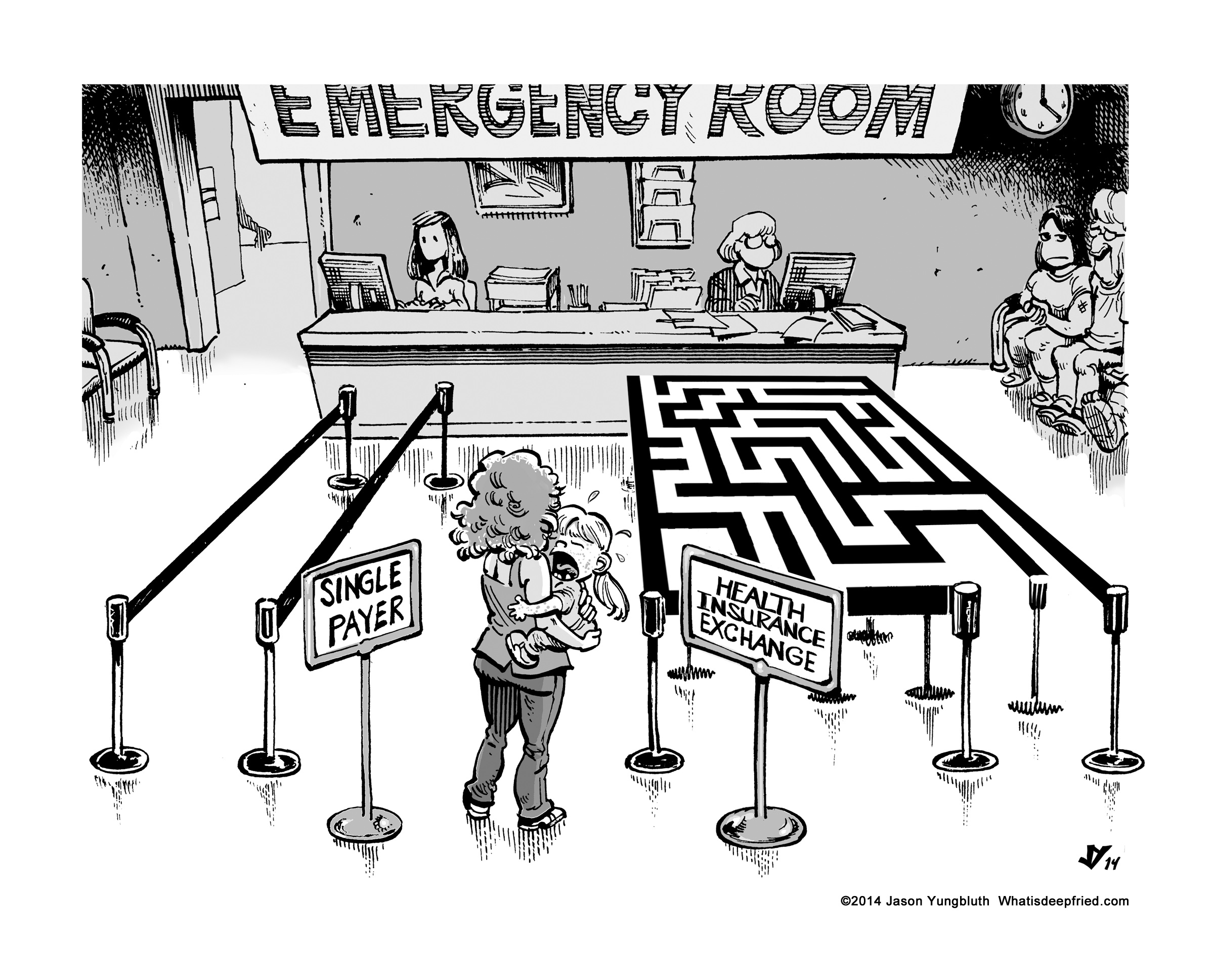
— He also needs to own up to other Administration failures and explain how things will be different next time around. Again, honesty and engagement are key.Maze_Finish

— He should present a convincing case that single-payer would be simpler than Obamacare, which was a cobbled-together compromise package. (Accompanying cartoon by Jason Yungbluth, provided to theVPO by the estimable Dr. Deb Richter.) 

— He should get strongly behind Dean Corren’s bid for Lieutenant Governort, including a lot of joint appearances. And he should urge the Democratic Party to do whatever it can to help Corren. A vote on single-payer in the Senate may well come down to a tiebreaking vote from the presiding officer. If you favor single-payer, do you want that vote cast by Phil Scott or Dean Corren?

— Turning, finally, from health care reform, the Governor needs to present ideas and show he has the energy to tackle other issues that are actually more pressing in the minds of voters: economic growth, school governance and taxation, and the general tax burden. 

— In gubernatorial debates, he needs to press Scott Milne (and Dan Feliciano, when he’s on hand) on the issues. He shouldn’t try to float above the fray, as if his opponents don’t matter. This is not so much for his own benefit, as for the cause of liberalism. He needs to remind people why they should vote for Democrats and Progressives. Too often, he has invoked conservative talking points to justify his moves to the center. He needs to cut that out. 

I think that covers it. I don’t want to see any prevent defense, and I don’t want even a hint of lofty entitlement. No taking the voters for granted. I want a strong, cogent, and relatable message that upholds the principles of modern liberalism and addresses the needs of Vermonters.

Phil Scott, passive aggressive master of specificity avoidance

VPR’s Peter Hirschfeld has produced a report on the race for Lieutenant Governor, which began with the existential question, If Dean Corren falls in the forest, would anybody hear? 

…does Corren think average Vermonters know who he is?

  “I don’t know,” Corren said Monday.

Gotta commend the honesty. Corren portrays himself as an issues candidate, while incumbent Phil Scott, the only Republican in statewide office, sees himself as both a facilitator and a roadblock: 

“There are a lot things in play right now that need to be addressed,” Scott said Monday. “And we need to be at the forefront in order to help move that forward, or stop them, one of the two.”

Phil Scott. Something for everyone. And no specifics for anyone. 

The meat of Hirschfeld’s report is about the looming Debate On Debates. Corren has called for at least ten debates. Scott isn’t committing to a number, but it’s not likely to hit double digits. 

“I certainly don’t believe that we need a dozen debates, but I do want to get enough opportunity for Vermonters to re-identify with me and show the differences between myself and my opponent,” Scott said.

Way to subtly exaggerate Corren’s position, you sly old shitweasel. 

We’ll soon find out whether Phil Scott has reason to fear the exposure of an active debate schedule. He and Corren will face off for the first time Friday morning at 9 on WDEV Radio’s Mark Johnson Show*. Should be a fun time. Corren can be a bit pedantic, but he’ll have the chance to put Scott’s feet to the fire, maybe force him to articulate an actual position or two, and test Scott’s ability to maintain an inoffensive image under direct assault.

*For those outside of WDEV’s impressive range, Mark’s show is live streamed on the station website. He also posts audio of selected shows in podcast form on his own website, and is virtually certain to post the debate. 

The limits of messaging

Just finished listening to a Reporter’s Roundtable on VPR*, with three of the better reporters around — VTDigger’s Anne Galloway, VPR’s Peter Hirschfeld, and the Freeploid’s Terri Hallenbeck– examining the entrails of last week’s primary election and the prospects for November. 

*Audio not yet available online, but it should appear here later today. 

Thin gruel, to be sure; the key races are essentially over, with the possible exception of Phil Scott vs. Dean Corren for Lieutenant Governor. But when the race for a mainly ceremonial position is your biggest source of intrigue, well, that tells you all you need to know. 

There was a lot of dancing around the fact that November is in the bag for the Democrats, with the noble exception of Galloway coming right out and saying that Governor Shumlin was going to win. The dancing is understandable, considering that (1) journalists want to appear objective, and (2) as political journalists, they’ve gotta cover this puppy for two more months, and what fun is it when there’s no intrigue? 

Much of the dancing centered on the idea that good “messaging” could carry a Republican candidate into a competitive position. The Dems aren’t invulnerable, the reasoning goes, it’s just that neither Scott Milne nor Dan Feliciano seems capable of delivering a solid, appealing message. 

That’s true, insofar as it goes. But there are three much more powerful factors operating against the Republicans: most voters pay little or no attention to messaging, the electorate is solidly center-left, and today’s Republican Party has little to offer on the key issues in Vermont. 

First, reporters and insiders overestimate the impact of tactics and strategy and messaging. The vast majority of voters have their minds made up before the campaigning starts. The only thing that could change their minds is some sort of shocking revelation or catastrophic event. Some voters do actually watch debates and bring an open mind to campaign coverage, but they only matter when an election is otherwise close. 

Second, it’s obvious from the results of the last decade or so that most voters prefer Democrats. The Legislature has been solidly Democratic for years. Among statewide Republicans, only Jim Douglas and Phil Scott have been able to buck the trend. Both have done so because of their unique personal appeal and by projecting an image of moderation and willingness to compromise. 

And third, Shumlin and the Dems are potentially vulnerable on issues like health care reform, the Department of Children and Families, the economy, taxation (especially school taxes), and the environment (Lake Champlain, the natural gas pipeline). 

On all those issues, the most appealing solutions involve more government, not less. Shumlin is more vulnerable to his left than to his right. 

In spite of Vermont Health Connect’s troubles, health care reform remains popular. Republicans have no answer aside from letting the market do its magic. Fixing DCF would require more resources, or at the very least more effective management. Have the Republicans given anyone reason to believe they care more than the Dems about poor people? Hell, no. Do the Republicans have a track record of good management? Only in the minds of Jim Douglas and Tom Pelham. 

Would the Republicans be better stewards of the environment than Dems? Ha ha. Can they plausibly portray themselves as defenders of public education, which remains extremely popular in Vermont? No; their only solutions are competition and union-busting. Can they convince voters that they’d preserve local control? Not if you could saw money by centralizing. 

On the economy, the Republicans have little to offer aside from the tired, discredited supply-side nonsense. Which took another bullet yesterday with the news (from the Federal Reserve Bank) that our post-Great Recession “recovery” has benefited the wealthy while middle- and working-class wealth has actually declined. One-percenters and corporations have a larger share of our wealth than ever, and all the Republicans can offer is policies that will further enrich the rich. 

And as for taxation, Vermonters may be dissatisfied with rising school taxes and worried about the cost of single-payer health care, but they also favor a robust government that can tackle problems effectively. Most voters don’t want a mindless “cut, cut, cut” approach, and that’s the standard Republican line. 

Here’s what a Republican would have to do, to be competitive on a statewide level: Bring an established reputation for effective governance, or at least an open-minded attitude toward the notion that government can actually solve problems. Express skepticism about political dogma, especially the cherished beliefs of the right. And do that without, somehow, losing too much support among the Republican base. And, finally, regain the support of the business community, which has largely abandoned the VTGOP in favor of a cooperative relationship with the Democrats. 

Now. If a Republican can identify and execute a strategy that accomplishes those things, s/he can win. Otherwise, no amount of good messaging will carry the day. It’s not impossible; there’s at least one potential Republican candidate who could manage it. But he ain’t running this year. 

Corren throws down the gauntlet

Dean Corren, now the Democratic and Progressive candidate for Lieutenant Governor, is challenging incumbent Republican Phil Scott to a lengthy series of debates — at least ten in all. His letter to Scott mentions that while “three or four have been scheduled or are in the works, we could easily do ten or 12…” And: 

As Aki Soga said in a recent Free Press editorial, “The candidates owe Vermonters a vigorous debate that makes clear how they will represent the people’s interest if they are elected to office.” 

With the gubernatorial campaign devolving into a one-sided laugher and the other three statewide offices effectively decided, the race for Lieutenant Governor is the only platform for a meaningful debate on the issues. Now that Corren has the Democratic nom as well as the Progressive, his challenge to Scott is a fully credible one. If Scott had managed to weasel out the Democratic spot, he could have portrayed Corren as a marginal figure. 

Of course, I don’t expect anything like ten debates. Scott will likely take the well-funded incumbent’s path: a minimal number of debates, to diminish the chance that he would commit a campaign-defining gaffe — or, more likely, that he would be forced to define himself politically for the first time in his career. Given a chance, Corren would have the opportunity to force Scott out of the bushes on health care reform, the environment*, campaign finance, taxation, human services, marijuana, and more. 

*Especially as Scott’s campaign has been lavishly funded by Vermont’s construction industry. 

Scott’s best chance for not only this year but his political future, is to maintain the benign good-guy image that has made him the only Republican with any appeal to the electorate. Which is why I think he’ll try to shorten the debate schedule. And he’ll probably get away with it.