
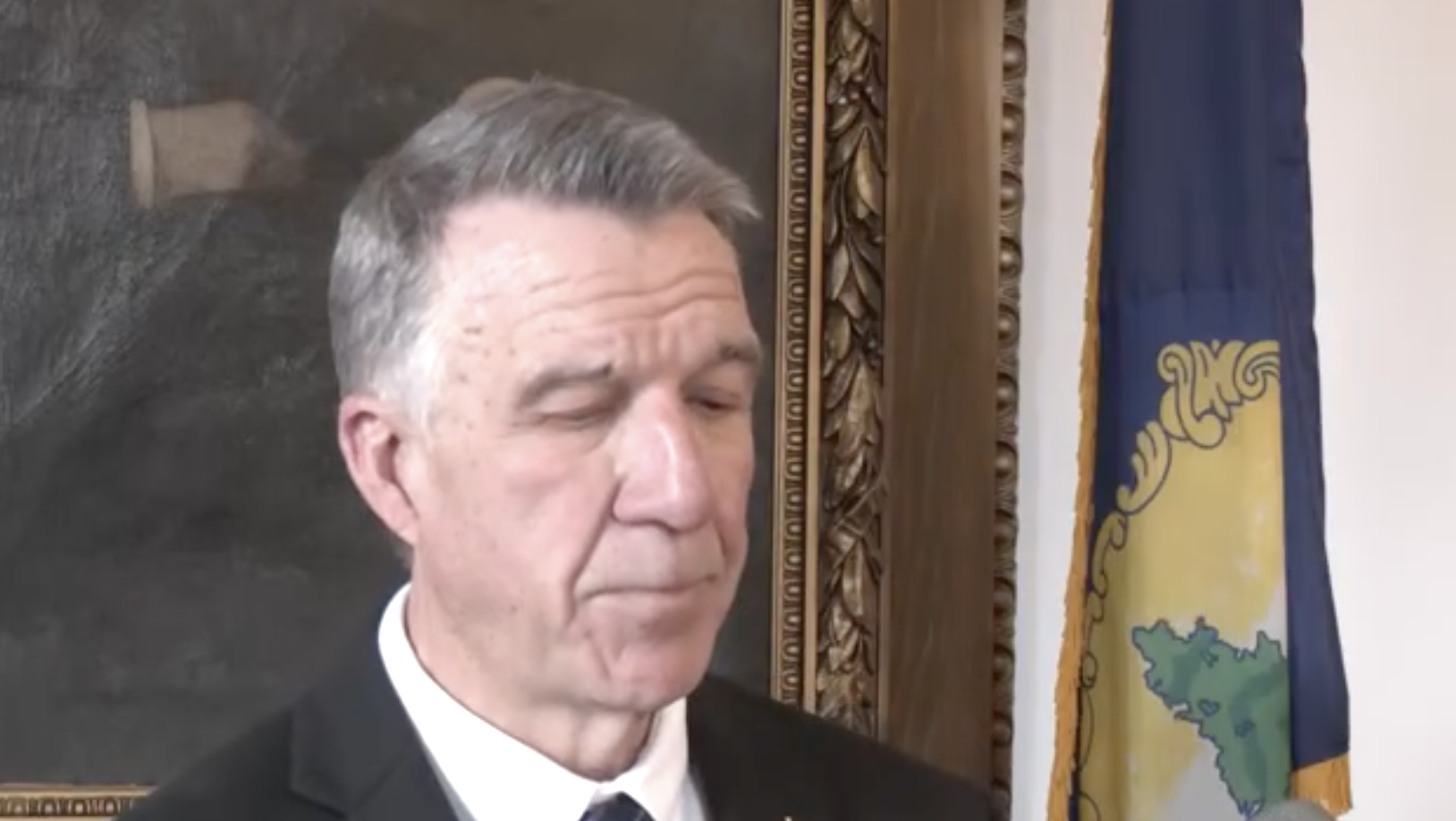
It’s been quite a while since I forced myself to endure one of Gov. Phil Scott’s weekly press conferences. I know, it ought to be appointment viewing for Your Political Observer, but I’m my own boss here and I feel free to follow my muse and limit the self-sacrifices. Every gubernatorial presser takes a couple nibbles out of my soul.
But after his angry, neo-Trumpian press release about this week’s Vermont Labor Relations Board decision, I felt like I had to see how he’d follow up in his weekly presser.
And boy, did he ever. It was a festival of self-pity and blamecasting. Nothing is his fault; every problem we face is because of the incompetent spendthrifts in the Democratic Legislature.
(After seeing this performance, I’ve upped the odds on whether he will seek another term; if the chances of him running were 95%, they’re now at 99. And it’s gonna be a nasty campaign, although swaddled in his famously avuncular style. He’s got such a collection of receipts to cash in, he’s gonna need at least one more election cycle to clear his cache. Hell, he might stick around out of sheer spite until we’re asked to re-elect Phil Scott’s Head in a Jar in the year 2050.)
It’s the governor as innocent bystander. Which is a real stretch, considering that he is by far the most powerful person in state government. He is the chief of an executive branch with thousands of employees. His appointees run every department and agency. The Legislature, by contrast, consists of everyday people who get paid a pittance and have little to no staff support.
Let’s count ’em, shall we? The leaders of the House and Senate have one full-time staffer apiece. Each chamber has a small central staff to handle operations and paperwork. Each committee has a single staffer. The entire Legislature has two small support operations: the Joint Fiscal Office and the Legislative Counsel. Compare that to the small army of administrators, bureaucrats and line workers at Scott’s beck and call.
He runs the joint. If he can’t find ways to work across the aisle, that’s on him. I realize it’s no fun to face Democratic majorities for nearly a decade. But it’s his job to find common ground with opposition lawmakers who, after all, have as much of a mandate as he does. He has failed to do so, and that’s why so many of our problems have gotten worse during his tenure.
The governor broke a bit of new ground at his presser, and not in a good way. In the past, he has felt free to criticize bills moving through the Legislature, but he has never predicted a veto until a bill lands on his desk. Not any more! When he was asked if he would veto the FY2027 budget as passed by the House, he simply said “Oh, yeah.” He did the same with the House Education Committee’s version of Act 73 implementation. No more fig leaves of neutrality for Governor Nice Guy.
One of the under-appreciated, or should I say under-criticized, aspects of Scott’s governorship is his push to enhance executive authority. He has made broad claims of executive privilege and voiced many a complaint about what he sees as legislative infringement on his power. Many of his record-shattering tsunami of vetoes are over such issues, which loom large in his imagination but seem picayune (if not downright wrongheaded) to many others.
His reaction to the VLRB decision is of a piece with this trend. Well, really, it’s an escalation. He clearly wants a Board that’s fully under his thumb and serves his interests. That’s not how the Board is described in state law, not at all. He’d like to see a complete overhaul of the VLRB so that it’s effectively a tool of the governor, but he knows the Legislature won’t go along with that so he’s not even going to try. He’s just going to complain. A lot.
The decision, for those just tuning in, overturned a Scott administration return-to-office order that forced all state workers to spend at least three days every week in their offices instead of working remotely. The Vermont State Employees Association argued that the order should be a matter for collective bargaining, and the Board agreed.
Scott didn’t simply disagree. In his press release he asserted that the “flawed, biased decision” showed that the VLRB itself was “broken, and a fair, unbiased process is impossible with the present Board makeup.”
Ahem. That’s the “present Board makeup” that includes four members appointed by Scott himself, plus one originally appointed by Peter Shumlin but reappointed by Scott himself. (The Board is supposed to have six members, but only five are listed on the VLRB website. Unfilled vacancy, I presume.)
Five out of five, with his fingerprints on ’em all. And he thinks “a fair, unbiased process is impossible” with a Board who all serve with his approval? Wow.
(Necessary detail: Board members are part-time, and each case is heard by three of the six. The three signatories to this decision were: David Boulanger, a former schoolteacher and expert on labor issues and the arbitration process, appointed by Scott in 2018 and reappointed by Scott in 2024; Gwenna Peters, a retired physical therapist and small business owner, appointed by Scott in 2025; and Michelle Phelps, who has spent most of her career as a human resources administrator for corporations, appointed by Scott in 2023. That’s your alleged Murderers’ Row of radical unionists.)
Also, it must be noted that Scott gets to name most of the members of the Labor Board Review Panel, the body that screens VLRB nominees and forwards a short list to the governor every time there’s a vacancy.
Now, if the Board that emerges from that process is fundamentally biased against the guy in charge of appointing the Board, then whose fault is that?
He offered further explanation, or should i say he dug the hole deeper, at his Thursday presser.
After a lengthy discussion of the budget, someone asked him about the VLRB decision. “Disappointing but not surprising, understanding the makeup of the Board,” he said. (Again, that’s the board entirely vetted, approved, and appointed by himself.) “I mean, it’s all weighted towards labor. It’s the Labor Relations Board.”
So he has a problem with the NAME? Is the concept of having a relationship with labor problematic in itself? Should we change it to the “Keeping the Grunts in Their Place Board?” Does Scott yearn for the Good Ole Days of indentured servitude? Make Vermont Medieval Again?
Scott then provided a lame reply to the whole “You appointed all those people” argument, which got a lot of play in coverage of his Wednesday press release.
I make some appointments, but there are some parameters, guardrails that don’t give us many choices.
Not sure what he means by “I make some appointments,” because the law clearly states that “The Governor shall appoint the members [of the VLRB] with the advice and consent of the Senate.” As in, ALL the members.
The process is more complicated than that, and there are some parameters and guardrails. But c’mon, if we have a VLRB that’s deeply tilted toward labor, Scott bears more responsibility for that than anybody else.
Besides, the law requires the Labor Board Review Panel to submit nominees with no rooting interest in labor issues. The Panel must gather from “both Vermont labor organizations and Vermont employer organizations… a list of nominees for each [vacant] position.” The Panel is to identify “nominees with neutral backgrounds,” meaning “individuals in high standing not connected with any labor organization or management position, and who can be reasonably considered to be able to serve as an impartial individual.”
Neutral. High standing. Not connected with any labor or management interest. Impartial.
I don’t see the problem here, governor.
Vermont Public’s Peter Hirschfeld asked a question that Scott or his minions should have been prepared to answer, but were not: “Is there a pattern with VLRB decisions? Are there others you disagree with?”
Scott’s legal counsel Jaye Pershing Johnson stepped to the mic. “It’s definitely part of a pattern,” she said, and then dropped the ball. “The only thing I can remember,” she said, happened “about seven years ago” when a Scott nominee to the VLRB was rejected by the Senate after some labor opposition.
Well now, that’s not a VLRB decision, is it?
And maybe Scott didn’t get his first choice that one time, but all that meant was he had to move on to his second choice. Who probably wasn’t, like, Ben Cohen or Jerry Greenfield, considering that he wields substantial sway over the nominating process.
In short, neither Johnson nor Scott could offer the slightest evidence for their claim of pro-labor bias in the VLRB.
The exchange closed with the governor expressing a desire for “a more balanced Board” but declining to propose any changes to state law. The law which, again, clearly requires Board members to be “neutral” and “impartial.”
But he didn’t get his own way on the return-to-office thing, and Heaven forbid he should admit he was wrong in imposing the return-to-office order. Instead, he casts himself in the role of betrayed innocent who has no control over a board appointed by himself through a process that favors his input over anyone else’s.
It may be the closest he has ever come to acting like Donald Trump, kicking his little feet in the air when he doesn’t get his way. Does it portend a more confrontational approach to dealing with Democratic majorities in The People’s House?
A more confrontational approach, that is, than the past approach that has produced a record number of vetoes — more than twice as many as any other governor in Vermont history?
Why yes, I believe it does. Which makes this a critical year for the Democrats to finally put up a fight against Scott’s bid for another term. He’s trending in a non-optimal direction.
 The Vermont Political Observer.