
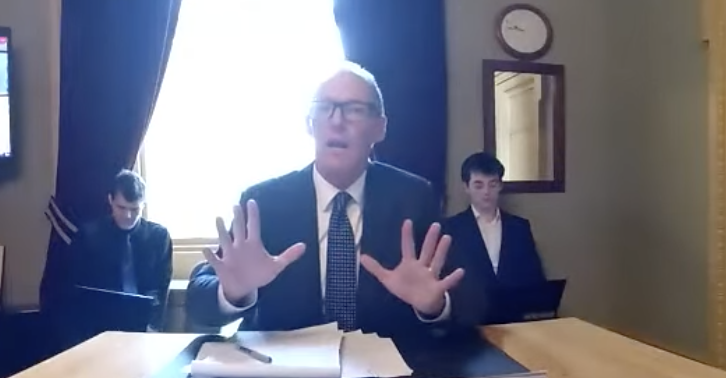
The state Senate Judiciary Committee pulled a rather Jesuitical maneuver on Thursday. It voted not to recommend the nomination of Michael Drescher to the Vermont Supreme Court, but not to oppose it either. The committee effectively punted the nomination to the full Senate, which is scheduled to debate the matter on Tuesday, February 3.
We’ll get back to the funny business in a moment. First, the background.
Drescher served as U.S. Attorney for Vermont under Donald Trump. In court he defended the notorious detentions of Rümeysa Öztürk and Mohsen Mahdawi, battles he eventually lost. In testimony before Judiciary, he explained that it was his duty to represent the federal government in such cases and his work didn’t necessarily reflect his own views.
That gets a little too close to Nuremberg territory for me. Just following orders, eh?
Now, it’s not that simple when it comes to officers of the court. Take the state attorney general; the office’s duties include representing the state. Our AGs often find themselves arguing positions they might personally disagree with. U.S. Attorneys are in the same boat.
Still. At a time when protesters are being gunned down on the streets of Minneapolis, it seems strange to be elevating someone who acted officially in support of Trump’s immigration crackdown.
The three Democrats on the committee were clearly swayed by a barrage of anti-Drescher feedback from constituents and felt the need to make a statement against his nomination. But in the end, they undercut their own stance by voting not to make a recommendation to the full Senate. In doing so, they likely paved the way for Drescher’s confirmation.
And I think that was the clear intent: Make space for performative opposition while still installing Drescher on the high court.
This parliamentary master stroke was the brainchild of that most Jesuitical of solons, Senate President Pro Tem Phil Baruth. After it became clear that three of the five committee members (the Democrats and a Progressive/Democrat) were ready to vote “No” on Drescher, Baruth floated the idea of sending the nomination to the floor without a recommendation.
“I think this is far too important to have one committee have the final word,” Baruth said, which made me bang my head on the desk a little. First of all, it wouldn’t have been the final word because the full Senate would have had its say no matter what the committee did. And second, the entire point of the committee system is to have a small number of lawmakers focus on a single area, presumably developing expertise in the subject and then giving the entire chamber the benefit of their insight.
Baruth further explained that “bringing things out with a negative recommendation is sometimes a subversion of the committee system.”
Huh what?
Seems a dubious bit of rhetorical gymnastics. Do such circumstances exist anywhere outside the mind of a person who doesn’t like a committee’s decision? How do you identify those “sometimes”?
Do senators not have the mental capacity and emotional capability of making their own decisions? If not, well, they shouldn’t be in the Senate. Or driving cars, for that matter.
After the committee voted 3-2 in favor of Baruth’s motion, there was a fair bit of discussion about what it really meant in practice and how it would be presented to the Senate. Which underscored the unusual nature of the motion — the senators themselves didn’t fully grasp it. Even after they approved it.
So okay, this thing is gonna go through the full Senate on the kind of procedural maneuvering that you often see from senior legislative bodies, which are more insulated from everyday life than junior chambers and more bound by tradition. Michael Drescher will be on the Supreme Court. We will have rewarded one of Trump’s willing instruments at the worst possible moment, but in terms of what happens on the Court, it’ll probably be fine.
It does make me wonder how our “moderate” Republican governor found himself nominating two people to the five-member Supreme Court who are both identified with Republican politics. Neither has been a partisan officeholder, but both served as U.S. Attorneys under a Republican President and Christina Nolan, whose nomination sailed through Senate Judiciary, did run for U.S. Senate as a Republican.
It’s the latest in a number of apparent, subtle rightward shifts by Phil Scott. I’ve heard from many people involved in government and advocacy that the Scott administration’s tone has harshened in the last year-plus.
There are a number of possible explanations for this, if it is indeed happening. Maybe he was emboldened by historic Republican gains in Vermont’s last election. Maybe he’s shifting to the right as his own party slams hard to the right, just to keep some connection to his own base. Maybe now that he has a larger cohort in the Legislature, many of whom are from the party’s conservative wing, he feels the need to accommodate them in some respects.
Maybe he’s always been more conservative than his public image, and he’s letting his freak flag fly a bit more freely. He is, after all, the guy whose political origin story cites a long-ago Act 250 entanglement that led him to shut down his motorcycle shop. He’s the guy who launched his first campaign for governor at the annual convention of the Associated General Contractors. He’s the guy who’s vetoed almost three times as many bills as any other Vermont governor. And he’s the guy who has no qualms about Drescher’s nomination, even after Trump’s immigration regime turned needlessly deadly.
Or maybe this is all in the eyes of beholders who are largely sick to death of beholding Phil Scott in the corner office. Either way, one small part of Scott’s legacy is the installation of a Trump instrument on Vermont’s highest court. Hope that works out okay.
Note: This post was written with the use of a new tool for keeping up with the Legislature: GoldenDomeVT.com, which provides AI-generated transcripts of legislative hearings and seamless access to select passages of hearing videos (which allows you to check the accuracy of a transcript). It’s a very useful thing, a hell of a lot easier than reviewing hours of often-tedious hearings. Recommended.
 The Vermont Political Observer.
A day after suggesting VTDigger needed to increase/improve it’s Statehouse coverage, you write this blog post built upon their Statehouse reporting — the only story from the major outlets to cover this Drescher vote. Seems noteworthy.
I don’t see a contradiction there. Digger is the leading voice in Statehouse coverage because so many other outlets have retreated from the beat, but there is far more Digger could be doing.
Any advice on who to call to influence the outcome?
Communications are most impactful from within a lawmaker’s district, so that’s step one. Drescher’s nomination is going to need at least two Democratic votes to pass; centrist Dem senators are the most likely to back Drescher. Spitballing the prospects, I’d say the two Bennington Dems (Bongartz and Plunkett) would be atop the list, followed by Thomas Chittenden from Chittenden-Southeast (district not named for him) and maybe Wendy Harrison from Windham. But if you’re represented in the Senate by any Democrat, it’d be a good idea to contact them before the Tuesday vote. The Dems who voted “No” in Judiciary were clearly moved by the volume of constituents opposed to Drescher.