
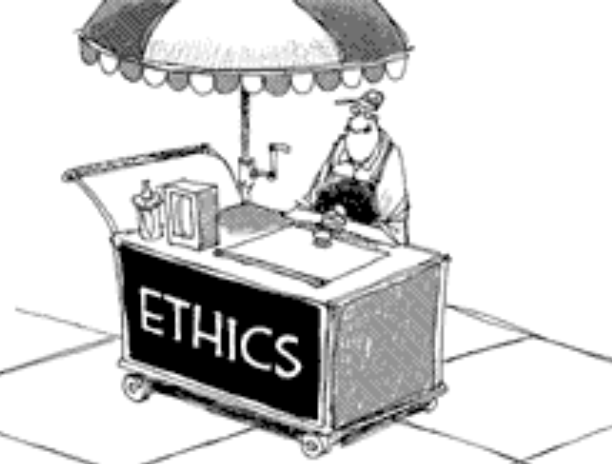
Hey, look: Somebody filed an ethics complaint against two state senators!
We wouldn’t know this, of course, except that the complainant announced the action in a press release. You’d never hear anything about it from official sources, because the Senate’s ethics process is a black hole from which no light can ever escape. Likewise the House’s process, but that’s another story.
The complaint was filed by Geo Honigford of Friends of Vermont Public Education. The targets, familiar to devotees of this here blog, are Sens. Seth Bongartz and Scott Beck. Honigford points out that both men have strong affiliations with private schools receiving public tuition dollars, and both lobbied aggressively for the interests of those schools in recent negotiations over public education reform.
I suppose you could think of Senate President Pro Tem Phil Baruth as an unnamed co-conspirator, since it was Senate leadership that chose to install Bongartz and Beck on the House-Senate conference committee on education reform. Or maybe his right hand, Senate Majority Leader Kesha Ram Hinsdale, could be included as well. She must have had a role in choosing two pro-private school senators to the committee.
Oh wait, Ram Hinsdale is chair of the Senate Ethics Panel, which will consider Honigford’s complaint. Right, right, probably best to leave her name out of it.
It’ll be simple for Ram Hinsdale to stuff a pillow over this complaint until it gives up the ghost, because the Senate Ethics Panel is not answerable to anybody outside of the Senate itself.
Stop snickering, I mean it.
The panel receives complaints. It doesn’t release any information about the complaints; it doesn’t even publicly acknowledge receiving complaints. Its meetings are behind closed doors. The only information about its deliberations is in a brief report filed at the end of each biennium, which does not identify complainants or the accused or offer any information about what they’re accused of doing.
The report for 2023-2024 (downloadable here) is three paragraphs long. It lists seven complaints received. One was referred to the Senate Sexual Harassment Panel, so we can infer that it had something to do with sexual harassment. Four “were dismissed and closed” by the Panel because “there was not probable cause” to proceed. Two were received last October and were “kept open for possible further consideration” as of December 31, 2024.
That’s it. That’s all we know. Honigford’s complaint will be reduced to an equally vague sentence in the Ethics Panel’s next report, due on December 31, 2026.
And the next thing Honigford can expect to hear is… nothing. Well, nothing about the proceeding itself. I know from personal experience; I was, to the best of my knowledge, the first person to file an ethics complaint against a legislator, and I didn’t hear boo from the House Ethics Panel until it had completed its consideration, which apparently consisted of a private meeting with the target of my complaint. I was not notified of the meeting or given the opportunity to testify or present evidence beyond my complaint. The only thing I got was a letter after the fact, informing me that the matter had been closed.
I suspect that Honigford harbors no illusions that his complaint will get anywhere. That’s why he issued his press release — to get the matter before the public eye. And he got what he wanted: both Vermont Public and VTDigger posted stories about the complaint.
The House and Senate panels have very high bars for ethical violations. You can’t be guilty of an ethical breach if you introduce or advocate for a bill that serves your interests, unless you uniquely benefit from passage of a bill. Say, for instance, you’re a lawmaker who’s also a political blogger. You’d be in the clear if you introduced a bill that exempted bloggers’ income from state taxes, or gave them a generous property tax exemption for home office space, unless the bill were written in such a way that you were the only one who benefited, or benefited to a unique and demonstrable degree.
As far as can be told, neither Bongartz nor Beck would gain any direct fiduciary benefit from H.454. That’s not true for the institutions they have served long and well; those institutions will benefit significantly if H.454 goes into effect.
But according to the Legislature’s own standards, that’s not an ethical violation. I expect Honigford’s complaint will wind up as a statistic in the Senate Ethics Panel’s enumeration of complaints “dismissed and closed by the Panel.” But at least Honigford will have brought the issues surrounding Bongartz and Beck’s activity into the light, and that’s a worthwhile outcome in itself. And the most we can hope for, given the Legislature’s attitude toward its own ethics.
 The Vermont Political Observer.
But at least Honigford will have brought the issues surrounding Bongartz and Beck’s activity into the light,
Hopefully, it will go to more publications.
I was reading this article out loud to my husband. And he had started to snicker just as I got to “Stop snickering.” Well done!
Sens. Seth Bongartz and Scott Beck are representing their constituents, period. The “changes” to the bill that they initiated simply kept things at status quo for St. J Academy, Lyndon Institute, and Burr and Burton, preventing their communities from the devastating impact that the unaltered bill would have wrought.
Perhaps someone should FOIA complaints filed… I suspect Geo wasn’t the only one and that more will be filed now that the damn has broken. Here’s the link for anyone who wants to give the ethics committees more to think about.
https://ethicscommission.vermont.gov/file-complaint
Please excuse the obvious Freudian slip typo. Should be dam not damn.