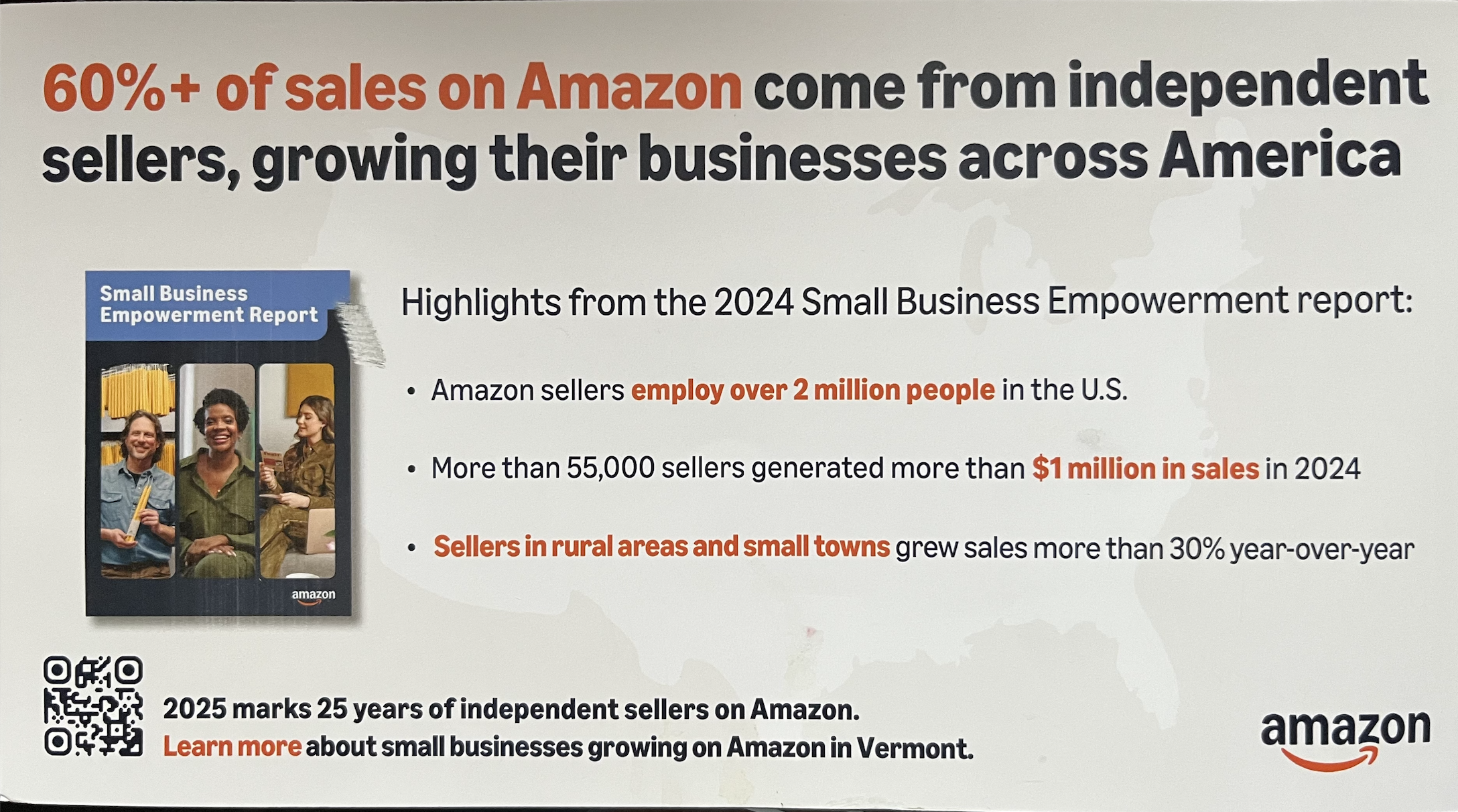
So, this landed in my mailbox last week.
It’s an extremely transparent attempt by the world’s biggest corporation to try to make itself seem all Vermonty: Cozy, human-scaled, not at all the most voracious shark in the ocean. Problem is, the flannel shirt still has a sales tag on the collar and the jeans and work boots are unsullied by exposure to dirt, mud, or physical labor.
I have to assume this is a PR blitz related to the ongoing controversy in Essex, where Amazon wants to build a 107,000-square-foot distribution facility in an industrial park, a proposal that has outraged many area residents. Now, I live nowhere near Essex, so I don’t know why Amazon is trying to convince me that its purpose in life is enabling human-scale entrepreneurship. Probably the difference between a mass mailing to Essex and a mailing to the entire state of Vermont is mere pocket change for Jeff Bezos. (I’m imagining him cackling softly and caressing a snow-white cat while approving this piece of corporate greenwashing.)
Do I have to critique this thing? Well, I guess I do. I am the one writing about it, after all.
Let’s start with the footnote-free reference to “the 2024 Small Business Empowerment Report.” I’m sure you will be as shocked as I, which is to say not at all, to learn that this report was paid for and promulgated by, ta-daa, Amazon itself.
The report boasts that since 2000, when Amazon “opened its doors to independent sellers,” it has generated $2.5 trillion in sales for “independent sellers.”
Notice the pivot there from “small business” to “independent sellers.” The latter can be of any size. The definition relies entirely on a lack of direct affiliation with Amazon itself. Its report claims that “most” of those independent sellers “are small and medium-sized businesses.” I don’t doubt that that’s true, but if you ranked Amazon’s “partners” by total sales instead of counting each as a single unit, I’m sure you’d find that “most” of that $2.5 trillion in sales went to the largest “independent sellers.”
That phrase “opened its doors” is also doing a lot of heavy lifting. It implies that this was an altruistic maneuver by Amazon — allowing others to access its platform regardless of corporate advantage or profit. In truth, this door-opening allowed Amazon to dramatically expand its stranglehold on retail markets. It could serve as the middleman, passing through products produced or bought by others — and taking a big cut of the proceeds.
But the real advantage gained by this move is Amazon’s sheer marketplace dominance. In 2023, it accounted for 37.6% of the U.S. e-commerce market. The next nine corporations on that list, which include such behemoths as Walmart, Apple, eBay, Target, and The Home Depot, combine for a mere 22.4% of the market. Amazon is almost twice as big as its next seven e-commerce competitors combined. It couldn’t have done that if it had stuck to its old business model.
Oh, and look here: Last fall, Amazon made a major change in its agreements with those independent sellers. Those precious small and medium-sized outlets can no longer sell their products to Amazon and let Amazon take care of sales and marketing — and assume the potential risk of unsold inventory. Those little guys can still sell through Amazon, but they have to manage inventory and marketing themselves. Amazon is offloading risk onto producers and retailers who are far less capable of weathering uncertainty.
So yeah, “most” of Amazon’s “independent sellers” are small to medium-sized. But the relationship is closer to master/slave than mutually beneficial. Those independent sellers don’t have any choice but to market through Amazon and be grateful for whatever scraps fall from the big table.
I mean, you can go ahead and try to make it on your own, but that will involve creating your own retail partners and distribution channels. And competing directly with Amazon itself.
I think we’ve established that Amazon’s cosplay isn’t fooling anyone. At least it’s not fooling anyone who sees Amazon as fundamentally evil and would rather not have a relationship of any kind with Bezos’ brainchild, whether it be as a consumer or as a neighbor.
The thing is, if you believe the latest story from the Essex Reporter, public opinion may make no difference at all in whether Amazon’s plan goes through. The town’s Development Review Board will make its decision on technical grounds, not philosophical:
In essence, the Essex DRB has made clear to the public its legal function is solely to approve any applicant that complies with the town’s zoning regulations and site plan review criteria — not to vet applicants through any moral, ethical, political or values-based standards.
“Comments that don’t pertain to site plan review criteria may not be considered by the DRB,” said Chair Ian Carroll [at a recent public forum]. “Comments regarding business practices, economic impacts, employee policies, or how business competes with other businesses are not relevant to the review of this site plan application.”
After a lengthy chronicle of public opposition, which has been virtually unanimous at public forums on the Amazon plan, the Reporter story said “the board carried on as if [the] build for the Amazon facility were any other proposal made by any other developer or company.”
Which it kind of is. The site of the proposed megawarehouse is forested land on an industrial park that is “zoned specifically for development.” And really, if the DRB made a decision based on “moral, ethical, political or values-based standards,” it would probably be staring down the barrel of a lawsuit that it would probably lose.
Planning and zoning are among the many “boring” parts of local governance. Well, most people think everything about local governance is boring. Problem is, once your planning and zoning is in place, you can’t turn down a specific proposal just because you don’t like the potential occupant. If the good people of Essex had wanted to prevent the Amazon facility, they could have pressed for more restrictive zoning. Or more housing-friendly and less industrial zoning.
I do my best to avoid shopping Amazon. I’d prefer that Amazon keep its distance from our B.L.S. But if Amazon chooses to go ahead with this plan, I doubt the public opposition will have any effect at all. Which makes this mailer seem all the more like a waste of money. And paper.
 The Vermont Political Observer.
“If the good people of Essex had wanted to prevent the Amazon facility, they could have pressed for more restrictive zoning.”
Are you kidding me?
We did press! Even as PC member in 2023 was a present South Burlington’s Environmental Protection Zoning LR-12 recommend be implemented immediately into our zoning regulations!
It’s the make up of the then PC and Select Board that pushed for RPDi to become industrial in a qualified not strictly industrial zone within the 40% designation. It is qualified because in our zoning regulations.
” The objective of the Resource Preservation District-industrial and related O1 District parcel is: to protect such natural attributes for public enjoyment and to carry out development activities in harmony with the natural surroundings.”
Our built environment determines how we live; the quality of our life! The roads we walk and bike on, on our Town road!
Our leadership chooses to ignore and try to get away with making our Town vote of Town Plan illegitimate!
It’s our Town, Not the DRB’s!
Stop disregarding the residents who expect better and fair treatment. It’s not Amazon per se, it’s changing the area to industrial and doubling up on our Town Highway as your industrial access!
Patty Davis