
At the end of my previous post, I looked ahead to Gov. Phil Scott’s inaugural address (which I mistakenly dubbed “State of the State,” sorry) with these words: “We’ll see how much actual ‘coming to the table’ he does, and how much kicking the Legislature he indulges in.”
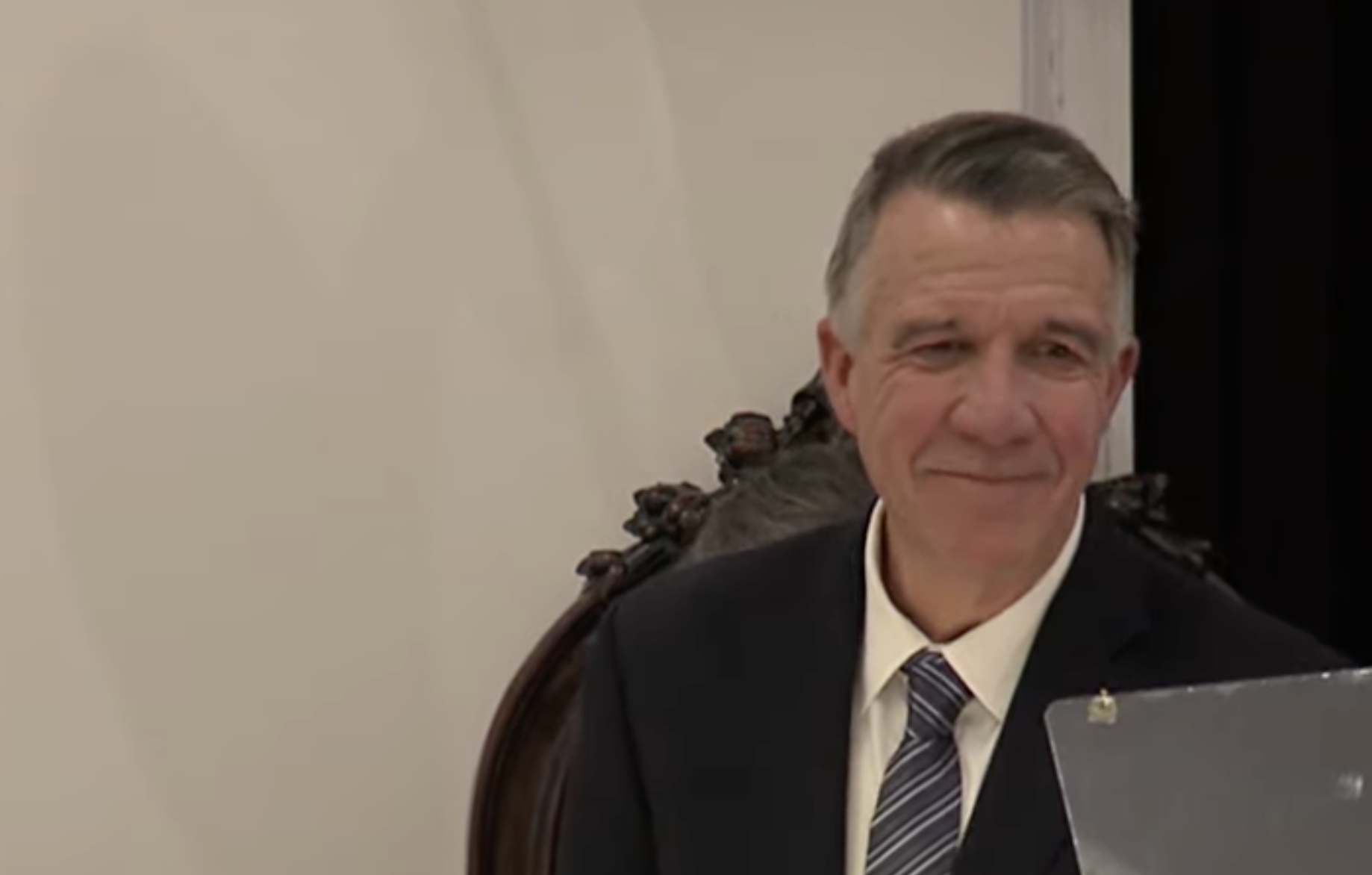
And now we know. The governor was sworn in and delivered his speech on Thursday afternoon. There was some definite kicking, to be sure. There was also a broad outline of an agenda that emphasized his usual talking points. But the final section of the speech was pure uplift. After ticking off the challenges we face, Scott listed some positive accomplishments not directly tied to anything partisan.
The first one, in fact, was a barely concealed slap at his fellow Republican, Donald Trump. “We’ve received over 1,000 refugees in the last three years and will continue,” Scott said, prompting one of two standing ovations that brought the entire chamber to its feet. (“Entire” as best I could tell watching the livestream, that is.)
His point was that Vermonters can tackle challenges and get hard things done. I may not completely share that optimism, but it was a positive, collaborative message.
At least for today it was. Scott’s budget address two weeks from now will contain the details of his 2025 agenda, and you know where the devil is.
The speech broke down into three sections. The partisan sniping was largely confined to the first, in which he spoke of two Vermonts without actually employing that hackneyed phrase. On the one hand, Chittenden and Franklin counties, with their strong economies and general prosperity. On the other, the rest of Vermont, struggling to keep pace and failing under a burden of high taxes and excessive regulation. He called them “the left behind communities,” without meaning to invoke the infamous series of Evangelical apocalypse porn.
He then manufactured himself a legislative majority out of thin air by noting that most lawmakers in both chambers represent the L.B.C.’s, and if they only voted in their communities’ best interests, they’d enact his agenda toot suite. This ignores the fact that many of those L.B.C.’s chose to send Democrats to Montpelier, presumably because they believe Democratic policies would be better for them and their neighbors.
Then came the most partisan moment of the speech, as Scott asserted that Vermont had gone down the wrong path and was lost in the woods — laying the blame specifically and entirely at the feet of the Dem/Prog supermajorities of the 2023-24 biennium.
After that, the bloody-shirt-waving was kept to a minimum. In the second section of the address, he emphasized two issues: Housing and the public education system. He wants (among other things) a housing bill that makes further changes to Act 250 in more places, and an expansion of Doug Hoffer’s favorite punching bag, the Tax Increment Financing program.
On education, he spoke of two major areas in need of change: Major reforms in managing a regime that’s too big, expensive, and overbuilt for our current student population, and a brand-new school funding system. He did not provide any details or even hints; those, he said, would come in his budget address. He also mentioned several other issues in passing, including health care, public safety, and climate change without going any deeper than that.
“None of this will be easy,” he said, but urged lawmakers to “be bold.”
Boldness is something he frequently talks about but rarely does. He has seldom risked his vast reserve of political capital in order to take on big issues. And if he is bold, will he be willing to accept compromises with the Legislature which, in spite of his whole-cloth majority claim, remains pretty strongly Democratic?
Then came the spoonful of sugar to make the medicine go down, the aforementioned list of positive accomplishments proving that Vermonters are willing to work together to help their neighbors and get hard stuff done. It was only rhetoric, but it was pretty inspiring stuff — especially if you graded it on the Phil Scott curve, where inspiration is fairly uncommon. But it was a good start.
Things are likely to get rockier when his full agenda comes down two weeks hence. Today was the easy part. The rubber has yet to meet the road.
 The Vermont Political Observer.