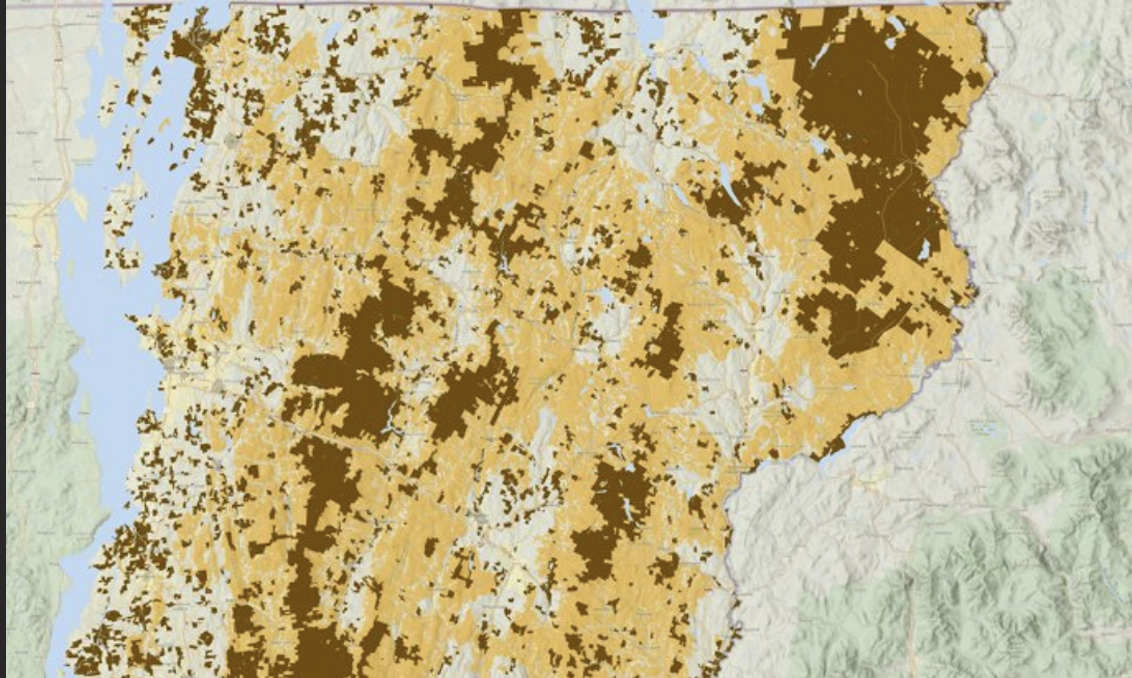
What you see above is a portion of Gov. Phil Scott’s latest masterstroke: A map of Vermont showing all the land that would get enhanced protections under H.687, the housing/Act 250 reform bill he vetoed last week. He thinks the map proves his point, that the bill goes way too far on conservation and not nearly far enough on encouraging development. Just look at all those yellow and brown areas! The Legislature is out of control!
However… I do not think his map means what he thinks it means.
This map reminds me of the Republican electoral maps showing who won each county. They show that the vast majority of the country’s physical space voted Republican, and help fuel stolen-election conspiracy theories. Truth is, Republicans win the big empty parts of the country while Democratic strength is mainly in population centers. And since our system involves one person, one vote — not one acre, one vote — well, the map is deeply misleading and proves nothing.
Same with Phil Scott’s H.687 map. It proves nothing.
Those yellow and brown areas are all places where there’s either no development or precious little. They include national forests, mountain ranges, bodies of water, and a whole lot of forest. Roughly 78% of Vermont’s land is covered in forest. How much of that do you want to clearcut?
And most of the yellow and brown is unsuitable, even from a cold-hearted developer’s point of view. They aren’t going to build condos or suburban tract homes in the middle of nowhere, even if Phil-style regulations allowed it. They have to build where people will want to live. Which is probably why developers were part of the broad consensus that produced H.687. Perhaps they’re willing to trade an easier path to development in desirable areas for a tougher burden elsewhere. And why wouldn’t they?
Scott put out this map on Friday afternoon when most people have their sights firmly set on the weekend, and did so on X/Twitter, which is a medium that most #vtpoli types have abandoned since Elon decided to light the platform and his $44 billion investment on fire.
It was also the last business day before the Legislature’s veto override session. Kind of late in the game to be tossing out a new proposal via social media. The process that led to H.687 has been going on for more than a year. The Legislature has been wrangling with the bill for months. And now he wants them to suddenly take up a new proposal? No chance.
Which means that, as with his clown act around the Yield Bill, this is nothing but political theater. He’s putting out a proposal destined for the trash bin entirely so he can claim he tried to make a deal. He’d rather campaign on the issue than try to solve it.
Well, either that or he and his people are just too lazy to engage throughout the process. Sounds like hard, messy work. Easier to sit back on the fifth floor and throw stones at the Statehouse.
 The Vermont Political Observer.
Trump had stupid sharpie tricks, Scott has stupid map tricks, guess which political party they both belong to…
Speaking as a resident smack dab in the middle of that big brown blotchy spot in the upper right hand corner, it’s kind of comical how you’ve spun this. Contrary to your opinion, that area isn’t “empty.” People actually live here. From what, do you suppose, this bill provides us “protection?”
We would love to have development that enables us and our neighbors to come close to the income levels you enjoy in the more populated areas. No, we don’t want to be overrun with the kind of development now blighting the Route 7/I’89 corridors. And you yourself concede that the vast majority of this land is unsuitable and undesirable by developers, so what is the rationale for legislation that further inhibits any development in an area that hasn’t been able to get any? Is this what is necessary to appease those paranoid about any tweaking to Act 250 that tries to address the homeless crisis?
Pardon us for looking at this bill with a different spin. We in the Kingdom see the unintended (?) consequence that keeps us economically disadvantaged. This bill seriously impacts any growth or improvements in our region. In exchange it creates what appears to be a state-mandated nature preserve, even though there exists no threat by developers to damage what currently exists. From this neck of the (literal) woods one might be forgiven for opposing such polarizing legislation.
I am not familiar with H687 but the hoarding of rural housing opportunities by the wealthy needs to be examined.
My town, Jericho, practices de facto segregation by income. State intervention is needed.
A single family home up to 60,000 sq/ft is a permitted use in 99% of Jericho. That’s bigger than a Hannafords.
But a small triplex of say 1,500 sq/ft is a permitted use in only 14% of Jericho.
More than two-thirds of Jericho is reserved for people who can afford 10 acres of Chittenden County land. The town wants to corral people with modest incomes in a few small areas and limit the rest of town to mini-estates of ten acres or more. Our Selectboard Chair claims banning triplexes in most of Jericho is consistent with state policy.
Jericho has further restrictions where the town most expects housing for people with modest incomes – like a ban on plastic flowers in front yards, a ban on play equipment in front yards (except for porch swings) and more. The Selectboard has no rules like this where the town expects higher income people to live.
In addition to Town sanctioned segregation, private Homeowners Associations bring additional restrictions to entire neighborhoods. Some require all homes be over 2,000 sq/ft and they frequently ban mother-in-law apartments and duplexes. Jericho recently approved a development with all three restrictions. Agreeing to neighborhood housing restrictions is frequently the price of homeownership in Jericho.
We need opportunities for housing clusters in more areas. If this is what Governor Scott intends than good on him.
Although he does sound late to the debate.
Your observations kind support for Joe Benning’s comments, above.
Interesting to me how Chittenden County manages to claim the mantel of Progressive representation at the same time it moves ever closer by default to the suburban glut and traffic congestion of, say, Monmouth County, NJ, population 643,615.