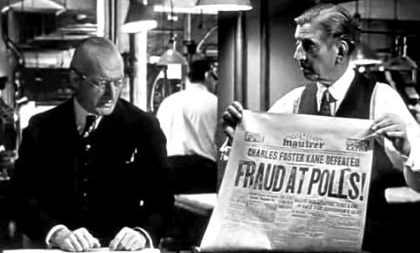

A sad but inevitable day for the dwindling cadre of Burlington Free Press readers, whoever they are. The “newspaper,” if that is indeed the proper term by now, has announced that as of April 1 (no foolin’), it will no longer deliver paper editions to subscribers’ homes, instead depending on the tender mercies of Louis DeJoy’s US Postal Service to get the papers to your doorstep mailbox within probably mere days of publication.
(As a subscriber to a paper that went to mail delivery a few years ago, I can tell you that this is a road to newspaper irrelevance. We hardly ever get the Times Argus on the day of printing. There’s often a gap of two or three — or four or six or more — days between publication and delivery.)
The announcement of the change, penned by the Freeps’ Dinosaur-in-Chief Aki Soga, contained a goodly quantity of desperate word salad meant to obscure the harsh reality of the business and make this seem like a good thing.
The reality is this: Free Press readership is cratering. I doubt that there are enough print subscribers to justify anyone’s time covering ever-longer delivery routes with ever-fewer paying customers.
I hadn’t realized how bad the carnage was until I read Seven Days’ writeup, which includes some extinction-level statistics:
As of September, the paper’s average weekday print circulation was just 3,705 — down 27 percent from the 5,084 it reported in March 2023, according to the Alliance for Audited Media. Over the same time period, Sunday circulation fell from 6,681 to 4,601 — a drop of nearly one-third.
That’s “a drop of nearly one-third” in only six months’ time. Ouch. Double ouch with nuts.
Triple ouch with nuts, sprinkles and a cherry on top: Go back to the golden days of 1991, and the Free Press‘ weekday circulation was a brisk 54,636. By 2012 it had dropped to 31,095 weekdays and 40,708 Sundays. It has now dropped nearly tenfold in less than 12 years, and if there’s a bottom in this well I can’t see any sign of it.
Soga’s explanation for the change hews to the company line that every cut made by corporate parent Gannett is aimed at improving service to readers. The above screenshot, taken from today’s emailed “Daily Briefing,” displays the careful curation that can only come from a staff of [checks notes] 10 reporters and three editors (as of two years ago, and who knows how far it’s fallen since then), which is how you get a top headline from a respected journalistic institution promising information about “own Meeting Day.”
See, they had to cut the “T” to save money. Or enhance reader engagement, take your pick.
Now let’s take a few moments to dissect Soga’s latest hostage video announcement to readers.
He begins by asserting that the change is meant to “optimize resources amidst increasing digital readership demand,” which is corporate-speak for “Nobody buys the paper anymore.” Readers have “made digital products the first choice for breaking news,” in no small part because the Free Press’ own coverage is largely lacking in actual news. I mean, recent emissions of “Daily Briefing” have leaned heavily on high school sports and an evergreen preview of St. Patrick’s Day events. There’s barely any news to be seen.
This is no knock on the efforts of its staff. I’m sure they are working their asses off to fill the “news hole” with fewer and fewer resources.
So, what’s the print paper for anyway? It’s “a place readers can dive into local news with more impact and context,” which is a fancy way of saying “They can read at their leisure about stuff that happened days ago.” Or, from my own experience with the oft-belated Times Argus, they can briefly scan the front page and then deploy the paper on a tour of duty in the bird cage.
Soga’s article then, weirdly, quotes Soga himself claiming that the Free Press “remains an integral part of the community,” which is a stretch worthy of Rose Mary Woods, and positioning mail delivery as “one more step to ensure we continue to deliver the news.” In context, this reads more like a threat then a promise.
We then get a choice quote from corporate HQ in the person of Michael Anastazi, “VP of Local News for Gannett,” who executes a Tony Hawk-worthy rhetorical trick that disguises his admission that he works in a dying industry:
“We know that by the time our informed readers pick up the paper, they know what happened yesterday – the print newspaper should provide additional context, to help readers better understand their community and the world around them.”
Which would be nice if it was true. But print papers keeps getting thinner and thinner, their pages filled out with predigested stories from the Gannett content farm, run-of-the-mill wire service copy, and feature content. Such as a helpful rundown of St. Patrick’s Day events which, if that’s what I wanted, Seven Days would be my first and last resource.
I kind of wish Gannett would just dry up and blow away. It is occupying a lot of potentially useful real estate in the news business, and occupying it to no productive purpose. It’s just sucking every last dollar out of its properties with no apparent plan to regain relevance, let alone prosperity. If our dying “newspapers” weren’t owned by big corporations or hedge funds, there would be new opportunities for the reinvention of journalism. In the meantime, the Free Press will take another voluntary step toward oblivion when it no longer promises to get readers the paper on the day of publication.
The end of home delivery strikes a nostalgic chord in this longtime newspaper reader, whose first brush with entrepreneurialism was a paper route for the Detroit News that was about as cushy a position as a preteen could wish for. The News was an afternoon daily, so I didn’t have to get up at the crack of dawn to deliver the rival Detroit Free Press. Not only that, but my route consisted of a bunch of apartment buildings directly across the street from my home. I literally traveled farther (two blocks, ahem) to get the papers from the dropoff point than I did to cover my entire route.
Ah, the good old days. They ain’t coming back. We knew that already, but the Free Press pounding yet another nail in its own coffin makes it crystal clear.
 The Vermont Political Observer.