

The Legislature’s Joint Fiscal Committee tried something different today. It didn’t really go that well.
The committee called a hearing that was kinda meant to embarrass the Scott administration over its utterly inadequate response to our crises of homelessness and affordable. Well, it was cast as part of the JFC’s responsibility to track the progress being made (or not) under Act 81, the Legislature’s last-minute extension of the General Assistance housing program approved in June 2023. But the intent was to put administration officials under a bright light and watch them squirm.
Problem was, said officials (including Miranda Gray of the Department of Children and Families and Agency of Human Services Deputy Secretary Todd Daloz, pictured above) came prepared with reams and reams of jargon. They filibustered the hearing. It wasn’t 100% successful, but it limited the committee’s capacity to ask questions. It also had the truly unfortunate effect of almost completely sidelining input from providers of shelter and services to the unhoused. On the agenda, the administration was allotted 45 minutes of the 90-minute hearing and three provider witnesses got a combined 30 minutes. In actual fact, the administration occupied an hour and fifteen minutes, while provider testimony was crammed into the final 10 minutes of the affair.
There were still some embarrassing moments for the administration and some good information from the providers. The hearing wasn’t a bust, but it was far less effective than it could have been.
Administration officials unfurled a lengthy presentation about all the work that’s been undertaken, which Daloz termed an “all hands on deck” effort: “team-based approach,” “cross-departmental coordination,” “engage individuals and communities,” stuff like that. All aiming toward the goal of, not helping vulnerable Vermonters, but the nice, sterile, bureaucratic “unit generation.”
Oh, they’re big on “unit generation.” They’re also big on graphs and charts, like this one:
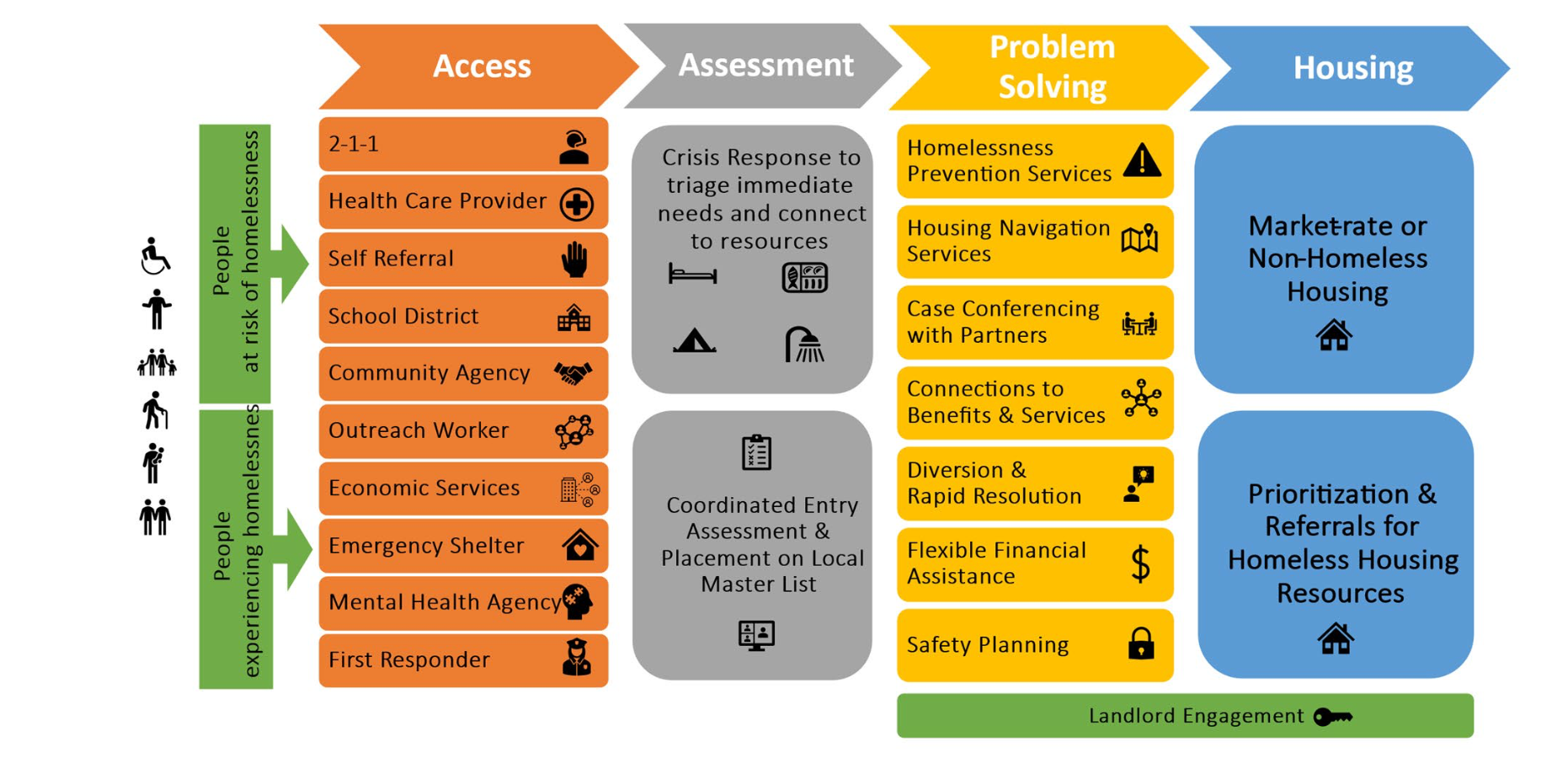
Ummm, okay.
The thickets of management-speak couldn’t completely obscure the truth: The administration has failed to act on any scale that might possibly meet the need.
Finally, after far too much of this, House Ways & Means Committee chair Rep. Emilie Kornheiser interrupted. “I hear a lot of process,” she said. “Can you demonstrate any results?”
They could demonstrate some results, bot not nearly enough. The administration’s monthly update on the GA Housing program, mandated by the Legislature, was another installment in a sad failure to make significant progress. The so-called “June cohort,” those who were in the program when it was extended by Act 81, numbered roughly 1,260 households last July 1. (That didn’t include hundreds who’d been exited from the program before its last-minute extension.) Of those households, over 500 are still in state-paid motel rooms. More than 700, Daloz said, had left the program, “many” to other kinds of housing. The nonspecific “many” obscured the fact that the administration simply doesn’t know where most of those people went. They exited to parts unknown.
However, there are another 984 households enrolled in other emergency housing programs, mainly under the adverse weather program. Many of them are also in motels, and are set to lose their housing sometime in the next several weeks and possibly as soon as the end of this week.
The administration’s own figures list a total of 1,701 households in emergency housing. That would put the estimated number of Vermonters whose shelter is on the line at somewhere around 2,200.
The Scott administration, meanwhile, has proposed creating roughly 200 more shelter beds. That’s around 10% of the urgent need.
“I don’t think the state is not trying,” said House Appropriations Committee chair Rep. Diane Lanpher. “But we’re very, very concerned with what is happening. We heard ‘all hands on deck’ a year ago. It’s not enough.”
Senate President Pro Tem Phil Baruth said the administration’s budget proposals were “clearly inadequate to meet the need.” He pointed out that when Scott signed Act 81, he made a commitment to keeping Vermonters in shelter. Baruth called Scott’s efforts “a failure on the administration’s part. The governor should be following the law he signed.”
Daloz responded with bloodless boilerplate. “Without other budget pressures, I agree we could spend more on shelter and support,” he replied. “The challenge is we have to prioritize across the entire budget.”
“We could,” eh? Not even “We should, but we can’t”?
Otherwise, Daloz is leaving out some stuff. The potential humanitarian disaster for one, if you care about that sort of thing. He’s also making the standard administration assumption that any money spent on shelter is akin to lighting it on fire. In fact, building housing and shelter is an economic driver. Frank Knaack of the Housing & Homeless Alliance of Vermont cited a 2017 study (during his designated three minutes of testimony) showing that the total cost of failing to house a person is in the range of $35,000. That’s the cost of health care, social services, law enforcement, education and more, to address the consequences of being unhoused. That figure, he added, has only gone upward with seven years of inflation. (I checked with an online Inflation Calculator; $35,000 in 2017 equals $44,000 today.)
“We need to commit to everyone being sheltered,” said Sen. Jane Kitchel, chair of the Senate Appropriations Committee. It remains to be seen what exactly she means by “everyone,” because in the very recent past she has talked of continuing to house only the elderly, those with disabilities, and families with children. But it’s a far nobler sentiment than “We can’t afford NOT to unhouse more than 2,000 Vermonters.”
If you look upward past the potential mass unhousing in our immediate future, you’ll see more dismal policy failure in addressing Vermont’s shortage of all kinds of housing. Commerce Secretary Lindsay Kurrle put the need for new housing at 5,000 units per year. But the current administration proposals would generate a mere fraction of that over the next 15 months.
The shame is, there are solid, sound, affordable policy options out there. They have been presented to the administration and the Legislature. They have been ignored. We don’t have to just shrug our shoulders and let thousands go unhoused. We can do something. We have a governor who isn’t willing to. We have a Legislature committed to mitigating the damage, although under its current plans, hundreds upon hundreds will lose their shelter this spring.
Our Democratic/Progressive lawmakers deserve their share of the blame for our current situation. But it’s on the Scott administration to deliver adequate, comprehensive policy. Top lawmakers have been begging the administration to develop that policy for at least the last two years. Today’s hearing, despite the best efforts of Scott’s managerial wordsmiths, shone a spotlight on its failure to deliver.
 The Vermont Political Observer.
“Our Democratic/Progressive lawmakers deserve their share of the blame for our current situation. But it’s on the Scott administration to deliver adequate, comprehensive policy.”
This whole humanitarian disaster is one more reason that shows us to ourselves why our republican mode of government is a total failure.
It’s coming up on four years now when Vermont’s Governor Scott was asked about heavily armed thugs from Slate Ridge who were terrorizing our fellow Vermonters.
Scott’s response was instant and concise and should have been a major tell: “What would you suppose [I] should do?” (https://vtdigger.org/2020/10/30/scott-on-slate-ridge-response-what-would-you-suppose-we-should-do/).
Scott is not competent at being Governor. All he knows how to do is get elected by being “super nice guy race car driver Phil” – and then we’re stuck with the “super nice guy” (he really isn’t) sans the Governor and good governance.