
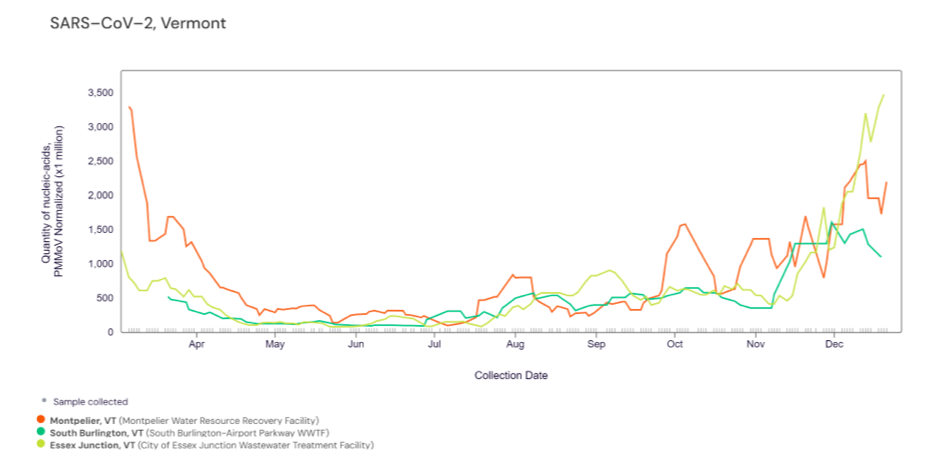
The available evidence points to one dispiriting conclusion: We are about to experience another substantial wave of Covid-19. Both state and federal data (the two are drawn from different testing regimens) show that our wastewater is full of the virus. The Centers for Disease Control says that nationally, wastewater levels are Very High, and the worst levels in the country are in the Northeast. Case counts in Vermont, although still classified as “Low” by the state Health Department, are on the rise. Nationally, according to the CDC, Covid-related emergency room visits, hospitalizations and deaths are all heading upward.
Dr. Michael Hoerger of the Pandemic Mitigation Collaborative is projecting that “Nearly one in three Americans will get infected during the peak two months of this winter surge. That’s 105 million infections & more than five million resulting Long Covid cases.” The PMC says we could be headed into the second highest peak for Covid transmission ever. Including those times when we avoided exposure as much as possible and wore masks whenever we ventured outside.
Yeah, well, I’m sure it’ll be just fine. At least that seems to be the foundation of Gov. Phil Scott’s post-pandemic policy. Because his administration isn’t doing a damn thing about it. Not even to “protect the most vulnerable,” which he says is one of the three pillars of his governorship.
In early December, VTDigger reported a series of post-Thanksgiving outbreaks in schools and long-term care facilities. Which stands to reason; Thanksgiving is a time when large groups tend to congregate. Even more so are the end-of-year holidays, except now the virus is much more prevalent than it was in late November.
In other words, we should expect to see large increases in transmission in the next week or two, likely followed by further increases in hospitalizations and deaths, and almost certainly followed by lots and lots of long Covid.
And don’t forget that the vaccination rate plunged dramatically this year, so relatively few people will be immune to new strains of the virus.
But hey, the pandemic is over, right?
Um. Even as I write this, Sen. Bernie Sanders announced that he has contracted Covid. He says his symptoms are “minimal,” but good grief, the man’s 82.
Generally speaking, Covid is a less fearsome beast than it was in 2020 or 2021. But that doesn’t mean it’s a walk in the park, especially when long Covid is always looming in the background.
Now, I don’t expect the Scott administration or anyone else to go all-out. You can tell by the low vaccine rates and the lack of masking in public spaces that the vast majority of people either aren’t concerned about the pandemic or are past the point of burnout. But the administration has failed to take reasonable steps to protect the most vulnerable, which I hate to keep mentioning but it’s supposed to be one of Phil Scott’s core principles. The actual operating principle appears to be “Welp, you’re on your own.”
Okay, I’m a big boy, I got the vaccine and I’ll take a prudent approach to being in public spaces. That’s not so easy for schools and long-term care facilities.
As for schools, the Education Agency isn’t lifting a finger. It hasn’t even offered any advice since the emergency was declared over in early 2022 (although its past guidance is preserved online “for reference purposes,” whatever the hell that means), and it isn’t providing any test kits or masks. If Thanksgiving was any indication, we’re going to see massive numbers of Covid cases in the schools.
Long-term care facilities are also on their own, and we have very little idea how many have even offered vaccinations to their patients — who can’t be expected to get the shots themselves. The Health Department surveyed long-term care facilities in September; it heard from only one-quarter of the facilities. “Of those, 80% were planning to offer or provide access to Covid-19 vaccines,” according to department spokesperson Ben Truman (via email).
But that 80% figure almost certainly doesn’t reflect actual vaccine access. I’ve been told that many facilities planned to use resources (like EMTs) that turned out to be unavailable. The Health Department didn’t do a follow-up survey for which, considering the low response it got the first time around, I can’t really blame them. But it does mean we simply don’t know how many facilities provided on-site vaccinations to patients — and if we did know, we’d probably be appalled.
I suppose the good news, in the Malthusian sense, is that widespread illness might ease the workforce crisis in our elder care system.
Long-term care residents are only part of the issue when it comes to people with disabilities that block (or significantly limit) their ability to travel for vaccination. The commonwealth of Massachusetts filled the gap with a state-run vaccination effort for the travel-challenged. It vaccinated nearly 13,000 people between December 2021 and late November 2023 at a total cost of less than $5 million. A similar effort in Vermont would have cost substantially less because, well, a lot fewer people. But the administration didn’t follow Massachusetts’ example. In fact, it even rejected a request for assistance on a partial grant-funded program.
Back in February 2023, Health Commissioner Dr. Mark Levine alerted VCIL to the existence of a National Council on Aging grant program for mobile vaccination efforts. Nice gesture and all, but VCIL is an advocacy organization. It’s not on the business of providing health care. Nonetheless, it applied for a grant and received enough funds to vaccinate 800 households. Far from ideal, but it’s something.
Cash in hand, it asked the Health Department for help. It got no response. Truman, in an email exchange with me, offered this rationale:
Now that the emergency is over — and with it, the end of the federal pandemic funding and resources — the ways in which people in Vermont receive care, including vaccinations, are returning to the pre-pandemic systems.
Okay, well, sure, the emergency is officially over by decree of the federal government, but that doesn’t mean the situation has returned to the “pre-pandemic” status quo. But the administration has washed its hands of responsibility. The Department, per Truman, “welcome(s) any partner organizations that has the ability to increase access for specific populations.”
It’s kind of a “thoughts and prayers” approach. Not blaming Truman, he’s only the piano player. But it doesn’t exactly indicate a dedication to protecting the most vulnerable, does it?
 The Vermont Political Observer.