
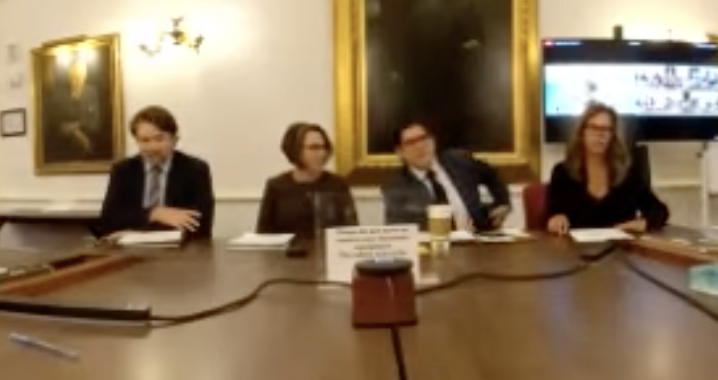
If the above image looks a little fuzzy, thank the limitations of the Legislature’s system for recording and livestreaming its hearings. But it reflects the situation we face on housing: Our public leaders seem small and indistinct when discussing the enormity of Vermont’s housing shortage, and their explication of the crisis was long on broad pronouncements and short on specifics.
The Scott administration’s A-team, pictured above, appeared before the Legislature’s Joint Fiscal Committee and delivered a gloomy overview that has to rank as one of the most depressing events I’ve experienced in my 12-ish years following #vtpoli. Doesn’t quite top Peter Shumlin’s surrender on health care reform or his near defeat at the hands of Scott Milne, but it’s not far behind.
The big takeaway: The housing crisis is even worse than we thought. From top to bottom, end to end, from the most basic of living spaces to the most extravagant, we don’t have nearly enough. Oh, and the epidemic of unsheltered homelessness that Our Leaders assured us was all taken care of last winter? That’s going to get even worse before it has a hope of getting better. And the “getting better” is going to take years.
And the interim solution, if they can manage to pull it off, is a massive increase in emergency shelters, most likely of the congregate variety. That, for a population ill-suited for such arrangements.
Other than that, Mrs. Lincoln, how was the play?
The administration officials saved the bad news on unsheltered homelessness for the end of their presentation. They led off with a dire assessment of Vermont’s overall housing shortage. We’ll get to that, but I’ll start with the former.
Chris Winters, Commissioner of the Department of Children and Families, acknowledged that progress on moving clients of the hotel/motel voucher program into alternative housing has slowed to a crawl. Human Services Secretary Jenney Samuelson anticipates a significant increase in voucher demand during winter: roughly 1,500 households requiring shelter in motels. She expects there won’t be enough motel rooms to accommodate all those people, which means we’ll see an increase in unsheltered homelessness during our coldest months.
Merry Christmas, everybody!
The administration is insisting that the voucher program must end on schedule next April 1. They’ve insisted on that before, time after time, and always relented when the specter of a humanitarian disaster reared its ugly head. But they sound serious about doing it this time, and have set a goal of creating 1,500 beds’ worth of alternative shelter by April 1, which is going to be one hell of a heavy lift. Sen. Richard Westman noted that one shelter plan in Lamoille County, which had community support, took a full year to come to fruition. We’re talking about multiple large shelters being proposed, vetted, approved, built, and staffed in less than six months!
And again, we’re talking any old shelter they can devise, which likely means heavy reliance on congregate shelters. You know, rooms full of cots? And we’re talking an unhoused population with large numbers of disabled folk and families with children, neither of which will do well in congregate arrangements.
Not that anybody does well in congregate arrangements, but here’s the bottom line: The administration is hoping it can create massive quantities of emergency shelter facilities on an extremely fast timetable. And that’s the positive scenario.
Winters offered an estimated price tag of $70 million for building and staffing the shelters. Plus there would be an ongoing budget draw for staffing and support services.
Administration officials expressed a need to disengage from the vicious cycle of the voucher program and progress toward long-term housing solutions. I think housing advocates will have quite a bit to say about that, but then, they’ve been ignored before and cynical ol’ me expects that will continue in the future.
Okay, on to the long term, which is setting up to be one giant political battleground in the 2024 legislative session. The administration is talking about serious and wide-ranging permitting reform as one part of its grab-bag of ideas for jumpstarting a housing market that has underperformed for decades.
Alex Farrell, the newly installed Commissioner of Housing and Community Development, outlined the scale of our housing shortage based on U.S. Census data — data which, he pointed out repeatedly, almost certainly underestimates the scope of the problem.
Farrell said that a healthy real estate market would have a 3% vacancy rate for home ownership and a 5% rate for rental units. Currently, ownership vacancy rates range from 0.5% in Chittenden County to 1.66% in Essex/Caledonia. The only other Census areas above 1.2% are Washington County at 1.57% and Rutland County at 1.34%.
The rental picture is slightly less dire, but still bad. Of Vermont’s 12 Census areas, only three (Bennington, Orange/Windsor North, and Windsor South/Windham North) are above the 5% mark. Six are below 4%. Chittenden, no surprise at all, trails the pack at 1.56%. (Westman, who owns rental properties, asserted that actual vacancy rates are much lower than Farrell reported. Rep. Jim Harrison, who hails from rural Rutland County, said “there’s no way the real vacancy rate is 3.64%. There are no apartments. And there are no homes available.”
More bad news: Rep.Diane Lanpher observed that if you factor in affordability, the vacancy rates would look a whole lot worse. Affordable housing of any kind is in especially short supply. Which is why the administration can’t wind down the emergency voucher program — there is nowhere for voucher clients to go, even the ones who have jobs and steady incomes.
Farrell said that restoring our ownership and rental markets to robust health may be literally impossible, even with an all-out effort to invest state funds, leverage other sources, and do as much as possible to unleash housing renovation and construction. “This estimate says we need 6,800 units statewide,” Farrell said. “The real need could be 10,000 to 11,000 right now.”
Key there is “right now,” because Farrell said the housing shortage will get even worse in the absence of strong action. Restoration and renovation isn’t keeping up with our aging stock. Dealing with Vermont’s workforce shortage means providing places to live for even more people. And the average Vermont household is shrinking — fewer families, more singles and couples. That means we need more housing for our current population.
The administration is still preparing a comprehensive plan for short-term shelter and long-term housing growth, but it’s going to be a big hairy deal when it goes before the Legislature. The governor took an uncharacteristically bold (and controversial to many) step in proposing Gateway Park, a reimagining of a flood-prone area in Barre City. Given the testimony offered by his officials today, the administration’s housing plan seems likely to be Gateway Park times a million.
 The Vermont Political Observer.
The saddest thing about this “housing crisis,” is that it’s something the state and the nation created on its own and just said to hell with the victims. Typical America. It didn’t have to be this way.
Does anybody actually think the Scott administration or the current legislative has any chance of addressing the housing crisis? Other then cots in auditoriums and hallways? Because I don’t… 8 to 10 thousand units needed in this glacier paced state… Add the fact that the Scott administraas not renegotiated the $4000
per client per month voucher…i don’t want to hear a word from that asshole about cutting costs…
Appreciate the post. But you have left out of the issues the disaster that congregate shelters pose for those who have trouble sharing shelter with others for emotional issues, including the panic attacks embedded in mental confusion. And anyone who’s been living rough for a while is very likely to experience that sort of panic and resulting reluctance to live in a group situation. Actually, would most of us want to suddenly be plunged into an experience that resembles “sleep-away” summer camp, complete with lack of privacy for making love, and unclean “sanitary” facilities? Nope. Congregate living is not a good answer to homelessness, period. Perhaps we can expect the modern equivalent of the “orphan trains,” carrying away the people who don’t adapt well to our existing social structures. What a nightmare!