
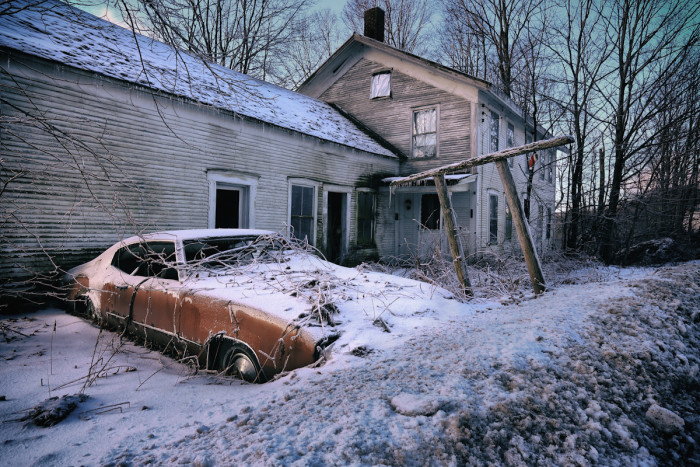
Since October 5, there have been seven eight suspicious deaths in rural Vermont. Yes, that’s a lot. But it’s not so far out of character as we’d like to believe for our oft-celebrated countryside. Which in our mind’s eye looks less like the above and more like the below:
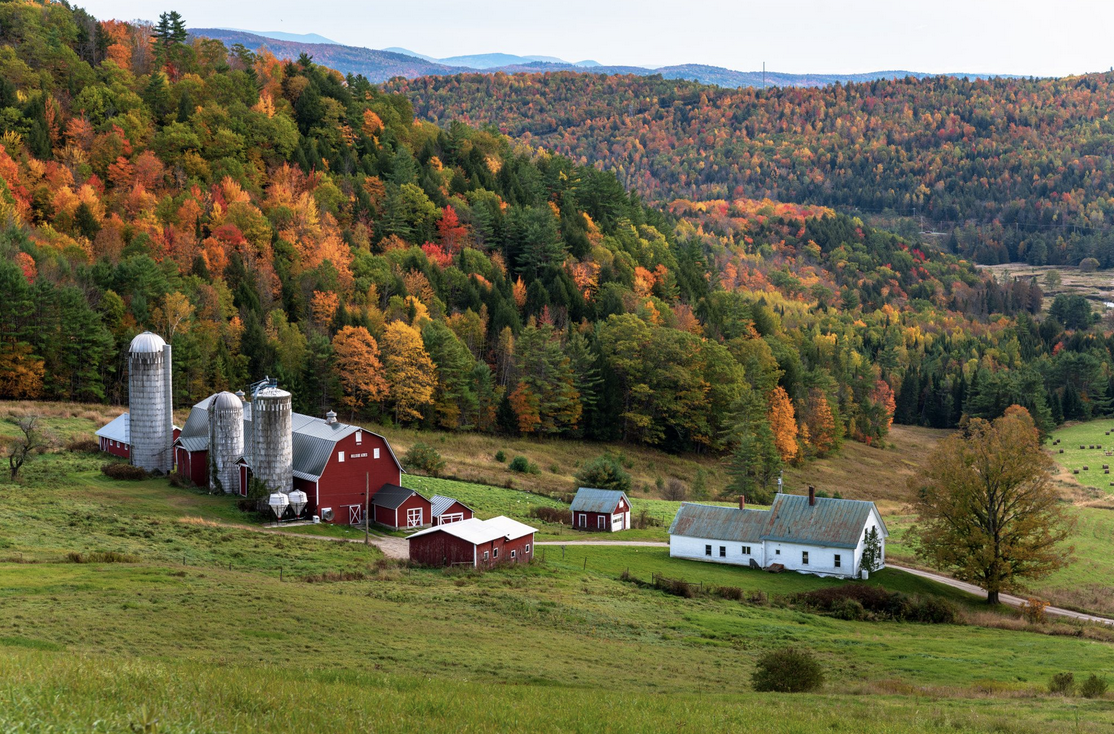
There is, in truth, plenty of both in rural Vermont. On balance, though, probably more of the former than the latter. Rural Vermont, like rural America, can be beautiful and ghastly, peaceful and dangerous, prosperous and abandoned.
It would behoove us to hold both pictures in mind. It might help break down the imaginary barriers between our suspect cities, full of drugs, crime, and recent arrivals, and our countryside, a paradise of scenic beauty and hardworking people. You know, the “real Vermonters” living in the “real Vermont.”
What bullshit.
One of the surprising nuggets in Mercedes de Guardiola’s new book Vermont for the Vermonters is how the rise of our tourism industry created a demand for that postcard-ready “real Vermont” and fueled a drive to clean up the countryside in order to fulfill the expectations of visitors.
Vermont, in the words of an early 20th Century tourism publication, was the “anti-modern foil to the challenges of modern, industrial America,” a place where Vermonters held “fast to the ways of their fathers, and… have preserved… something valuable that might otherwise be lost in the larger pattern of American life.”
Problem was, as de Guardiola puts it:
Reality was a bit harsher. The hard-working families did not dress in charming, homemade clothes, have animals lazing around the fields ready for playtime, or offer up feasts fresh from the gardens every meal.
For many, perhaps most, making a living in rural Vermont was tough and demanding. Still is.
The eugenicists and their upper-crust allies saw the Vermont countryside as the breeding ground of the tough, straight-edge “old stock.” In truth, rural Vermont has always produced more than its share of poverty, despair, addiction, ill health, and violence. If the eugenicists had achieved their goal of purging the inferior “germ plasm” from our gene pool, the pressures of rural life would have more than replenished the ranks of the “feeble-minded.”
At least some of the eight shootings are drug-related, and it’s commonly believed (and said, and employed as the basis of public safety policymaking) that this is a plague visited upon us by big-city (read: POC) dealers coming to Vermont (read: white) for the easy pickings. There’s truth in that, but they wouldn’t be coming here if there weren’t plenty of customers eager for their offerings.
Many years ago I read a story about a drug bust in a small town in Michigan’s Upper Peninsula. It turned out to involve dozens of town residents, including several community leaders. Pretty much everyone was involved or well within Kevin Bacon territory. That’s one data point, but the overall numbers paint a picture of widespread substance use in rural areas. The main difference between rural and urban areas: Treatment tends to be far more available in the latter.
There is beauty down many a backcountry dirt road. There is also violence and fear. Just ask Wynona Ward, survivor of an abusive rural upbringing and now head of Have Justice Will Travel, a nonprofit that supports rural victims of domestic violence.
Or ask the Center for American Progress, which found that most of the American counties with the highest rates of gun violence were rural. Most were in the South and Midwest, but the common thread: Permissive gun laws. Which is also a feature of life here in Vermont. Gun rights advocates like to argue that an armed society is a polite society, but the truth is that the more guns there are, the more likely it is that someone’s gonna get shot.
When I first moved to Vermont, I was a freelance writer. Spent a lot of time on assignment driving around the state. Saw a lot of communities that didn’t live up to the Vermont image. The outlier was Grafton, which seemed like the most classic Vermont small town I’d encountered: well-kept properties, inviting retailers, classic town green.
And then I learned that Grafton is basically a theme park, created and largely maintained by the Windham Foundation. Nothing wrong with that, Grafton’s a lovely spot. But it underscores the fact that economic realities don’t support that kind of “real Vermont.” It takes money to make an idealized small Vermont town — more money than such a town can generate entirely from market forces.
That’s why whenever Hallmark has a movie set in Vermont, it never does any filming around here*. There aren’t any Vermont locations that look enough like the “real Vermont” to satisfy our expectations. Not even Grafton.
*Correction: They did actually film one of ’em in Vermont: “Moonlight and Mistletoe,” a 2008 epic filmed in Chester, starring the inevitable Candace Cameron Bure. The vast majority of Hallmark’s “Vermont” movies are shot in western Canada.
None of this is meant to denigrate rural Vermont. All I want to do is bring some realism to its pure arcadian image, and tear down the stereotypes that fuel our obsession with real Vermont and real Vermonters. Take off those foliage-colored glasses and discover the complicated truth of what Vermont is actually like.
Note: The title of this post comes from the great T Bone Burnett.
 The Vermont Political Observer.
I’m with you. Too bad that people always put more emphasis on the adjectives that tend to precede “people” rather than the common noun “people”–city people, country people, black people, white people, Christian people, Muslim people, Jewish people…..the only adjectives that matter are ones we rarely employ: decent, indecent, honest, dishonest, violent, trustworthy, generous, miserly…..
There are a few more variables, including the clumsy application of urban “solutions” to rural settings. Multiply this with lack of infrastructure to support recovery (from addiction, poverty, etc.), and the fact we’ve helpfully sent a generation of (mostly) young Vermonters to urban out-of-state prison. Great learning environments. Like Southern Appalachia, VT is getting pummeled by generational poverty>isolation>drugs. There’s still beauty here, with amazing people, places, and things. But we’re sure tipping over the lip of rescue.
Was at a zoning hearing in one of Vermont’s bucolic, scenographic little towns south of Middlebury. This was for an interesting project oriented to the younger, less affluent creative set. You should of heard the screams and howls of protests from the middle class crackers from the neighborhood. These people actually publicly said they only want rich [white] people moving into their neighborhood. One woman stated that the state does not have enough housing for wealthy people and that is the only kind of housing the town should be supporting.
Vermont is a dark, sick f**king place made darker by all the nice wealthy white people who think they are god’s gift to universe. Evidence the ‘terrorism’ in Middlebury referenced by Angelo Lynn in the AI. Homeless people getting in the way of the jet set enjoying an overpriced pastry and ponying up $300K to have dinner with the BOT of the college.
We are a country of the rich, by the rich, and for the rich and this is what we’re getting for it.
It should also be noted that ‘rich white people only’ is the official policy of the State of Vermont. Case in point, take the 2022 revision is the state’s lead paint rules that now far exceed Federal mandates. Was there any scientific evidence suggesting that VT was in some sort crises requiring the enacting these new rules. NO. What these rules do is dramatically increase the cost of dealing with lead paint – the end result being that the only people who can afford to follow the rules are the wealthy. All those ramshackle New England rentals cloaked in clapboards can only be painted by ‘licensed’ painters of which there are next to none. The state is hoping to turn those shacks over to the rich as landlords will be unable to comply with IRC. The poor and working class will have even fewer options for housing while the ‘affordable housing developers’ are paid mindless sums of money to build out crapbox housing where the less fortunate wage slaves can be contained and policed.