
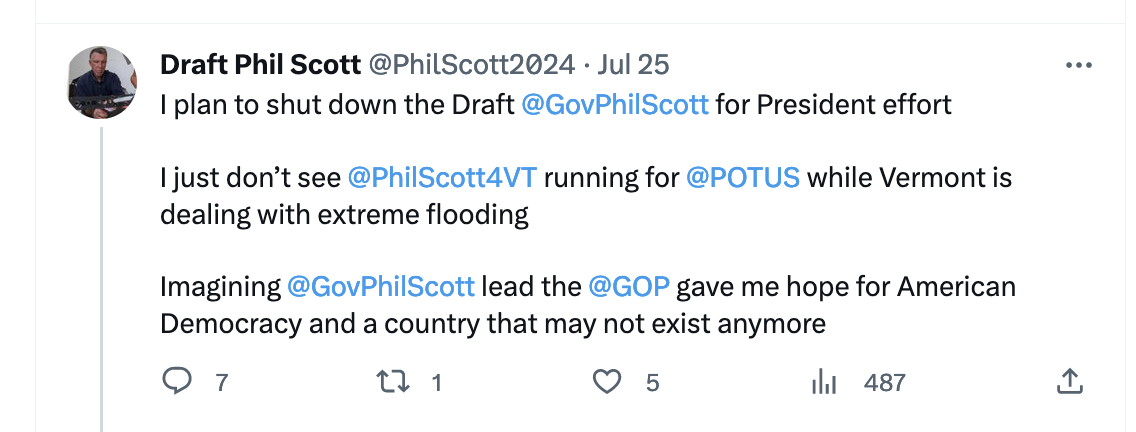
We have apparently seen the last of the invisible-except-on-Twitter “Draft Phil Scott” effort, which put forth a plausibly earnest belief in the potential national appeal of our indisputably popular Republican governor. I never took it seriously because, well, I see no path forward for Scott or any candidate who’s not a creature of the far right.
The arguments in favor of Scott: He’s the most popular governor in the country (true); he’s a real man of the people (that’s his image, certainly); he is particularly popular in the Connecticut River valley (okay); that popularity would give him a shot at success in the historically pivotal New Hampshire primary (nah); and a strong showing in the Granite State could make him the candidate of choice for those seeking an alternative to arch-criminal Donald Trump.
Well, if I hadn’t jumped off the bandwagon before then, that last imaginative leap would definitely lose me. Because the Republican Party of DPS’ imagination hasn’t existed since a lifetime ago. And I’m talking the lifetime of senior-discount-takin’ Yours Truly, not any of you young whippersnappers.
The last “moderate” Republican president was Dwight Eisenhower who, deep historical cut here, was accepted by a GOP whose conservative tendencies were overcome by the desperate need to win a damn election after 20 years out of the White House. His vice president Richard Nixon presented a stubbly veneer of moderation in his 1960 campaign but it’s hard to take that seriously given his history of virulent Red-baiting, not to mention the kind of president he turned out to be.
But the national GOP turned away from Ike’s brand of politics for good in 1964 when it chose Barry Goldwater and decisively rejected Nelson Rockefeller, Henry Cabot Lodge Jr. and Bill Scranton. Historian Rick Perlstein called the 1964 Republican convention, which featured open hostility toward the media,
…the ugliest of Republican conventions since 1912, as entrenched moderates faced off against conservative insurgents. In an era in which a national consensus seemed to have coalesced around advancing civil rights, containing Communism and expanding government, the moderates believed they had to win to preserve the Republican Party. The conservatives—who wanted to contain the role of the federal government and roll back Communism—believed they were saving not just the party but Western civilization.
Kinda sounds like the Trump movement, no?
The conservatives won the intra-party contest and, although Goldwater got steamrollered by LBJ, they’ve held sway in the GOP ever since. In 1968, Republican voters rejected Rockefeller once again, not to mention George Romney — the Phil Scott of my home state of Michigan* — in favor of Nixon, who based his campaign on catering to southern white voters disaffected by Democratic support for civil rights legislation.
*FIscal conservative, social moderate, successful businessman. For a taste of Romney’s political bravery, watch this five-minute clip of his speech to the 1964 GOP convention in which he blasted “know-nothing extremists” and espoused equal rights for all.
Throughout Nixon’s presidency his chosen number-two, Spiro Agnew, captured the hearts of the Republican world with his overheated rhetoric. He certainly would have been Nixon’s designated successor if only he could have kept his criminality in check. (His response to his prosecution on charges of extortion and fraud was fully as brazen as Trump’s.)
In 1976 Republican voters came close to rejecting their sitting president, Gerald Ford, in favor of conservative showman Ronald Reagan — who was unstoppable in 1980 with a campaign heavy on dog whistles meant for the ears of southern whites. His vice president and successor George H.W. Bush was kinda-sorta moderate — but he was also the guy who palled around with the Dick Cheneys and Donald Rumsfelds of the world and ended his one-term presidency by pardoning those convicted in the Iran-Contra scandal.
Republicans spent the eight years of the Bill Clinton presidency engaged in the kind of conspiracy-hunting that’s become a core feature of the party’s brand. They dug and dug and dug looking for scandal of any sort before finally settling on a stained blue dress. The ensuing impeachment effort only solidified Clinton’s popularity and deepened Republicans’ desire to get him — and his wife — by any means necessary.
Which brings us to 2000, when the Republican electorate definitively put a bullet in the brain of “Draft Phil Scott.” Perhaps you don’t recall it, but John McCain scored a decisive victory in the New Hampshire primary, the kind of win that would supposedly vault Scott into his party’s nomination. But in the end, primary voters preferred the performative cowboy George W. Bush to the authentic war hero McCain.
Republican politics were pretty damn dire in the George W. Bush years between the unnecessary wars, the buildup of the security state in response to 9/11 and the general rightward drift of the administration. Never forget Bush’s determination to privatize Social Security and cut payouts for future retirees, a plan abandoned because of severe political backlash. And while the GOP nominated non-extremists in 2008 and 2012, the party itself staged a comeback from its late-Bush decline thanks to the Tea Party movement.
The Republican hierarchy spent the Obama years as it spent the Clinton presidency — seeking desperately for scandal and abandoning any pretense at policy in favor of obstructionism.
In the eyes of some, Donald Trump was an outlier — a renegade who staged a takeover of the Republican Party. To me, Trump was of a piece with the Republicanism I have known since at least 1964: staunchly conservative, blowing every available dog whistle, uninterested in actual governance, and avidly seeking to tar the image of any Democrat who dares show their head above the parapet. The Republicans have done nothing during the Trump years or since to persuade me otherwise.
If there had been a Draft Phil Scott movement, its seeds would have fallen on the stony ground of a MAGA, QAnon-dominated Republican hierarchy and electorate. There was no path forward for Scott, or Larry Hogan or Charlie Baker or any other creature of anyone’s Third Way dreamscape. Republican voters would prefer a fire-breather to a moderate, a scoundrel over a person of reason and principle. Hell, the VTGOP electorate has no real love for Phil Scott, whose positives are a lot higher among independents and Democrats than among his fellow Republicans.
Absent uncomfortable political realities, it’s possible that a Phil Scott could appeal to a general electorate sick and tired of the fighting and name-calling. But anyone like Scott could never survive the archconservative gauntlet of modern Republican politics. “Draft Phil Scott” was well-intentioned but doomed to fail.
 The Vermont Political Observer.
“But anyone like Scott could never survive the archconservative gauntlet of modern Republican politics.”
We can only hope that the Republican party, modern or otherwise, soon becomes the history it should have been back in 1964 or even earlier.