Tag Archives: Doug Racine

So it was a push, not a jump

Media reports posted after my initial VPO piece on Doug Racine’s departure make it clear that Racine was fired as Human Services Secretary; he did not resign. And he was fired in a sudden and coldblooded way. The best reporting comes from Paul “The Huntsman” Heintz, who got the skinny from the firee himself.

In a phone interview, he said he was summoned to the 5th floor of the Pavilion State Office building at 4 p.m. Monday for a meeting with Shumlin chief of staff Liz Miller and Secretary of Administration Jeb Spaulding.

“I went in and sat down. They said, ‘The governor wants to make a change at your agency.’ I said, ‘Who would that be?’ Jeb looked at me and said, ‘You,’” Racine recalled. “We talked about it for a few minutes and then I went to the office and cleaned out my desk.”

So now we know who wields the hatchet in the corner office. Shumlin did give Racine a call about an hour after the meeting, and it was relatively cordial; but hell, couldn’t he do the actual deed himself? Especially since Racine had handled the hardest and most thankless job in state government for three and a half years?

There was also a Profiles In Courage moment Tuesday afternoon, when Shumlin went kinda wishy-washy on the nature of Racine’s departure, i.e. voluntary or not:

Asked what, specifically, prompted Racine’s exit, Shumlin said, “Specifically answering your question is exactly what I’m not going to do.”

Well, at least it was a head-on refusal to answer instead of the usual “bury ’em in bullshit” routine.

When I call AHS Secretary the “hardest and most thankless job,” here’s what I mean. It handles a whole lot of disparate programs aimed at helping our most unfortunate. It’s a huge agency by Vermont standards. As I noted earlier, it was hit hard by the Douglas Administration’s ill-fated Challenges for Change initiative, not to mention its misadventures with technology contracts (which were at least as bad as Shumlin’s). And it was ground zero for the health care reform effort and all the attendant troubles.

In addition, AHS’ challenges were compounded by Tropical Storm Irene, which left a whole lot of people in need of help — and which scattered the agency’s personnel to rented spaces in multiple communities because of the flooding in Waterbury. And they are still scattered today. Not to mention the flooding and forced closure of the Vermont State Hospital and the ensuing years of chaos in the mental health care system. 

Doug Racine handled all of that with grace and dignity. He kept his nose to the grindstone and almost never uttered a discouraging word in public. I’d think that was a good thing, but apparently he was too quiet for Shumlin’s taste:

According to Racine, the governor wanted a secretary more willing to engage with the news media and interest groups.

“If anything, it was perhaps not being out there enough,” Racine said.

I always thought Racine’s quiet style was perhaps exactly what Shumlin wanted from his longtime political rival. Either that, or Racine himself opted for the low-profile approach because he didn’t want to come across as bitter or as a potential political threat.

As I said in my previous post, I understand the need for a sacrificial lamb. And between the problems with health care and DCYF, I can see why Racine got the axe. But the way it was done? I think Racine deserved better.
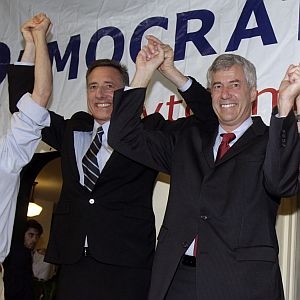
A head has rolled

Shocking, but not surprising news this morning out of the capitol city. Paul “The Huntsman” Heintz:

Gov. Peter Shumlin has dismissed onetime political rival Doug Racine as secretary of the embattled Agency of Human Services.

“These decisions are difficult, but the governor felt a change in leadership at AHS was needed at this time,” Shumlin spokeswoman Sue Allen said Tuesday morning.

Doug 'n Pete in a happier moment. (Photo from VPR)

Doug ‘n Pete in a happier moment. (Photo from VPR)

Laura Krantz at VTDigger writes it as a Racine departure, not a firing. Which makes me wonder if the last straw was last week’s emergency budget adjustment, with its calls for further cuts in an already-overstretched agency. Maybe Racine stood up for his people, and got shot down for his trouble. I have no inside information on that point, but the timing certainly fits.

Whether a push or a jump, the shock is the suddenness of it all and the fact that the scythe took its first cut at the top level rather than, say, taking a Mark Larson or a Robin Lunge. It’s not surprising because sooner or later someone in state government had to take the fall for Vermont Health Connect’s continued troubles.

I say so not because any one of the three is more or less culpable for the VHC mess, but because Larson and Lunge were more directly involved. And because a cabinet member is a key gubernatorial appointment, this is a more direct reflection on the Governor himself.

But as Heintz points out, the trouble isn’t all health care-related. AHS’ Department of Children and Families has also come in for criticism following the deaths of two young children under its supervision. In that context, Racine was the most relevant target.

Health Commissioner Dr. Harry Chen will be interim AHS chief, with an appointment through the end of the year.

My take, and I have absolutely no knowledge of how AHS works or doesn’t: It was an almost impossible job. In fact, when Shumlin appointed his chief political rival to the post, I wondered whether it was an honor or an exile. AHS is a big, complicated operation that’s usually overtaxed and underresourced. Racine took the job after years of Jim Douglas-mandated cuts, and the disastrous implementation of Challenges for Change. It was the kind of job that was almost certain to leave Racine with a tainted reputation as a manager, especially with the Governor’s aversion to tax hikes and obsession with cost-cutting. And on top of all that, AHS was home base for health care reform and its myriad pitfalls.

It was a thankless job, and Racine kept at it for almost four years. And did his job largely out of the public spotlight, with a dignity and dedication that speaks well of him.


The Milne Transcripts, part 7: No vilification here, nope, no sirree.

This the penultimate entry in my series of posts from Scott Milne’s trainwreck of an interview on the July 25 edition of WDEV’s Mark Johnson Show. Yes, only one more entry after this. Believe me, there could have been more. The hour-long interview is packed with uncomfortable pauses, inarticulate phrasings, abrupt transitions, unanswered questions, and general bumblefuckery. 

Over and over again in his young campaign for Governor, Scott Milne has insisted he will not “vilify” Governor Shumlin. He said so in his campaign-kickoff speech, and immediately followed that promise with words like ultra-progressive, brazen, bullying, radical, headstrong, and “unbridled experimentation.”

No vilification there, none at all.

Milne was apparently nonplussed by the reporting of his speech in this space and at VTDigger, which pointed out the obvious contradiction. Because early on in his Mark Johnson interview, he stuffed this little gem into a discussion of the Shumlin Administration’s competence:

…it’s hard to get into this game without — you know, I want this, this, these are political objective words not meant to be mean-spirited or, and my tone is, you know, I respect most of what Shumlin and his family have accomplished, so it’s not personal at all, but on the one hand you’ve got this guy who’s a very deft, smooth, political guy. On the other hand, if I compare him to the governors going back to Phil Hoff, he’s the mo — he, he, he doesn’t, he doesn’t stack up well against any of them in my opinion.

Got that? Words like radical, brazen, and bullying are “political objective words not meant to be mean-spirited.” Because he respects “most of what Shumlin and his family have accomplished,” but on the other hand, Shumlin is the worst Governor in Milne’s living memory. 

I’d say he’s trying to thread a needle, except there’s no hole. He’s trying to thread a pin.

The rest of the interview was studded with criticisms, not of the Governor, but of the “Shumlin Administration.” Even when the criticism was clearly aimed at the top man in the operation. Take this:

My read on the Shumlin Administration is they run the state like it is a campaign. They’re always readin’ polls, figurin’ out what’s gonna be popular and pretendin’ they’re leadin’ that parade. And I think that’s the opposite of what we need for leadership.

See, you can’t pretend to be talking about the entire Administration by slamming its “leadership.” When you’re talking leadership, you’re talking about the leader — not the team.

At one point, Milne praised Doug Racine as “a man of great integrity.” Later, Johnson asked if he also considered Governor Shumlin “a man of integrity.” Milne squirmed like a fish on the hook.

Uh, Doug Racine, I think, is uh you know, uh, in my limited dealings with Doug Racine, he’s totally comfortable looking you in the eye and telling you he disagrees with you and trying to convince you to agree with him or disagree with you.  My experience with the Shumlin Administration is, that’s not exactly the — uh, and integrity, uh, I wouldn’t, I wouldn’t say anything about Governor Shumlin’s integrity. I would just say, I think that they run the state like it’s a political campaign, and I would like to see the state run like it’s a, a family where we need to make sure that we’re looking out for our own best interests in the long term.

Woof. Even if you like Scott Milne, even if you plan to vote for him, that’s just painful to read.

It’s a common problem with the nascent Milne campaign: he’s trying to carry out complex rhetorical maneuvers, but he just doesn’t have the skills.

This is the problem when a person who’s successful in another field (usually business; see also Tarrant, Rich) takes a leap into the deep end of politics. A good politician possesses a broad range of skills: crafting a message, interacting with the public, giving speeches, being interviewed, managing a campaign, and a whole lot of stamina. Among other things.

Aside from one losing campaign for a much lower office, Scott Milne is a political newbie. You compound that with a very late entry into the race, and this is what you get.

In the last installment of The Milne Transcripts, I’ll recount some of the worst moments from his interview. I’m serious; there’s worse.  

The Milne Transcripts, part 4: The Great and Terrible Doug Racine

Yet another instlalment in my epic series of posts from Scott Milne’s horrific appearance on WDEV’s Mark Johnson Show on July 25. It was his first long-form interview since formally opening his bid for the Republican gubernatorial nomination, and it was bad on so many levels… 

One of the many intricate dances Milne was trying to perform was projecting an image of moderation without alienating the GOP base. A difficult task, given that some prominent GOPers are already talking up Dan Feliciano, the Libertarian candidate.

During an attack on the Shumlin Administration’s alleged managerial failings, Milne went off on a tangent about the 2010 campaign. As you may recall, after Jim Douglas bowed out of the race, five Democrats jumped in — and Peter Shumlin eked out a win in the primary, with Doug Racine finishing a close second. Take it away, Mr. Bunny…

I would have loved to have seen a Brian Dubie/Doug Racine governor’s race. I think Doug Racine is an accomplished state public servant, a man of great integrity, and I would have loved that governor’s race. I would have supported Dubie in that, but I thought that would have been a good governor’s race with two very different, um, paths forward for Vermont. But where I would have felt like both people were just being totally candid about what they thought, and not trying to read polls and figure out what they needed to say to get elected.

Got that? Liberal Democrat Doug Racine, man of integrity, “accomplished public servant,” and quality gubernatorial candidate, unlike the unprincipled opportunist who won the nomination, and who shall remain nameless because Milne has declared that his campaign will not “vilify” anyone. (Just as I am not vilifying Scott Milne, a fine businessman who possesses many fine qualities — political skill being conspicuously absent from the list.)

But this remark was preceded by a direct attack on poor management at two agencies: Natural Resources, and Health and Human Services. The latter helmed, of course, by none other than Doug Racine. Just before this, Milne had slammed Governor Shumlin’s so-called “Team of Rivals” cabinet that included some of his adversaries in the 2010 primary. Milne said “I don’t think those were good management choices.”

Okay, so I guess the “accomplished public servant” Doug Racine would be a crackerjack candidate for Governor, but he has no business heading a state agency?

Of course, Milne made it clear that he, personally, wouldn’t have voted for Racine, but still: making Racine the Democratic nominee is putting him in line to run the entire state government, when you think he’s not even capable of running a subset thereof. It’s like saying Sarah Palin was a darn fine candidate but would’ve made a lousy Vice President.

It was a very poor way to make a very weak point. Milne apparently wanted to have something good to say about a prominent Democrat in order to burnish his bipartisan credentials. In the process, though, he managed to compliment and crucify the same person in the space of two paragraphs.

Stay tuned for more installments of The Milne Transcripts, coming soon to this space. But first, I gotta do some weed-whacking. 

The new state hospital: A milestone, but not the end of the road

Yesterday’s happy-smiley ribbon cutting at the new State Hospital in Berlin was, indeed, a happy occasion. The post-Irene period — almost three years — has been extremely tough on seriously ill patients, their caregivers, and the entire mental health care system. Long waits, days spent in emergency rooms, endless shuffling of patients from one facility to another, constant searching for even a single empty bed. It’s been damn tough, and the interregnum has been longer than it should have been.

But nobody should confuse this milestone with the finish line. There are still a lot of questions to answer and issues to address. (Many of these were covered in Pete “Mr. Microphone” Hirschfeld’s fine piece for VPR, which went above and beyond the pro forma coverage of a ceremonial event and actually addressed the meat of the issue.) First and foremost: is this new hospital big enough?

After Irene, the experts were insisting that a new hospital needed to be at least as large as the old one. Instead, it’s half as big. I realize we’re trying to deemphasize hospitalization and move to a multifaceted, community-based system. But we’re talking about the sickest of the sick: even at 54 beds, that’s one bed per 11,593 residents. A central hospital isn’t for patients who might be better served in outpatient or community settings; it’s for the very, very small number of people who are too ill to function, too dangerous to themselves or others.

It remains to be seen whether 25 beds are really enough. It’ll definitely ease some of the intense pressure on the system, and it should prevent the widespread warehousing of patients in ERs or other unsuitable locations.

And there’s still widespread legislative dissatisfaction with the cost of the new facility, which makes me fear that the hospital will be nickel-and-dimed by lawmakers more concerned with the bottom line than with adequate patient care. Sen. Jane Kitchel, for one: she was more than pleased to take part in the ribbon-cutting, but she’d really like to see the hospital run more cheaply. 

Many lawmakers are complaining that the new hospital’s per-patient costs are substantially higher than the old one’s. That’s true, but I’d point out a couple of obvious items:

The old hospital was inadequate. Everyone says so. It lost its federal certification, which meant it did not qualify for Medicaid funding. If the old hospital wasn’t up to snuff, well, of course the new hospital will cost more.

Many of the costs are fixed. So when the Legislature happily signed off on a smaller facility, it tacitly agreed to much higher per-patient costs. A brand-new 54-bed state hospital would have had higher operating costs than the old one, but it would have cost a lot less per patient than the new 25-bed facility. This shouldn’t be a surprise to anyone in the legislature.

Many of the costs of the old state hospital are now redistributed across multiple locations, and helping to fund new community-based programs. (Or at least that’s the way it’s supposed to work.) This very intensive kind of psychiatric care requires staffers with special training and expertise; in a single central facility, you can have a more concentrated level of expertise. In the new system, we’ll have to spread those people around. And almost certainly hire more of them.

So I don’t want to hear any whingeing from the legislature about the new hospital’s cost. This was their idea.

But it must raise serious questions about the legislature’s willingness to fund the community-based facilities that are supposed to undergird the whole system and prevent a whole lot of hospitalizations. <a href=”http://digital.vpr.net/post/after-long-wait-mental-health-hospital-ready-first-patients”>Via Hirschfeld: </a>

Northfield Rep. Ann Donahue is a mental health advocate who has spent years advocating for a new state mental hospital. Impressive as the new facility is, Donahue says the system won’t function properly unless the community-based facilities are actually built. And she said much of the bed space and treatment capacity called for in the reform plan have yet to be constructed.

“Some of them are still in development, some of them are on budget hold. And we need to really enhance that aspect or we won’t reduce the need for inpatient care,” Donahue said.

At the ribbon-cutting, Human Services Secretary Doug Racine trumpeted the claim that Vermont “has the best mental health services in the U.S.” As of today, that claim is one step closer to reality but, fundamentally, it remains in the realm of political blather. The truth is, Vermont may well have the best mental health care system in the country ON PAPER. But a long struggle remains to turn it into reality. And penny-pinching Democrats are, sad to say, the biggest obstacle in our path.