Category Archives: Peter Shumlin

On the putative tightening of the gubernatorial race

A new poll in the Vermont governor’s race was released today. And, like another recent poll, it showed an apparent closing of the gap between Governor Shumlin and Scott Milne.

And this one came from a reputable source: CBS/New York Times/YouGov, instead of the right-leaning Rasmussen Reports.

On top of that, the new poll shows a closer race than Rasmussen. To recap, a CBS/NYT/Alphabet Soup poll taken in July gave Shumlin a 56-27 edge on Milne. The polling began, and ended after, Milne’s actual entry into the race. A couple weeks ago came the Rasmussen survey, which showed a 48-36 race. Which I pooh-poohed at the time, considering its source. But the latest survey is a tad closer: Shumlin 45% and Milne 35%, with 5% for other candidates and 15% undecided.

So, the question is, does this mean the race is truly getting close? Should the Governor be shaking in his boots?

In a word, no.

He does need to tend to his knitting, but this poll is less revealing than it seems. Three big reasons:

— Milne’s 35% reflects the hard-core Republican electorate. He’s done nothing to convince  independents or Democrats. 35% is, more or less, the default number for a generic Republican candidate.

— The poll includes three names. Inexplicably, none of them is Libertarian Dan Feliciano, who has emerged as a conservative spoiler in the race. It did offer three choices, but the third is not Feliciano but Emily Peyton. If Feliciano had been included, you’d have to think he would have siphoned off at least a few percentage points from Milne — perhaps making the race 45% to 30% with 5 for Feliciano. That doesn’t seem like much of a stretch to me, considering that Feliciano’s got the active support of some high-profile Republicans. (Peyton draws 2% support in the poll, with 3% opting for unnamed “other.”)

— The poll was taken between August 18 and September 2. Shumlin hadn’t even begun campaigning at the time. Sure, he held a lot of high-profile events, but he hadn’t started counter-attacking. And he’d suffered through months of bad publicity over health care, DCF, and school taxes.

What this poll indicates is that Shumlin has to generate fresh enthusiasm for his campaign and his governorship. But that’s right in his wheelhouse; he is an energetic and skilled campaigner. If he can’t spark a rebound in his poll numbers, I’ll be very surprised.

I expect Milne to hold steady in the mid-30s — unless Feliciano continues to gain ground. And I expect Shumlin to rebound into the low 50s, assuming he runs a smart campaign. This election may be closer than 2012’s (unless Milne keeps up his rumblin’, fumblin’ ways), but not by much.

But please, Governor, don’t rest on your laurels.

Scott Milne hints at an actual policy position

So, Our Man Mahatma was up in Newport on Wednesday, hangin’ out at the Agway and talkin’ politics with the folks. And there to capture the excitement was a camera from the Newport Dispatch, an online-only news website.

Simple, short video, a few Q&A’s; one of which concerned rising property taxes. And while Milne did not take an actual position, he did hint at the vague outlines of a position. Which, for him, constitutes news. Take it away, Mahatma:

“I think there’s a need to rapidly address a solution for not having taxes increase any more while we figure out how to restructure things. That’s gonna be one of the fundamental principles of our campaign, something we’ll be talking a lot more about over the next two weeks. So I’d ask you to stay tuned. You’ll be happy with what we’re going to be talking about.”

Sounds like he’d call for a freeze on property taxes while he and the Legislature work out a longer-term solution. It sounds unworkable to me; there’d be a pretty rough immediate impact on school budgets and the transfer payments needed to ensure equal funding across the state. But hey, it’s an idea from Scott Milne. And that’s news.

But then he kinda blows it by promising an actual policy in “the next two weeks.”

Oh, c’mon now. When he outlined his two-stage campaign — attack Shumlin in August, unroll his positions in September — it seemed way too late to introduce a Milne Plan to the voters. Now he’s promising a Plan by the end of the month. Only a few weeks before the election.

Meanwhile, Milne continues to cede the conservative spotlight to Libertarian Dan Feliciano, who once again held a news conference yesterday where he once again got more attention than he deserves. The funny thing is, Feliciano pulled a Milne: he criticized Shumlin on state spending, but refused to say how he’d cut the budget.

Scott Milne has allowed Dan Feliciano to become a big problem. Not as a viable contender, but as a third “real” candidate in the race, likely to be included in gubernatorial debates.

If those debates were simply Milne vs. Shumlin, then Milne would have room to attack and establish his own positions. With Feliciano sharing the stage, there’ll be a lot less room to maneuver. Milne will be the Man In The Middle, and he’ll almost certainly look wishy-washy by contrast to the tight-fisted Feliciano and the self-proclaimed “progressive” Shumlin. He’d have to be a very strong, forceful presence to stand out in that situation. And to date, Milne has shown no ability whatsoever to be strong or forceful.

Mahatma Milne Reveals Himself

Aww, sheeeeit. 

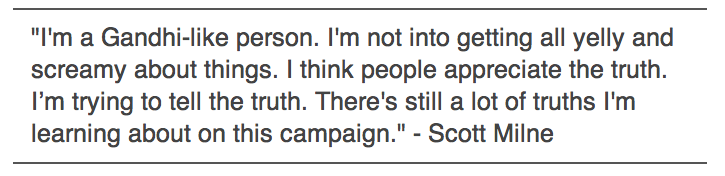
Screen Shot 2014-09-10 at 9.50.14 PM

The above quote is from Milne’s interview today on VPR’s Vermont Edition. 

Where do you start? 

I’d say “self-absorbed, egotistical, and deluded,” but I suspect the real answer is “clueless and maladroit.” In his very brief time in the spotlight, Scott MIlne has already established a reputation for verbal blunders, malapropisms, abrupt changes of subject, and a weird combination of aggression and passivity. (Example: On the one hand, excoriating Vermont Health Connect as radical experimentation; on the other, refusing to rule out the even more progressive single-payer system.) 

When he wasn’t elevating himself to the highest ranks of humanity, Milne spent a lot of time failing to define himself or his candidacy, per VPR’s Jane Lindholm: 

 “I’m not talking about what my plan is today,” he said. “I’ll be very clear, and I’ve been very consistent from the beginning, that what we need is a health care system that offers access to everybody.”

Milne is short on details on other issues as well. He believes that property taxes are too high and getting higher in many towns around the state. He said we need to reform our education system to keep costs down. When questioned on Vermont Edition, Milne backed away from a prescription for a fix. 

… “Stay tuned,” he said.

C’mon now, Mahatma. It may go against every fiber of your pacifist, meat-eschewing self, but sometime, someday, you do have to start revealing policies of your own.

Back in late July, Milne laid out a two-part strategy: August was for criticizing Governor Shumlin’s record, and September was for his own policy rollout. 

Hey, Mahatma: September began a week and a half ago. Time to shit or get off the pot.

What the Governor needs to do

Finally, Governor Shumlin has begun campaigning for re-election. For those of us who’ve yearned for the relative brevity of a parliamentary-style campaign, the Governor has delivered the closest thing we’re going to get. 

Given the state of the opposition, this should be more victory lap than competitive contest. But still, there’s a lot he needs to accomplish in order to set the stage for a productive third term. Here’s my short (and probably incomplete) wish list. 

— If he really wants single-payer, this is a crucial election. He’ll need to show skeptical Democrats that he still enjoys broad public support. The bigger his margin of victory, the more agreeable the Legislature will be in 2015. 

— He also needs to stump hard in marginal constituencies and elect as many pro-reform lawmakers as possible. That includes money: he has more than enough, not only to fight this election but for a solid foundation for 2016. He should tell some of his deep-pocketed supporters to give to House and Senate campaigns. Or make some donations himself. 

— He should have a very clear explanation for the failures of Vermont Health Connect and the slowness of his Administration’s response. Honesty is better than defensiveness, even if it hurts. And as I’ve written earlier, he might need to fire some folks to show he’s unhappy with the results so far. 

— He also needs to own up to other Administration failures and explain how things will be different next time around. Again, honesty and engagement are key.Maze_Finish

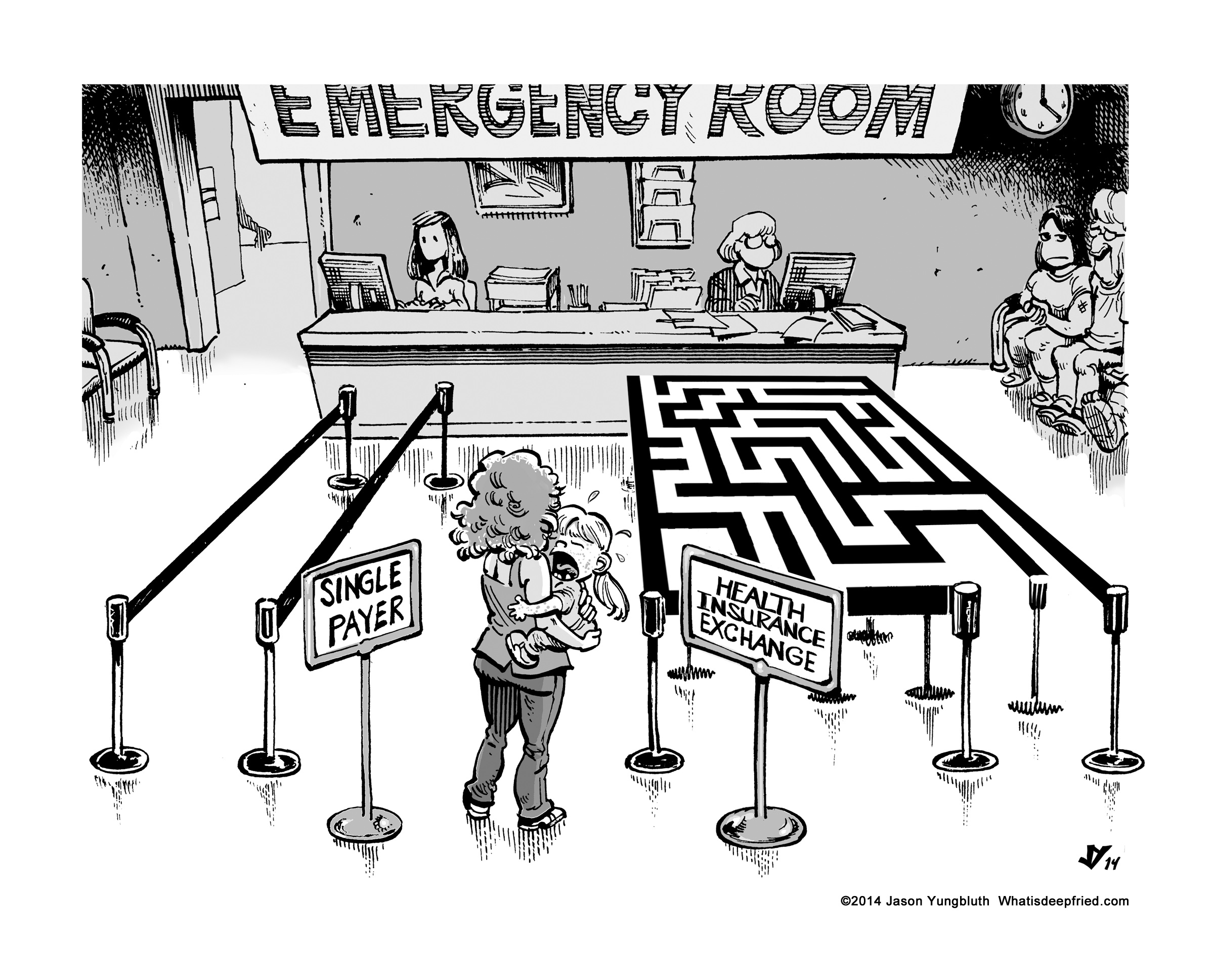
— He should present a convincing case that single-payer would be simpler than Obamacare, which was a cobbled-together compromise package. (Accompanying cartoon by Jason Yungbluth, provided to theVPO by the estimable Dr. Deb Richter.) 

— He should get strongly behind Dean Corren’s bid for Lieutenant Governort, including a lot of joint appearances. And he should urge the Democratic Party to do whatever it can to help Corren. A vote on single-payer in the Senate may well come down to a tiebreaking vote from the presiding officer. If you favor single-payer, do you want that vote cast by Phil Scott or Dean Corren?

— Turning, finally, from health care reform, the Governor needs to present ideas and show he has the energy to tackle other issues that are actually more pressing in the minds of voters: economic growth, school governance and taxation, and the general tax burden. 

— In gubernatorial debates, he needs to press Scott Milne (and Dan Feliciano, when he’s on hand) on the issues. He shouldn’t try to float above the fray, as if his opponents don’t matter. This is not so much for his own benefit, as for the cause of liberalism. He needs to remind people why they should vote for Democrats and Progressives. Too often, he has invoked conservative talking points to justify his moves to the center. He needs to cut that out. 

I think that covers it. I don’t want to see any prevent defense, and I don’t want even a hint of lofty entitlement. No taking the voters for granted. I want a strong, cogent, and relatable message that upholds the principles of modern liberalism and addresses the needs of Vermonters.

The only thing Vermont Gas has to fear is Vermont Gas itself

Our friends at Vermont Gas have been their own worst enemies when it comes to the proposed natural-gas pipeline near the state’s western border. Worse than the environmental groups opposing the pipeline. Worse than the small number of landowners resisting the project. Worse even than the Yippie-style provocateurs at Rising Tide, with their sometimes amusing, sometimes alarming tactics. 

In spite of the opposition, the pipeline would be sailing through to full approval if it wasn’t for Vermont Gas repeatedly shooting itself in the foot. The company has been overly aggressive with landowners, overly sensitive with protesters, and really clumsy when it comes to state regulators who would be happy to approve the project if only Vermont Gas could get its shit together. 

Vermont Gas is clearly the front-runner for Worst Public Relations of the Year. For a brief moment it looked like Burlington College would give VG a run for its money, but after a weekend of utter confusion around the kinda-maybe resignation of its president, BC righted the ship. At least for now. VG’s efforts have been consistently inept throughout the process. Its tone-deafk spokesman, Steve Wark, should be fired or moved to a back-office job. And whoever’s managing VG’s public relations (Jason Gibbs, I hear) seems to be committing professoinal malpractice on an unforgivable scale. 

The latest development came late last week, when the Public Service Board announced it would look into reopening the case because of VG’s 40% higher cost estimate. That revision was, obviously, a huge black mark on VG’s reliability. And it rightly calls into question the project’s feasibility, since its biggest selling point is cheaper fuel. And now, even while the PSB is pondering whether to reopen the process, VG says it’s proceeding with the eminent domain process with recalcitrant property owners. 

Whoa there, big fella. Take a breath. 

Vermont Gas’ top priority right now should be regaining the trust of the public and regulators. Seizing land and digging trenches should be secondary right now. If VG can show it’s acting in good faith, its problems will be minimized. 

The PSB and the Shumlin Administration are favorably disposed toward the project. (As are the vast majority of residents in the affected area.) Last week, Governor Shumlin asked the Public Service Department to hire an independent property appraiser to take part in any eminent domain proceedings that might occur. At first glance, he seemed to be drawing a line in the sand. But when you look more closely, he was providing Vermont Gas with a roadmap to approval. 

Shumlin said he would “leave it to the lawyers to determine this issue,” but said the constitution protects private property owners from land use “without just compensation.” 

… He said property should be used “hopefully by agreement, but if necessary, eminent domain.” 

Which is another way of saying, “Hey, Vermont Gas, stop pooping the bed and you’ll get your pipeline.” 

I’m not particularly exercised over the proposed pipeline. The furor over the notion of our state being tainted by “fracked gas” seems overblown to me. We face much direr environmental issues. But Vermonters tend to get especially upset over new stuff coming from the outside — while there’s sadly little furor over the bad things we’ve been doing all along. 

Such as the persistent fouling of Lake Champlain. And our often inadequate wastewater infrastructure. And our highest-in-the-nation rate of adult asthma, mainly a result of woodstoves. 

But my feelings are beside the point. The point is, the only entity that can defeat the Vermont Gas pipeline is Vermont Gas.

The limits of messaging

Just finished listening to a Reporter’s Roundtable on VPR*, with three of the better reporters around — VTDigger’s Anne Galloway, VPR’s Peter Hirschfeld, and the Freeploid’s Terri Hallenbeck– examining the entrails of last week’s primary election and the prospects for November. 

*Audio not yet available online, but it should appear here later today. 

Thin gruel, to be sure; the key races are essentially over, with the possible exception of Phil Scott vs. Dean Corren for Lieutenant Governor. But when the race for a mainly ceremonial position is your biggest source of intrigue, well, that tells you all you need to know. 

There was a lot of dancing around the fact that November is in the bag for the Democrats, with the noble exception of Galloway coming right out and saying that Governor Shumlin was going to win. The dancing is understandable, considering that (1) journalists want to appear objective, and (2) as political journalists, they’ve gotta cover this puppy for two more months, and what fun is it when there’s no intrigue? 

Much of the dancing centered on the idea that good “messaging” could carry a Republican candidate into a competitive position. The Dems aren’t invulnerable, the reasoning goes, it’s just that neither Scott Milne nor Dan Feliciano seems capable of delivering a solid, appealing message. 

That’s true, insofar as it goes. But there are three much more powerful factors operating against the Republicans: most voters pay little or no attention to messaging, the electorate is solidly center-left, and today’s Republican Party has little to offer on the key issues in Vermont. 

First, reporters and insiders overestimate the impact of tactics and strategy and messaging. The vast majority of voters have their minds made up before the campaigning starts. The only thing that could change their minds is some sort of shocking revelation or catastrophic event. Some voters do actually watch debates and bring an open mind to campaign coverage, but they only matter when an election is otherwise close. 

Second, it’s obvious from the results of the last decade or so that most voters prefer Democrats. The Legislature has been solidly Democratic for years. Among statewide Republicans, only Jim Douglas and Phil Scott have been able to buck the trend. Both have done so because of their unique personal appeal and by projecting an image of moderation and willingness to compromise. 

And third, Shumlin and the Dems are potentially vulnerable on issues like health care reform, the Department of Children and Families, the economy, taxation (especially school taxes), and the environment (Lake Champlain, the natural gas pipeline). 

On all those issues, the most appealing solutions involve more government, not less. Shumlin is more vulnerable to his left than to his right. 

In spite of Vermont Health Connect’s troubles, health care reform remains popular. Republicans have no answer aside from letting the market do its magic. Fixing DCF would require more resources, or at the very least more effective management. Have the Republicans given anyone reason to believe they care more than the Dems about poor people? Hell, no. Do the Republicans have a track record of good management? Only in the minds of Jim Douglas and Tom Pelham. 

Would the Republicans be better stewards of the environment than Dems? Ha ha. Can they plausibly portray themselves as defenders of public education, which remains extremely popular in Vermont? No; their only solutions are competition and union-busting. Can they convince voters that they’d preserve local control? Not if you could saw money by centralizing. 

On the economy, the Republicans have little to offer aside from the tired, discredited supply-side nonsense. Which took another bullet yesterday with the news (from the Federal Reserve Bank) that our post-Great Recession “recovery” has benefited the wealthy while middle- and working-class wealth has actually declined. One-percenters and corporations have a larger share of our wealth than ever, and all the Republicans can offer is policies that will further enrich the rich. 

And as for taxation, Vermonters may be dissatisfied with rising school taxes and worried about the cost of single-payer health care, but they also favor a robust government that can tackle problems effectively. Most voters don’t want a mindless “cut, cut, cut” approach, and that’s the standard Republican line. 

Here’s what a Republican would have to do, to be competitive on a statewide level: Bring an established reputation for effective governance, or at least an open-minded attitude toward the notion that government can actually solve problems. Express skepticism about political dogma, especially the cherished beliefs of the right. And do that without, somehow, losing too much support among the Republican base. And, finally, regain the support of the business community, which has largely abandoned the VTGOP in favor of a cooperative relationship with the Democrats. 

Now. If a Republican can identify and execute a strategy that accomplishes those things, s/he can win. Otherwise, no amount of good messaging will carry the day. It’s not impossible; there’s at least one potential Republican candidate who could manage it. But he ain’t running this year. 

Scott Milne’s missed opportunities

Yesterday, over at Green Mountain Daily, I wondered whether the Scott Milne campaign was a real thing or an Andy Kaufman-style work of performance art. 

Still wondering. 

In the last week before Governor Shumlin takes center stage, Milne is spending the vast majority of his time not campaigning. At least not visibly. Yesterday, he sat in on ex-Governor Jim Douglas’ book launch thingy in Burlington, which got him no attention whatsoever; and then, a few hours later, he got five minutes of free airtime on WCAX’s “The :30.” And, as I reported earlier, this was one of his more active days in a week when he should have been taking full advantage of Shumlin’s absence from the fray. 

Meanwhile, the other guy who has no chance of winning, Libertarian Dan Feliciano, was occupying the political spotlight with a clever maneuver straight out of Campaigning 101: Holding a news conference and delivering a simple, headline-friendly message. His reward: what must be the most widespread media coverage ever received by a Libertarian candidate for any office anywhere. 

Libertarian candidate for governor Dan Feliciano says Vermont Health Connect should be scrapped and the state should adopt the federal health care exchange.

Government is standing in the way of health care reform, Feliciano said. He also called Wednesday for the repeal of the state’s health care reform plan (Act 48), the elimination of the Green Mountain Care Board and a return to an open marketplace for health insurance.  

Feliciano said Gov. Peter Shumlin’s goal of creating a single payer health care model in Vermont is “fantasy.” 

He’s wrong, of course. Switching to the federal exchange would result in much higher costs for a lot of Vermonters. He’s also kinda self-contradictory: he wants government out of the way of health care reform, but he wants us to go along with Obamacare. To be fair, it’s a fait accompli, but still: it’s a bit rich for him to call government an obstacle to reform while calling on Governor Shumlin to accept the federal system instead of pursuing a uniquely Vermont approach. 

But my point here isn’t who’s right or wrong — it’s who won the day’s battle for attention. And Feliciano clearly kicked Scott Milne’s ass. 

While Feliciano was delivering a clear message, Milne was rambly and waffly on Channel 3. When asked about single-payer health care and his own idea for reform, he made like an octopus and squirted a cloud of ink: 

I think there’s people on the Governor’s extreme end of radical progressive legislative agenda, which believes uh without facts to back it up, without a plan for how we’re going to pay for it, uh without really a plan for how it’s going to work, believe that single payer’s going to solve all of our problems. I believe on the other extreme are people who don’t even want to consider it because it’s a government takeover of one part of the economy.

The primary plank upon which I’ll be running this campaign, and upon which I’ll be governing Vermont, ah is that we really need to be focused on what’s practical, uh not being driven by what’s a political ideology. So I think the, ah, Vermont Health Connect disaster is a great example of taking a political ideology from the top down, shoving it down the throats of Vermonters without really havin’ a plan in place. So, ah, our team is working hard to get a plan in place, ah, we’ll have very specific ideas for voters to talk about, think about, and hopefully use as one of many criteria for deciding to vote for Scott Milne for Governor in November.  

Got that? Shumlin’s plan is extreme and radical, but not out of the question. Also, Milne doesn’t yet have a plan of his own. 

Yeesh. 

According to his own absurd timetable, August was Phase One of the “unconventional” Milne candidacy, in which he would assail Shumlin’s record. Then, in September, he’d unveil his own agenda. 

Hello? It’s September Fourth. 

All that said, while Feliciano clearly won the battle for September Third, he still ain’t winning in November. However, if Milne keeps up this kind of stuff, Feliciano will be an effective spoiler — earning a double-digit share of the vote, and pushing Milne down into the 20s. The longer Milne goes on looking like a bumbler, or a performance artist, the more Republicans will abandon his cause and vote Feliciano out of disgust or desperation. 

Which would be very damaging to Phil Scott’s party-broadening project. The Milne implosion is emboldening the True Believers to continue resisting Scott’s plan. It could even lead to a blood-on-the-floor battle for control of the party after the election. And, worst case, a permanent split in the already-small VTGOP, with conservatives either joining the Libertarians or deciding to opt out Vermont politics entirely. 

And while the True Believers are a small group that cannot hope to win elections in Vermont, they are the most dedicated and supportive Republicans. Their absence from the VTGOP donor rolls has pushed its already-dire finances into virtual nothingness. 

If the VTGOP had managed to find a credible candidate — say, Heidi Scheuermann, or Phil Scott himself — it would still lose this year, but it might be on the road to self-reinvention as an influential political force. Instead, they’re saddled with Scott Milne. And whatever enthusiasm exists among Republicans is there for Dan Feliciano’s taking. 

Dave Yacovone’s astoundingly well-timed job opportunity

In a hastily-scheduled news conference, on the second working day after Governor Shumlin’s return from vacation, Dave Yacovone announced today he is resigning as head of the Department for Children and Families. He’s taking, as Paul “The Huntsman” Heintz puts it, “an undisclosed job outside state government.” He and the Governor both insisted Yacovone’s departure was “unexpected and entirely voluntary.” 

So why is my bullshit detector pinging nonstop? 

Perhaps because the timing is awfully convenient for an Admininstration wishing to put a controversy behind it. 

I have absolutely no inside information on this, but here’s what it looks like to me. DCF’s well-publicized troubles led to the forced ouster of Human Services Secretary Doug Racine on August 11. Three weeks later, Yacovone suddenly finds a new job. Which he won’t disclose. And which requires his immediate resignation. 

That last item is a big one. Usually, top administrative jobs are filled in the course of months, not days or weeks. Yacovone had to have been looking around for a while now. And transitions are built in to the timing, so an executive has time to ease out of the old job. Not Yacovone; he’s out the door right now. 

Doug Racine was fired, not for job performance, but for “style,” for failing to be a cheerleader for the Administration’s policies. Yacovone was a vocal defender of the agency’s work, so when it came time for him to go, he was allowed to pull the ripcord himself. 

Perhaps a nice job opening was even arranged on his behalf. 

The unspecified job is in Lamoille County, and involves human services in some form. Professionally, this has to be a significant step downward. There may be other factors in Yacovone’s case; he lives in Morrisville and he might want a job closer to home. He’s old enough that he might be looking to wind down rather than climb the ladder. 

This is all speculation. What isn’t is the timing: three weeks after Racine’s departure, and a few days before Shumlin formally begins his re-election bid. Time to shove a skeleton back in the closet. 

Personally, I don’t believe that DCF’s troubles warranted anyone’s departure, voluntary or otherwise. The Department has been chronically underfunded and understaffed, and the most capable administrator in the world can’t fully compensate for that. But political considerations are apparently more pressing at DCF than at Vermont Health Connect, whose problems, IMHO, are more serious and politically damaging. I’ll be interested to see if there are any conveniently-timed, face-saving departures at VHC in the near future. 

More on primary write-ins

A small addition to my earlier post about today’s Board of Canvassers certification of the primary results. 

In the Democratic race for Lieutenant Governor, Progressive Dean Corren took the nomination with 3,874 votes, or 60% of the total. Republican incumbent Phil Scott received 1,895 write-in votes on the Democratic line, or 40%*. And in the race for the Republican gubernatorial nomination, Libertarian Dan Feliciano managed to get 2,093 write-in votes in losing to Scott Milne. 

*Correction: Scott received 29.6% of the Democratic write-in vote. My mistake. I should never try to do math while blindfolded. 

Earning nearly 4,000 write-in votes is an impressive accomplishment for a, frankly, little-known candidate. Scott’s a well-established and well-liked figure, while Corren is a former State Rep who hasn’t been a candidate for any office since 1998. 

This is Corren’s second notable achievement in the campaign. The first, and more significant, was qualifying for public campaign financing. He must have a solid organization, and he must have some measure of appeal. We have yet to see whether a focused enthusiasm will translate into broad support from the public at large. 

At first glance, his 60-40 margin of victory over Scott, who wasn’t even campaigning for the Democratic nomination, doesn’t look too strong. If the primary electorate was representative of the general public, I’d say Corren is in serious trouble. But the primary voters — the 9% of all registered voters who bothered to show up — is a self-selected group of people with a strong interest in politics. Strong enough to cast a ballot in a relatively inconsequential primary. Scott’s 40% does not mean he can count on 40% of the Democratic votes in November; far from it. An indeterminate number of his votes were from Republicans taking advantage of (a) Vermont’s open primary, and (b) the complete lack of anything worth voting for on the Republican ballot. For many Republicans, the most constructive thing they could have done last Tuesday was to get Phil Scott on the Democratic ballot. That would have ensured his re-election. 

All that said, Corren remains a longshot. Phil Scott is well-known and well-liked, and the argument by people like Ed Adrian (that we need at least one Republican in a statewide office, and that Scott serves a valuable function in that role) is likely to have some resonance. Especially since Scott projects such a friendly, reasonable persona. And the Shumlin Administration’s continued bungling of Vermont Health Connect won’t exactly help Corren, who’s committed to single-payer health care. 

As for Feliciano, he took 93% of the Republican write-in votes for Governor. Or, about 13% of the total vote. It wasn’t enough to challenge Scott Milne, who had 72% of the total vote. A couple thousand write-in votes is a respectable number, but it’s not enough to indicate a real split among Republicans. But that could change; if Milne continues to stumble on the campaign trail and in fundraising, and it becomes clear that he poses no threat to Shumlin, then conservative voters will have nothing to lose by casting a protest vote for Feliciano. And if Feliciano finishes a solid third, he’ll push Milne into laughable-loser territory, and that would encourage the true believers to carry on their fight for control of the VTGOP. 

One housekeeping note. This was the first election in which town clerks were legally required to report their results on election night. Some failed to do so; 31 precincts out of 275. Secretary of State Jim Condos said, “We’ll reach out to towns that didn’t report on Tuesday night, and find out why they didn’t.” He speculated that there might have been confusion with a new reporting system, or ignorance of the new legal requirement. 

Condos is hoping for complete returns on time in November, but he doesn’t have a stick to go with his carrot. When the Legislature adopted the election-night requirement, it did not enact any penalties for failure to comply. 


The Friday Afternoon Newsdump of the Year

Gee, what a co-inky-dink. A new report on the rumblin’, stumblin’, fumblin’ rollout of Vermont Health Connect was released on Friday afternoon. 

Before Labor Day weekend. 

When Governor Shumlin was hundreds of miles away, at his vacation home in Nova Scotia. 

Ah, leadership. 

The report is pretty damning, and should have been tackled head-on by the Governor instead of being shuffled quietly out the door on a holiday weekend. It’s not too late; he could come back to work, express dismay at the report’s conclusions, take repsonsibility for administrative failures, promise to learn lessons and do better in the future, and maybe even fire a few people. 

Now, that would be leadership. And it would allow the Governor to launch his re-election campaign next Monday in a strong, purposeful, and accountable manner. Do I think that will happen? Eh, probably not. But it’d be nice. 

The report was written by Optum, the consulting firm that’s trying to fix the mess left behind by former contractor CGI. Topline, per VTDigger: 

A lack of leadership at Vermont Health Connect left the tech firm CGI unaccountable for work it was supposed to complete on the state’s health care exchange, according to a consultant’s report released Friday.


The state “ceded” responsibility for the project’s success to CGI, …and as a result, “CGI has not met its commitments.”

This is bad. This is not a technology issue in a super-complicated new system, as the Administration has insisted; it’s a failure of management on the part of Administration officials who should have been riding herd on CGI. Instead, the Vermont Press Bureau’s Neal Goswami says, 

Optum found that accountability for program management is unclear. “Neither (the state) nor CGI believe they are accountable for project outcomes,” the report says.

Am I the only one who’s appalled by that? CGI was fired for poor performance; but state officials failed to make CGI “accountable for project outcomes.” As any business-school professor could tell you, that’s fucked up. And if CGI deserved to be fired, so do the government officials who played a big part in its failure.

And none of those officials are named “Doug Racine.” 

Optum recommended that the state hire a project manager with experience in handling large-scale IT projects. State health care reform chief Lawrence Miller says the state is about to hire such a person. 

Well, huzzah. That’s a little bit late, isn’t it? 

In March, TIME Magazine published a cover story about how the federal health care exchange was on the brink of complete failure last fall. The Obama Administration realized, belatedly, that while they had a lot of policy expertise, they were woefully short in IT. So they basically called the Geek Squad: a team of IT experts from Silicon Valley “dropped what they were doing… and came together in mid-October to save the website. … Washington contractors had spent over $300 million building a site that didn’t work, this ad hoc team rescued it and, arguably, Obama’s chance at a health-reform legacy.”

You’d think, after all of that, the Shumlin Administration would have known it had a huge challenge on its hands, and that it required both IT expertise and intensive management oversight to fix the health care exchange. 

Instead, only now are we hiring an IT expert. 

On Friday, in the Governor’s absence, Lawrence Miller and Health Access Commissioner Mark Larson released the Optum report. And their statements were not at all encouraging; they downplayed the significance of the report and the need for further action. Miller called the report “something of a snapshot,” although as Goswami says, “the findings… are similar to previous assessments by independent parties.” In other words, this report may have been a snapshot, but the picture has stayed pretty much the same over time. 

Miller also said the Administration would use the report “to make decisions about the best way forward with the project.” Well, that’s half right. But you should also use the report to assess the failings of the past — so that you stop repeating them. 

For his part, Larson was even more determinedly lipsticking the Optum pig: 

“On a broad level what we have taken, generally, from this report is that we have worked hard with our vendor partners to create a foundation for Vermont Health Connect.” 

I’m sure they’ve all worked hard. But I’m not convinced that they have worked well or effectively. In fact, if the Optun report is accurate, a lot of the hard work has been wasted or misdirected thanks to a lack of accountability and oversight. Working hard is not an excuse for failing to deliver the goods. 

Oh, and the other news from the ultimate Friday afternoon newsdump: on Optum’s advice, Vermont Health Connect has stopped working on fixing the system. Instead, it will try to make the incomplete system more customer-friendly in advance of the November-February open enrollment period. Further work on fixing the system won’t resume until after open enrollment. 

Great. Even as Governor Shumlin is unveiling his single-payer health care system and asking the Legislature to approve it, Vermont Health Connect will still be an unproven work in progress. 

You know, if I were a lawmaker, I’d refuse to take any action on single-payer until Vermont Health Connect is fully functional. The Governor can’t, in fairness, ask lawmakers to vote for a huge new system as long as the health care exchange isn’t working. 

I’m fully aware that single-payer will actually be simpler than Vermont Health Connect. On a policy level it makes perfect sense. But on a political level, you can’t take the next step in the process until you’ve successfully finished the previous one. 

Beyond the immediate situation, bad as it is, I have a more existential concern. Governor Shumlin earned a reputation as a capable manager in his first term, thanks largely to his response to Tropical Storm Irene. The endlessly-troubled health care rollout threatens his reputation for good management. And that’s why I’d advise him to step up strongly and take his medicine. And, yes, fire  the people who failed to hold CGI accountable. 

If he doesn’t, I fear the best days of the Shumlin Administration may be over. When you’ve been in office for a while, and the opposing party is in disarray, there’s a natural tendency to relax a bit, start seeing yourself as invulnerable, and pay more attention to your image than to the quality of your work. That is the beginning of the end for great leaders everywhere throughout history. Is it the beginning of the end for Peter Shumlin? 

And for single-payer health care?