
Hey, let’s start with a tangent. Last week’s episode of “There’s No ‘A’ in Creemee” featured deputy state auditor Tim Ashe, now running to succeed the retiring Doug Hoffer in the big chair. And honestly, I thought Hoffer caught a couple of strays. Podcast co-host Andy Julow opined that during Hoffer’s tenure, the office has been “kind of a sleepy position” because Hoffer is not an “in front of a camera kind of guy,” There was no dissent from co-host Joanna Grossman or from Ashe himself.
To which I say, whose fault is that? Hoffer doesn’t chase cameras, but he does try to draw attention to the work of his office. Too often, that work is ignored by the news media and the Legislature. And that’s not his fault.
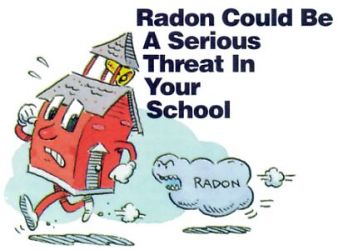
Take last week, for example. Hoffer’s office examined compliance with a law requiring Vermont schools to test their buildings for radon gas. As Hoffer wrote, “Breathing air with radon increases the risk of developing lung cancer and is the second leading cause of lung cancer deaths in the United States after cigarette smoke.” Seems like something we’d want to prevent — especially when it comes to the kids, no?
The law was adopted in 2021 and testing deadlines were extended the following year. As amended, the law required all schools to test for radon by June 30, 2025. However, as Hoffer reported, the law “did not include a reporting requirement.” Kind of a legislative oopsie there. Or a deliberate omission meant to defang the law while creating the appearance of Doing Something.
The result: No one in state government had any data, or any idea whether testing had actually been done. So Hoffer’s team did the work instead. (His report is downloadable here.)
Want to know the results? Our major media outlets apparently didn’t think so, because they didn’t bother covering it. There were stories on WPTZ-TV and in the Rutland Herald and Times Argus, but that was about it.
Anyway, the results and what they mean.
The vast majority of schools, to their credit, did respond to Hoffer’s inquiry. Of those responding, 69% had completed testing by the deadline and another 4% did so by the end of the year. That left a total of 68 schools that did not comply with the law. Some of them belatedly scheduled testing after being, um, reminded by Hoffer. Another 10 schools, all in the Southwest Vermont Supervisory Union, never responded at all.
Of all the schools tested, a total of 20 had radon levels at or above the EPA recommended action level. Those schools are listed in Hoffer’s report, along with untested and unresponsive schools.
One more thing: Hoffer did not include the so-called “approved independent schools” in his survey, probably because the state Supreme Court has ruled that his office lacks the authority to review the work of state contractors. He suggests that the Health Department do so.
Hoffer recommends adding a reporting requirement to the law. Will the Legislature amend the statute? Remains to be seen, but past performance suggests no. Legislative leadership seems to view Hoffer as something of a nuisance. On more than one occasion, I have seen Hoffer’s legislative testimony accepted without comment and without action.
And often, without any coverage in the media.
I’m also not optimistic because the Legislature appears poised to back away from its commitment to testing all schools for polychlorinated biphenyls (PCBs). House Education Committee chair Peter Conlon has introduced a bill that would end the testing program for quite a remarkable reason, as VTDigger’s Corey MacDonald reported last month.
Conlon calls the program “the mother of all unfunded mandates” because the state can’t afford to fund remediation. “If we’re going to do this,” he added, “we’ve got to put our money where our mouth is and say we’re going to pay for everything,”
And if we can’t do that, we kill the testing program and whistle past the graveyard, I guess? That’s where Conlon has ended up.
So I think Hoffer’s radon report will suffer the same fate as much of his previous work. Which has been thorough and valuable, and too often ignored. If Ashe is our next auditor, he’ll face the same struggle in attracting attention and having an impact.
 The Vermont Political Observer.
As you wrote above: “Hoffer doesn’t chase cameras, but he does try to draw attention to the work of his office.” Hoffer is a man of good and honest character. We need more like him in this world.
If re-elected to the Senate, I would introduce a bill that gives our auditor’s advice some teeth. I’m told some states have auditors whose recommendations must be heeded.
Would probably need to be a constitutional amendment, which is an arduous task. And our legislators are not fond of ceding power to anyone else. But hey, I wish you well.
Understand. Someone needs to get the ball rolling.
The only thing more impossible than “impossible” is to accomplish something if you never try.
Agreed on Hoffer. I wish he wasn’t retiring and the more he caught, the better off we are for it. We’ll miss him.