
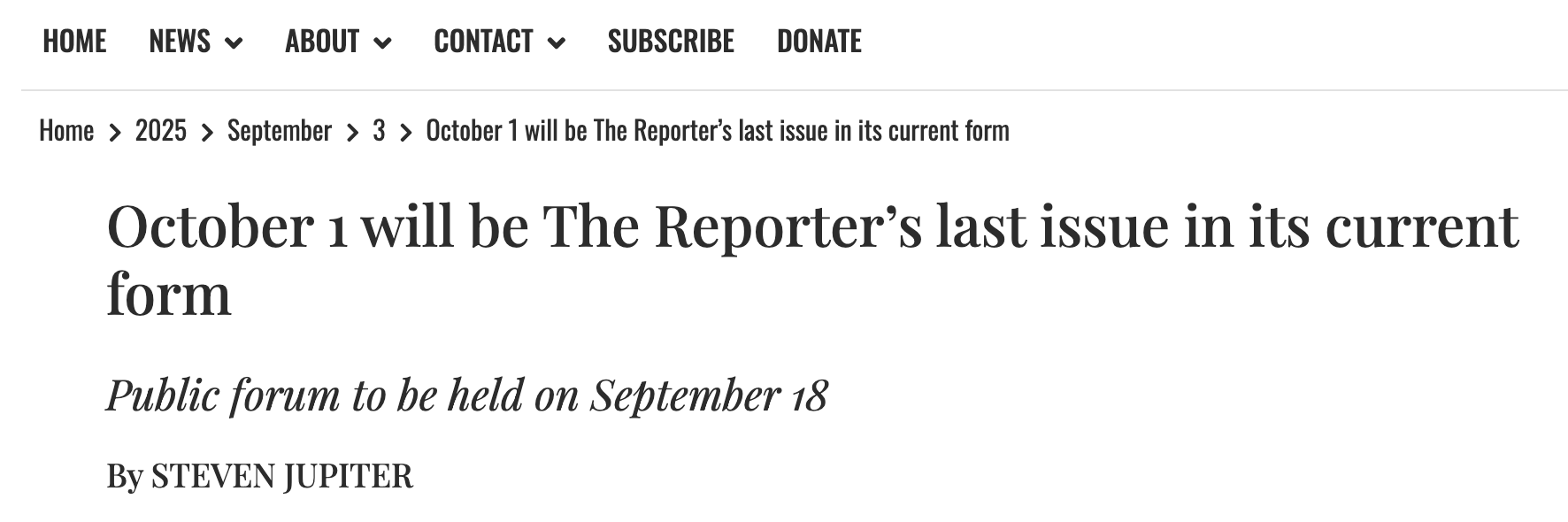
We interrupt our somewhat-regularly-scheduled feature, News You Should View, to bring you some sad tidings on the local journalism front. As related in the above headline, the nonprofit Brandon Reporter has announced it will cease publication in early October. Ironically, its self-proclaimed last gasp will take place the day before the University of Vermont’s Center for Community News begins its first national conference on university-led efforts to foster and support local journalism.
A bit too late for The Reporter, as it turns out. Although really, the conference is aimed at a much higher level and, even if The Reporter still existed on October 2, would have had little relevance to the struggles of a small, local journalistic nonprofit. But more on that in a moment.
As described in Steven Jupiter’s story, The Reporter had been owned by The Addison Independent, but in 2022 it was sold (or given, it’s unclear) to a group of Brandon residents determined to reinvent The Reporter as a nonprofit. They did their level best, but have now decided to call a halt. Jupiter and his colleagues are painfully aware that, absent a local newspaper, the Brandon area will become a news desert — a place where there is effectively no real coverage of local events. So they’ve thrown a bit of a Hail Mary, hoping that The Reporter might continue in some form.
The nonprofit’s leaders will hold a forum on Thursday, September 18 at the Brandon Town Hall “to help the community decide what kind of paper it wants and can sustain.” They’re hoping for an influx of energy and new leadership, because they themselves have nothing more to give.
I can relate. Being on the board of The Hardwick Gazette brings plenty of hope, but it can seem like an endless slog. The community goodwill is there — I wouldn’t be surprised to see a strong turnout at the Brandon meeting — but turning that into concrete action, in ad sales and reader support, is a difficult task. Readers aren’t accustomed to directly supporting local papers, and the staff don’t have the skills or experience in leveraging positive impressions into actual dollars.
I wish The Reporter and its community all the luck in the world. They’ll need it, to be honest. They’ve already burned through one set of dedicated volunteers, and now they’re looking for a bunch of replacements. It’ll take a lot more than noble intentions.
Meanwhile, in the floating sky city of Elysium, we find academics, funding organzations, and leaders of larger journalistic nonprofits (the Vermont Publics and VTDiggers of the world) gathering at UVM for a conference in early October where the official (discounted?) hotel accommodation runs a cool $299 per night. Must be nice up there.
The conference is one expression of an enterprise with pure intentions, plenty of talented people, and a fair bit of philanthropic cash behind it all. The conference is entitled “The Impact of Student Reporting.” The full agenda has yet to be published, but presumably the “student reporting” reflects the Center for Community News’ own efforts to use journalism students as interns and on-demand reporters for understaffed enterprises.
They’ve done a lot of good work. But in terms of securing the future of journalism, it’s kind of a band-aid on a broken arm. Providing student reporters doesn’t do anything to address the fundamental economic problems of real-world journalism. It’s nice to get a little more help, but really, we need to create an industry that can provide good livings to its workers and build staffs commensurate with the demand for local journalism without resorting to student reporting. CCN’s model is really aimed more at solving a problem for journalism schools than for boosting the industry; giving students the opportunity to create content for actual outlets is a great advantage for the educational program and its students.
If CCN’s primary focus was on the industry’s real problems, they’d be working with UVM’s business school to research and develop pathways for success in nonprofit journalism. And they’d be offering internships in financial management, donor solicitation, and advertising sales as well as reporting.
There’s also the issue of students’ lack of experience with boots-on-the-ground journalism. The Gazette has had some good, smart interns, but none have been prepared for the brisk pace and quick deadlines of a local paper. By the time they get their feet under them, their internships are over and they’re headed back to campus with a valuable new line on their resumés.
But that’s a relatively small point. CCN is trying to develop similar enterprises at universities across the country. It’s a worthy endeavor, and I wish them success. But to the foot soldiers of 21st Century journalism, it seems like it’s all taking place on another planet entirely. Or at least in a luxurious space station in distant orbit. (Last year, CCN was awarded a $7 million grant from the Knight Foundation to expand its journalism training programs. That’s great and all, but when my paper has to work really hard to generate a few thousand bucks, I have to wonder how much good that $7 million could have done if it was aimed more directly at the actual needs of the industry.)
Meanwhile, those of us trying to keep local journalism alive are taken aback by the failure of The Brandon Reporter. Our own effort at The Gazette is a couple years younger than theirs. We’ve experienced setbacks and missed payrolls, and our capacity to take on new efforts at generating revenue is extremely limited.
I can easily see a future, two years down the road, where our communities have rallied behind The Gazette and provided the resources needed to make it sustainable. But I can also see a future where we’ve continued to struggle and used up the energy, resilience, and patience of ourselves and our staff. The future of The Gazette is not yet assured, and the same can be said of the local paper in your community. There’s a lot of work to be done, and a lot of questions that need good answers.
 The Vermont Political Observer.
FWIW: By treating this as a primarily economic problem, solutions will be primarily economic – and in the current economy (where short-term financial profit is virtually the _only_ metric of all decisions), this ensures failure. Because it’s precisely how and why we got here.
We can’t “economic” our way out of the problem.
BTW: Because this is true in _many_ areas, the necessarily broader thinking is going on all over the place; ex: https://rushkoff.substack.com/p/borrow-a-drill-save-the-world