
Welp, the other shoe has dropped. Two months after the death of NASCAR legend and central Vermont radio mogul Ken Squier, the stations of Radio Vermont have been sold. Depending on which source you trust, the new owner is failed Republican candidate (and very briefly head of the Ethan Allen Institute) Myers Mermel (Radio Vermont press release) or Mermel and failed Republican candidate and travel mogul Scott Milne (VTDigger). The press release, posted at the Vermont Daily Chronicle, lists Milne as “an investor” and “key advisor,” while Digger bills him as a full partner. Either way, the two men are deeply conservative. Milne somehow got a reputation as a moderate, but he’s a lot less moderate than Phil Scott.
The crown jewel in the Radio Vermont firmament is WDEV, a throwback of a locally-owned, community-oriented station with a mixed format of news, talk, music and sports. The station bills itself as “a forum for all voices to be heard,” although in recent years the loudest voices have come from the right. I expect that trend will only accelerate under its new Republican ownership.
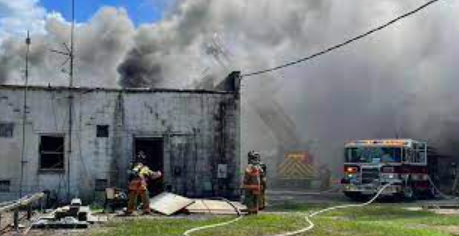
Coincidentally, the call letters “WGOP” are probably available for pocket change. The letters are currently assigned to a tiny AM station in Pocomoke City, Maryland, whose building was destroyed by fire in August 2022. It’s been off the air since then.
I’m a bit sad that the Squier family has exited the scene after owning WDEV since its founding in 1931. I’d be more dismayed by the partisan lean of the new owner/s, except that the station — and all of terrestrial radio — is a mere shadow of its former self.
Long gone are the days when local radio was a cornerstone of community life. WDEV makes an admirable effort, but I have to think its audience and revenue have suffered the same kind of shrinkage as the medium in general. Who listens to radio anymore? I’m old, and I’ve almost entirely switched to music streaming and podcasts.
More to the point, who advertises on commercial radio anymore? It used to be that any local business with a promotional budget would have no choice but to buy time on the local station because it was one of the best places to reach their customers. These days if you pay attention to the ads on WDEV, you’ll hear a goodly quantity of local ads in morning drive time — but otherwise, there are few local spots at all. The ad time is largely occupied by national spots that the station is required to carry in exchange for syndicated network programming.
Broadcast licenses used to be valuable commodities. Depressing as it was that licenses originally granted with an obligation to serve the public interest had become commodities, they generated big profits for a handful of giant corporations that came to dominate the radio scene as federal limits on ownership were lifted and lifted again during and after the Reagan years.
One of those giants, Audacy (formerly Entercom), just declared bankruptcy. iHeart Media (formerly Clear Channel) is in private equity hands so we don’t know how they’re doing, but before it went private it was burdened by heavy debt generated in all its acquisitions. The days are over when they and their fellows would stomp across the country like apatosauruses, scooping up licenses like foliage.
I’ve been told by one source that the purchase price for Radio Vermont was in the $500,000 range. That might seem like a lot of money, but trust me, it’s not. Back in the early 90s I worked for a Squier-type operation in another state — a mixed-format, community-oriented station owned by a local rich guy. Near the end of his life he started liquidating assets and in 2003, about ten years after I’d left for greener pastures, he sold the station.
He’d gotten two offers: One from a locally-owned broadcaster that intended to keep the station as it was, and the other from a big national corporation. He sold to the latter, and the station’s format quickly became a cookie-cutter outlet for conservative talk and canned music.
The local offer was in the range of $1.5 million. The second was somewhere north of $2 million. It was a rounding error in that guy’s portfolio, but he grabbed the cash and ran.
Twenty years ago, and a single AM station (albeit in a larger market) sold for four times as much as the entire Radio Vermont group? That is, of course, if my source is correct.
To be perfectly honest, I think it’ll be hard for Mermel to realize any profit from his investment. There might be a path forward for a station like WDEV, if ownership went full-tilt with the community orientation and got really creative in the process. And if he has ambitions of using his radio platform as a launching pad for his own political career or an influential voice in our marketplace of ideas, he is badly mistaken.
But I will wish him well. I’d like to see WDEV continue to exist as something of a community resource, and I’d like to think that Mermel will want to invest in making the station a better place to work and something of a public common for central Vermont.
I don’t expect to see it, but I’d like to.
 The Vermont Political Observer.
“I don’t expect to see it, but I’d like to.”
Me neither. I haven’t listened to radio for decades now. I got sick of listening to all the stupid ads. I definitely won’t listen to WDEV now with these two in charge of it.
John, I always enjoy reading your work. I may not always agree with you, but I appreciate your insight and courage to try to make sense of events around us. Also, you are very funny. I think of you as our modern-day Mencken, a brilliant public intellectual whose biting criticisms still ring true in some cases. The WGOP idea is pretty funny, and it made me laugh. Thank you for that. And for your concluding well wishes. I too am saddened by the loss of Ken Squier: he made a significant contribution to Vermont by continuing the community radio format his father built. Community radio really does bring the community together. And you are right; community radio has become a rare format. But when you wrote, ”There might be a path forward for a station like WDEV, if ownership went full-tilt with the community orientation and got really creative in the process,” that’s what we want to accomplish. That’s exactly what we want to do. Community voices mean all voices, and our state community is decidedly more liberal, independent, and progressive than conservative. We need to reflect that if we reflect our community. We aren’t building Fox News nor are we building MSNBC. We intend to continue the Squier legacy of including everyone. However, we also intend on expanding local coverage at WDEV and diving even deeper into events happening here in Vermont. That’s what people care about. That deep local coverage is what you do, right? And it works for you, doesn’t it? Just one thing. I would say that the stations are much more economically vibrant than you think. And there are a lot of advertisers. Advertisers use WDEV because it makes them relevant; they become part of the conversation across the entire state. Remember, radio is free and in every car. Substack, better podcasts, prized reporting, and Spotify are not free. I think the tropes of the death of radio, the death of radio advertisers, and the death of community radio just do not hold true. I know you “don’t expect” us to do the right thing because we aren’t your favorite flavor—but we may surprise you. Despite your doubts, I may actually be creative. Getting RFK JR to speak in Burlington wasn’t cookie cutter. In the meantime, I look forward to reading more of your work, and I would pay a reasonable subscription to do it. Best, Myers Mermel