Monthly Archives: September 2014

How pertinent is a candidate’s past? A case study

Update: Some of what I write in this post is not true. The candidate has, in fact, spoken publicly about his past. Please see the following correction for the full story and my apology. 

The other day I got a tip. It was about a candidate for the legislature who had  supposedly been charged in another state with running an investment scam, pled guilty to a reduced charge, and served time in prison. Since his release, he has apparently kept his nose clean. Indeed, he became something of an inmates’ rights activist.

He later moved to Vermont, where he has continued on the straight and narrow. He’s now running for State House. He hasn’t revealed his criminal past, nor has anyone reported it, although it can be found through a simple Google search.

The story is more complicated than the original tip would suggest. And I pondered whether I should let it alone. After all, he seems to have reformed himself, and everyone deserves a second chance.

In the end, after much thought, I decided to write this post. The deciding factors: His offense was a serious one — he was accused of bilking investors of as much as $150,000. This happened relatively recently, roughly ten years ago. He was under court order to repay his victims, and as far as I can tell he has failed to do so. And he has not revealed his troubles; his campaign bio carefully omits any hint of his criminal offense and incarceration, even as it trumpets his advocacy for inmates’ rights.

My conclusion: His offense doesn’t disqualify him from public service, but the voters deserve to know and have the opportunity to make their own judgments. It appears to me that the candidate could tell a powerful and believable story of redemption. But he needs to explain why he deserves the public’s trust.

The candidate in question is Janssen Willhoit, Republican hopeful for the State House in St. Johnsbury. His story:

In June 2004, Willhoit was arrested on charges of “theft by deception.” His victims included the mayor of Stanford, Kentucky. The details:

The investment scam was first reported by Stanford Mayor Eddie Carter, said [Stanford police detective Rick] Edwards. Carter had reportedly invested more than $50,000 of his personal money with Willhoit’s false company, Net City. Net City, which promised investors high interest rates, was supposedly a subsidiary of National City Bank. But when Carter called to check on his account, he was told the number was a phony.

… False investment paperwork had lulled the victims into trusting Net City by indicating the company was a affiliated with Met Life Insurance companies and of legitimate financial protection companies, Securities Investor Protection Corp. and NASD. Officials from the bank and Met Life confirmed that Net City was never an associate during that time, police report.

… Investors’ cash is thought to have been used to support Willhoit’s comfortable lifestyle before his arrest.

In August, Mayor Carter filed a civil suit against Willhoit. He quickly won, and was awarded $55,000 in restitution and damages.

In November 2004, Willhoit agreed to a plea deal that would have let him avoid prison if he repaid his victims. The first step in that process was to post a $10,000 bond, followed by monthly payments of $600.

But in December, he was back in court:

Janssen Willhoit, 25, who swindled approximately $95,000 from three Stanford residents through a phony company, was sentenced to 10 years in prison with the possibility of shock probation.

… Willhoit faced Circuit Judge Robert Gillum without having paid the promised money. Both the judge and Assistant Commonwealth’s Attorney Daryl Day expressed their frustration with the development.

“He doesn’t have the $10,000,” said [defense attorney Mitchell] Berryman. “It leaves us in a quandary.”

“It doesn’t leave me in a quandary,” Gillum said. “I guess he’s going to serve some time then. He’s obviously not going to meet the conditions of probation… He lied to the court.”

In February 2005 Willhoit was back before Judge Gillum to request “shock probation,” which is sometimes granted inmates — usually first-time offenders —  after they’ve been in prison for a short time. The idea is that being behind bars might “shock” a person into changing his ways. But the judge wasn’t buying it. 

Lincoln Circuit Judge Robert Gillum, who handed down Willhoit’s sentence last year, again had stern words for the swindler. Gillum said Willhoit lied to the court in the past by promising to, but not posting, a $10,000 bail to be used as restitution money. Gillum said Willhoit was a flight risk, despite his claims otherwise, and denied the motion.

Screen Shot 2014-09-21 at 10.01.59 PMWillhoit went back to prison. I haven’t been able to determine exactly when he was released. He was definitely out no later than 2009; in February 2010 he testified before a state legislative committee in favor of a bill to allow former inmates to regain their voting rights. He described himself as a former inmate. (Accompanying image is from the video of his testimony.)

Later that year he moved to Vermont and began studies at Vermont Law School. After graduating, he moved to St. Johnsbury and joined the law firm of Willey & Power.

Earlier this year, Willhoit launched a campaign for State House. In the August primary, he came in second in a three-way race for two Republican nominations, advancing him to the November election.

Willhoit’s campaign bio barely mentions his life before 2010. It does boast of his volunteer efforts after Tropical Storm Irene, his work as a public defender in the Northeast Kingdom, his active membership in a local church, and his work mentoring prisoners.

It also proclaims his commitment “to serving the least among us” without ever mentioning that he used to be one of the least among us.

As I said earlier, I don’t believe that Willhoit’s criminal past or his apparent failure to make restitution should disqualify him from the Legislature. (Insert snide comment about the probity of State House denizens here.) But the people of St. Johnsbury should know about it, and he should fully explain the circumstances of his offense, whether he has repaid his victims, and if not, why not. After that, the voters can make an informed choice.

Copy editors? We don’t need no stinkin’ copy editors!

On Friday, Governor Shumlin released his 2013 income tax form. The Freeploid’s Nancy Remsen  wrote up the story… which included this little gem:

He lists five vehicles, a boat and farm equipment with total value of $128,300. One car, a 1964 Porsche, is valued at $55,000. The other vehicles are older and much less valuable. Since becoming governor, Shumlin gets little chance to drive as he is always chauffeured by his State Police guards.

Huh. Five vehicles. One is a 1964 Porsche. The others “are older.”

Let me guess…

— 1962 Chevy Nova

— 1958 Trabant P50

— 1952 Nash Metropolitan

— 1951 Fuldamobil

— 1948 GAZ-M20

Yeah, that sounds about right.

Funny; I would have guessed that our millionaire Governor would  own at least one car newer than 1964. But hey, the Freeploid reported it, I believe it, and that settles it.

Dems endorse Corren, but their assistance will be limited

The Democratic Party State Committee, meeting today in Montpelier, formally endorsed Dean Corren, the Progressive Candidate for Lieutenant Governor, who had won the Democratic nomination in the August primary as a write-in candidate.

The vote was 31 for Corren and 4 against. I’d presume that most or all of the “no” votes concerned Corren’s strong support of ridgeline wind power. At his debate with incumbent Phil Scott, Corren referred dismissively to the “imagined horrors” of wind farms.

All those who spoke at the meeting were strongly supportive of Corren; Windham County chair John Wilmerding called him “a crucial addition to our slate” because of his advocacy of single-payer health care.

However, thanks to potential conflicts with campaign finance law, the Democrats will not share their database or voter lists with Corren, and he will not take part in the Dems’ Coordinated Campaign.

Some Dems had earlier voiced concern about sharing the party’s robust data with a longtime Progressive who might well pass it on to his fellow Progs. Democratic Party officials said there would be no sharing — but not because of concerns about sharing, but because of legal limits on tangible support to a candidate who has accepted public financing, which Corren has.

Under the law, a candidate who takes public financing cannot accept additional contributions. And because of “the proprietary nature” of the party’s data, said Executive Director Julia Barnes, sharing the information or adding him to the Coordinated Campaign would be considered a donation to the Corren campaign.

There was one hint of Dem/Prog friction. Former party staffer and candidate for Burlington City Council Ryan Emerson McLaren* noted Corren’s vocal support for Democratic candidates, and urged Corren to make the same plea to the Progressives in Burlington who, Emerson said, might nominate a candidate to oppose Burlington’s “fantastic mayor” Miro Weinberger. Emerson asked Corren to urge the city’s Progs to support Weinberger’s bid for a second term. At the meeting, Corren offered no immediate response; nor did he really have the opportunity to do so.

*Please note corrected error: it was not Ryan Emerson, but Ryan McLaren, who raised the Burlington issue. My mistake, and my apologies to Ryan Emerson. 

One other tidbit of news from the meeting: Three statewide Democratic officeholders who won their respective Republican nominations in the August primary because they finished first in write-in votes have all decided to decline the VTGOP nomination. Auditor Doug Hoffer had previously announced he would decline; Secretary of State Jim Condos and Treasurer Beth Pearce have now joined him.

Which means a bunch of big embarrassing vacancies on the Republican ballot this fall. Good times.

Mahatma’s meltdown

Scott Milne, the man who famously called himself “Gandhi-like,” is finding that it’s awfully hard being a pacifist when the bullets are flying. He made an unplanned call to WDEV’s Mark Johnson Show on Friday morning and… well… spent about 20 minutes ranting about the media’s unfair treatment of the Milne campaign. And specifically impugning the good name of Our State Pundit Laureate, Eric Davis. That will never do, Mr. Milne.

Davis had been a guest during the first hour of the program. He and Johnson discussed the gubernatorial race. The consensus was that Governor Shumlin had left himself vulnerable because of various scandals and issues. And that it’s too bad the Republicans didn’t have a better candidate, because Scott Milne had made a mess of things.

Apparently it was enough to make even a Gandhi-like person’s blood boil. A little while later in the show, Milne called in to rebut Davis’ analysis. Or to slap it around, anyway. At great length and in pretty extreme terms: at one point, he accused Davis of “laughing at me.” Sorry, Mahatma, I don’t think I’ve ever heard Eric Davis laugh at anyone. If he’s anything, he’s a straight arrow, cautious to a fault.

Here’s a sample of Mahatma’s Meltdown:

When you’re bringing people on the air that influence people with, ah, you know, tenured professorships from elite institutions, you need to ask the tough questions and bring out the contradictions in what they said. If you look back on Mr. Davis’ track record of picking things in Vermont over the last few elections, it’s not stellar. And I think it’s a form of, uh, you know, uh, you know, journalistic malpractice. You just let him get away with saying some of those things.

I’m sure the folks at Middlebury College are happy to be considered an “elite institution,” but otherwise, good God. Eric Davis’ track record hasn’t been perfect, but it’s been awfully good. That’s why he’s the go-to political analyst for Vermont media. He knows his stuff, he’s conscientious, he doesn’t take chances, and he certainly doesn’t engage in gratuitous attacks. He has earned the respect he is given by the media and by news consumers.

Milne railed against the notion that his campaign lacks ideas. Which isn’t accurate; what we say is that he lacks policy positions and proposals. Milne’s definition of “idea” includes such things as “Peter Shumlin spends too much time out of state” and “the economy isn’t growing quickly enough.” What Milne is criticized for is his real, true, honest-to-God lack of proposals. He tries to make this a virtue by saying, on issue after issue, that he’s going to get all parties together and work out the best solution.

That’s awfully thin gruel. And besides, his current definition of ideas is at odds with what he was saying earlier on: that he would spend August attacking Shumlin, and start rolling out his own proposals in September. He hasn’t delivered on Part 2. “Give me 30 days,” he said on July 25. It’s been 50 days since then.

Milne also repeated one of the more extraordinary statements he’s made during the campaign:

I am uncomfortable about calling people and asking them for money to support a public policy campaign, and feeling 100% like I don’t owe them something afterwards.

I guess you could say that has a certain freakish nobility. But it’s a fantasy: Politicians have to raise money. Yes, there’s too much money in politics. But Milne has raised a laughably small amount — and virtually all of it from his family, friends, and his own back pocket.

Now we know why. He doesn’t want to ask for money, and he doesn’t want to be obligated.

Somebody should. tell Phil Scott about this. He’s been raising money right and left from contractors and gas companies and rich Vermonters and his vast network of cronies, and insisting that it doesn’t make any difference in his politics. Scott Milne would beg to differ.

Somebody should also tell the Scott Milne of midsummer about this. At the time, he said he planned to raise and spend about $200,000, which would be enough to wage an “unconventional campaign.” As of early September, he’d raised about 20% of that total. And since then, his full-time professional campaign manager has resigned. And we haven’t seen any TV ads or mailings or yard signs or any other tangible measures of an adequately resourced organization.

Milne was upset Eric Davis’ characterization of his campaign as “running on fumes.” He said, “If [Davis] hasn’t talked to my bank, he has no way of saying that.” And he pointed to his paid staff of five people as evidence he had money.

And then he contradicted himself.

We’ve got a strategy. Granted, it’s not perfect. I’m going to make mistakes. But I think our strategy is, you know, we’re running an insurgent campaign. We’re going to use our lack of money as best we can as an asset.

“Our lack of money.” Yep, he said it.

And about this “insurgent campaign” stuff. Yes, Milne is running an unconventional campaign. And yes, Eric Davis and Mark Johnson and me and all the rest of the punditocracy are basing our judgments on political convention: you have to take time to build name recognition, you have to generate news coverage, you have to have a robust infrastructure from the central office to the grassroots, you have to have a decent amount of money to run advertisements and do mailings and staff phone banks and print signs and all that other stuff of retail politics. You have to have ideas and positions that give people positive reasons to vote for you. You need a certain capacity for public speaking and pressing the flesh and handling the media.

And, preferably, you need a track record of accomplishment in the public sector.

Scott Milne has none of that. And he’s made a bunch of obvious blunders.

And so, when measured against every available standard for judging a campaign, Milne comes up short.

Now, if his “insurgent campaign” taps into a vast unseen reservoir of support, then all us conventional thinkers will get our asses kicked on November 4.

And I, for one, will be more than willing to admit I was wrong.

But I am extremely confident that I’m not wrong.

Of course, if Milne loses it’ll be Eric Davis’ fault.

What I need are people who want change and balance in Montpelier, to be naive enough to believe that they can make a difference by voting. And having people like Eric Davis that don’t think that, there’s a  lot of that, but somebody like you giving him a microphone week after week, when he’s got a track record he has of saying things that are factually inaccurate, I believe he purports an awful lot of opinions like they’re facts and you let him get away with it, and I don’t think that’s fair.

He went off the rails in mid-sentence there, but his point was that Eric Davis’ negativity was going to keep him from building momentum, and cause him to lose the election.

Sigh.

Like I’ve said before, pundits and reporters and even little old partisan bloggers like me simply don’t have that kind of influence. The vast majority of voters have already made up their minds. And the rest of ’em won’t spend the next seven weeks poring over media coverage of the campaign. The crowd of political junkies who pay a lot of attention to this stuff is a very small crowd indeed.

No, Mahatma, Eric Davis won’t kill your insurgency by the power of his punditry. Peter Shumlin will kill it with his superior organization, warchest, and advantages of incumbency. The Vermont Republican Party will kill it with its nonexistent grassroots organization, lack of resources, and internal divisions. The voters will kill it because a solid majority of them are liberal or progressive, and the Democrats have a built-in advantage.

And Scott Milne will kill it with his lack of political experience and smarts, and his poor performance on the public stage.

By all conventional measures, Scott Milne has run a terrible campaign. And I’m a guy who, when Milne first came on the scene, had some hope that he’d turn out to be a solid representative of moderate Republicanism. If he were doing a good job, I’d be reporting as such. But he’s not.

The Scott Milne Policy Watch Continues

It’s beginning to seem like a distant memory, or perhaps just a fever dream.

Remember when Scott Milne promised to roll out his platform in September?

If you do, it’s probably because I keep reminding you.

The Ghost Campaign in the flesh

The Ghost Campaign in the flesh

Well, here it is September 19th, and the only shred of policy we’ve gotten is an ill-thought-out proposal to freeze property taxes for two years while we figure out a new system. No hint of how local schools are supposed to cope with rising costs for salary, benefits, and energy, among others. And no clues about the kind of system Milne would like to implement.

Anyway, on Thursday Milne made an appearance before “30 people” at the Colchester-Milton Rotary. (I wonder hwo many left after the raffle and before the guest speaker.) And perhaps out of sympathy, Seven Days sent reporter Mark Davis to cover it. 

Which produced this nugget:

Milne offered few specifics of his agenda. At various times, he told the 30 people in the crowd that he would release his own plans for health care, education and job creation in the coming weeks.

Cough.

“In the coming weeks”?

Weeks?

WEEKS?

Will somebody please remind Our Man Mahatma that Election Day is only six and a half weeks away?  I’m concerned that his Staff Fabricator may have convinced him the election is actually in November 2015.

The most significant thing about Governor Shumlin’s first TV ad of 2014

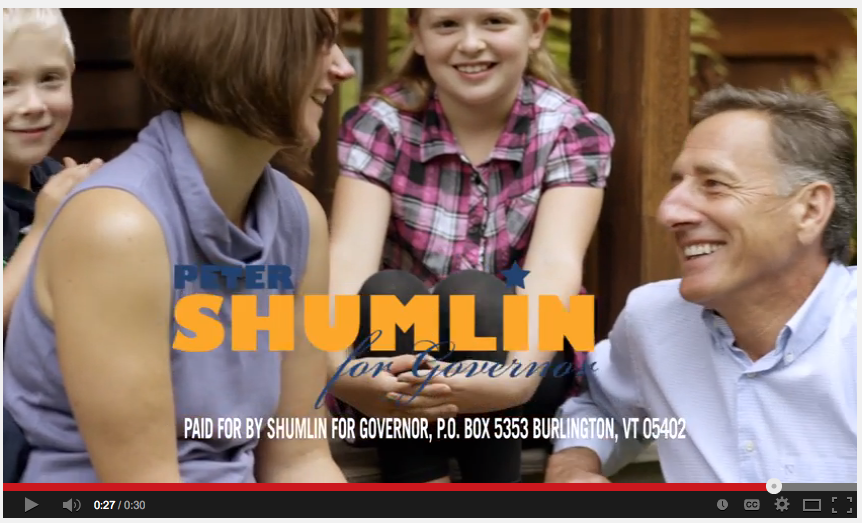
The Shumlin campaign has taken to the airwaves with a 30-second commercial that features real-life Vermonters who have benefited from Shumlin initiatives. The aim of the ad is to remind viewers of the administration’s many accomplishments — to counteract the stream of bad news about Vermont Health Connect and the Department of Children and Families, and to remind liberal voters that the Governor has, indeed, delivered on many of his promises.

All he needs is rainbows and unicorns.

All he needs is rainbows and unicorns.

Pretty standard stuff, and it’s been duly reported in the media. But they haven’t noticed* the most significant thing about the launch: its timing.

*Correction: All but one of them failed to notice. Sevan Days’ Paul Heintz reported it two days before I did. That’s why they call him The Huntsman.

In 2012, the Shumlin campaign didn’t take to the airwaves until roughly two weeks before Election Day.

This year, the campaign hits your TV screens almost a full month earlier.

According to campaign finance reports, the Shumlin camp spent $125,000 on ad buys in 2012. Campaign manager Scott Coriell isn’t saying how much they’ll spend this year, but it figures to be a lot more.  They’ll be filling airtime for six weeks instead of two, so it’s fair to guess that they’ll triple their spending this year. Or more.

So, why?

In 2012 Shumlin faced an underfunded, underorganized, mismanaged opponent. Shumiin’s re-election was never in doubt. This year, he faces one opponent who’s far worse in all three categories, and another who represents a fringe viewpoint with a proven track record of appealing to a sliver of the electorate. Recent polls (and deeply flawed polls at that) notwithstanding, his re-election is once again in the bag.

But the Governor isn’t aiming his campaign at the broad electorate. He’s trying to pump up the base and generate higher turnout by core Democratic voters. Hence the reminders of popular Democratic initiatives.

If he can get a pure majority of the vote — at least 50% plus one — he’ll have a lot of political capital to spend in next year’s debate over single-payer health care.

But if he wins with a plurality and, worse case, he gets fewer votes than the Republican and Libertarian candidates combined, he’ll have a lot less pull with the Legislature. And right now, he’s polling in the mid-40s. He needs a boost.

Plus, of course, the higher his vote total, the more Dems and Progs will ride his coattails to victory. And he’ll need every liberal vote he can get, if single-payer is to pass next year.

That’s the significance of the early TV launch this year.

Who’s writing the headlines @MilneforVT?

News release just landed in my inbox from the Scott Milne campaign:

POVERTY NUMBERS INDICATE A NEED FOR CHANGE

Mm. Mm-hmm-hmm. Mm-hmm-heh-heh-HAHAHAHAHA.

From Clipboard“Poverty,” “Need for Change.” Get it?

I’d say somebody chez Milne has a sly sense of humor, but the truth, I suspect, has more to do with cluelessness.

The rest of the press release is unimaginative bumpf about Governor Shumlin’s reckless spending. Nothing at all about job creation or what Scott Milne plans to do. Just a mindless, poorly aimed attack-by-the-numbers.

With a really stupid headline.

The Burlington Free Press: Your Shameless Hometown Daily

Last week, I called attention to a bit of hypocrisy from Vermont’s Largest Newspaper: Veteran reporter Mike Donoghue Tweeting a complaint that WCAX had poached his story without attribution. Which was a clear example of Pot/Kettle Syndrome, since the Freeploid has a reputation among journalists as a serial story poacher. Like ESPN, the ‘Loid likes to pretend it’s the only news source in its market.

At the time, I pointed out just one recent example of the Freeploid failing to give credit to another outlet, to wit Paul “The Huntsman” Heintz at Seven Days.

Well, they’re at it again.

On September 3, Seven Days published an article about John Barone, superintendent of schools in Milton, receiving his advanced academic degrees from an institution known to be a diploma mill.

And hey, whad’ya know, on today’s Freeploid front page, there’s a story about John Barone, superintendent of schools in Milton, receiving his advanced academic degrees from an institution known to be a diploma mill.

And it gives no credit to Seven Days.

If you think that’s a coincidence, I’ve got a bridge you might be interested in buying.

And the Free Press had the brass-plated balls to COPYRIGHT the story.

I’m sure they have some ass-covering explanation for this, but I ain’t buying.

Burlington Free Press, serial story-poacher.

On hiring a “disgraced journalist”

Remember Scott Milne’s new “flat organization”? The one with no campaign manager? The one that includes his son Keith and a few others?

Well, VPR’s out with a story about one of them.

Scott Fletcher, a former managing editor for the Times Argus. Fletcher was fired in 2002 for a front-page story that didn’t seem to be based in reality.

And after the brouhaha over that one story, serious questions emerged about others penned by Fletcher. He couldn’t, or wouldn’t, provide tangible evidence to support the stories.

So I guess you’re expecting This Partisan Blogger to go all medieval on Fletcher’s ass and the Milne campaign’s.

Nope, got some nuance to peddle.

A disgraced journalist, like any offender, deserves a second chance. Hiring a past offender isn’t, by itself, worthy of criticism. Indeed, it’s often praiseworthy.

There are some issues, however.

First, Fletcher is unrepentant. He insists his stories were true. Which makes me wonder if he’s learned any lessons and if he’s capable of doing the same stuff again.

Which leads to the second: Fletcher’s role in the Milne campaign.

That role, Milne said, is “research and background stuff that he’s doing directly for me.” The candidate said he has no concerns that Fletcher is bringing forth anything but the truth.

Why NOT? Good grief, Fletcher’s current job directly relates to the duties that got him in trouble in the first place. And to judge by his professions of innocence, I’d have a hard time trusting him as a researcher and writer. I’d have no problem hiring him to run my phone banks or buy ad time or drive my freakin’ car — but hiring an unrepentant serial fabricator to do my research? Hell no.

If Scott Milne knew about Fletcher’s past, the hire is yet another example of the candidate’s tone-deafness. If he didn’t know, well, he should have.