Tag Archives: Burlington Free Press

Freeploid Follies, Weekend Catchup Edition

Things are getting a little sketchy at the Burlington Free Press, Vermont’s ever-dwindling Largest Newspaper. I’ve got several items to report; none merited separate posts, but they make a nice collective bundle.

— Things are worse inside 100 Bank Street than I thought. And I thought things were pretty damn bad, what with almost every news staffer being forced to reapply for jobs and a new era of clickbait-oriented, sales-friendly journalism about to begin. Er, sorry, that’s the Newsroom Of The Future.

But as Paul Heintz reported in Wednesday’s Fair Game column, the pursuit of clickbait is already in progress:

Sources say that editors have become increasingly focused on web metrics in recent months. Reporters are expected to monitor the number of clicks their stories receive on a daily basis and rejigger headlines and copy to boost readership.

Oh joy. Not only are they allowing reader metrics to determine which stories they cover, they’re rewriting stories and headlines after the fact in hopes of goosing the pageviews. That’s gotta grind at the soul of any self-respecting journalist.

And things will only get worse in the NOTF, when a “Content Coach” will be monitoring pageviews and “coaching” reporters who don’t measure up. (“Say, Terri, any way you could mention the Kardashians in that school-consolidation snoozer?”)

— Speaking of self-respecting journalists, remember the Columbus Day tag team Tweetwar that erupted between The Freeploid’s Mike Donoghue and Adam Silverman in one corner, and Seven Days’ Mark Davis and Paul Heintz in the other? Donoghue and Silverman were vociferously defending the honor of their employer.

Well, interesting thing about that. As Heintz reported on Wednesday, Donoghue and Silverman are two of only four news staffers who are exempt from the reapplication process. No wonder they’re singing the praises of the Freeploid: they got a pass, and won’t have to go through the demeaning and degrading ordeal of having to re-interview at their current employer.

— Speaking of demeaning and degrading, ace journalism watchdog Jim Romenesko reports that Gannett is offering opportunities for current staffers to, ahem, adjust to the Newsroom Of The Future. Gannett’s holding a virtual re-education camp with seminars on subjects like: How to perform well when interviewing for one of the new jobs, writing “sharper” headlines, achieving better SEO for stories, using social media to “establish your brand and personality,” and “cleaning your copy.” The latter will be crucial because the NOTF will include far fewer copy editors, and reporters will be expected to submit publication-ready stories.

You know, if by some hellish circumstance I was offered a job at Bank Street, I’d turn it down. It’s sounding like a truly awful place to work.

— Speaking of truly awful, my Friday Freeploid arrived with a big fat section on pink newsprint. The front page bore the image of a pink ribbon, the Freeploid’s Circle-B logo, and the title “Making Strides: Breast Cancer Awareness.” Inside were a handful of heartwarming articles about cancer survivors and people involved in fundraising, treatment, and research.

But mostly, the 32 pages (!) were full of advertisements by local businesses proclaiming their support for the fight against breast cancer.

Nowhere, as far as I could see, was there any statement that any of the hefty proceeds from this special section would go to cancer research or treatment. Nope, it was the Freeploid cashing in on an emotionally appealing cause. And their many advertisers doing the same.

— Finally, an odd note from late Saturday night. Apparently, the Newsroom Of The Future was empty except for the gray countenance of Executive Editor and Chief Corporate Shill Michael Townsend, because Townsend himself was sending out a stream of Tweets about stories on the Freeploid’s webpage. And one of ’em was a real headscratcher.

Screen Shot 2014-10-18 at 11.26.38 PM

That’s odd, I thought. So I clicked on the link, which took me to an article about Entergy’s announcement on Friday that decommissioning Vermont Yankee will cost $1.24 billion.

But WTF is with Townsend’s gratuitous shot at single payer health care? The article has nothing to do with health care reform.

Maybe Mike was sitting at his desk on a Saturday night, Tweeting his brains out and drowning his sorrows in a bottle of Kentucky’s finest. Otherwise, how can you explain this out-of-nowhere shot at Governor Shumlin’s top priority? It was certainly unbecoming for the Freeploid’s number one exemplar of the Newsroom Of The Future.

Here’s a protip for “establishing your brand” on social media, Mike: Measure twice, Tweet once.
A picture is worse than a thousand words, I guess

Where do you draw the line between journalism and exploitation?

I know where the Burlington Free Press draws it, after reading its downright grisly, torture-porny article on yesterday’s testimony in the Allen Prue murder trial. The article colorfully entitled:

Medical examiner: Jenkins looked ‘beat up’

The Freeploid was happy to report WCAX’s mistaken broadcast of a crime scene photo that showed the murder victim’s body. (Or, as the ever-sensitive Mike Donoghue put it in a Tweet, “naked body of slain teacher.”) Which was wrong, and WCAX News Director Anson Tebbetts fell all over himself apologizing for it.

So, it’s wrong to show a picture. But apparently it’s all right to publish every detail of Medical Examiner Stephen Shapiro’s testimony, including the following phrases:

“Jenkins’ bruised and marked body”

Shapiro “…told the jury about the marks left by different types of strangulation. Shapiro said he determined Jenkins’ official cause of death to be manual strangulation, meaning done by hand.”

Gee, thanks for that clarification. I wouldn’t have guessed.

‘She looked beat up,’ Shapiro said, later adding. ‘She did not do this to herself.’

“Shapiro used a laser pointer to highlight different scrapes and bruises… including six circular marks.”

This was followed by a thorough retelling of the effects of a stun gun on a human body:

Shapiro said the effect of a stun gun is not quite the same as a Taser, since the Taser almost instantaneously incapacitates the person. The stun gun, on the other hand, causes pain but does not incapacitate.

“A stun gun that’s pressed up against your body is more of a compliance weapon,” Shapiro said.

You can almost feel the burn, can’t you?

The first sentence of the story began with “Several loved ones of Melissa Jenkins inhaled sharply and covered their eyes…”

If they happen to read today’s Free Press, I think they’ll be inhaling sharply and covering their eyes all over again.

I know how the Free Press would defend itself. It’s a high-profile murder case, the trial is open, the testimony is fair game, and The People Have A Right To Know.

But do we have to know every detail? Or is this another case of Clickbait Uber Alles?

To me, this story crossed a line. And it makes the Freeploid’s sanctimony over WCAX seem downright hypocritical.


Ride with Uber. Chances are, you’ll get there in one piece

Ah, Uber… the latest high-tech industry disruptor. The “ride-sharing” service that’s just like a cab company without all that pesky regulation. The service that actively, and aggressively, resists any attempt to regulate its business. Now operating in the Burlington market, as the Freeploid reported last week:

Uber will provide rides through the low-cost service called uberX, which uses local drivers in their own cars. Burlington is now the 216th city on the Uber map, and the company will build up to 24/7 on-demand service.

The ‘Loid’s April Burbank went on to detail the city’s response to Uber, which arrived at a time when Burlington was already pondering how to update its taxi regulations, and to dutifully reproduce the complaints of local cab operators and Uber’s reassurances that its services are reliable and safe.

Safe. Hmm. That’s an issue that Burbank failed to explore further. And neither did Seven Days’ Alicia Freese, in a pair of stories that focused on Uber’s successes in other markets and the uncertain reaction from local regulators. All this, even though a quick Google search will reveal a host of problematic experiences and near-brushes with abduction and assault, to which Uber’s standard reaction is “Oops, sorry, here’s your money back, now go away.”

Let’s review some recent trouble spots on Uber’s record, shall we?

A woman in Los Angeles boarded an Uber vehicle for a ride home from a party. Instead, the driver took her 20 miles out of the way

…arriving in a dark, empty parking lot in the middle of the night despite her repeated protests. When she tried to exit the car, her driver locked the doors—only when she caused a commotion and screamed did he finally return her home. What should have been a quick ride took over two hours.

Uber’s initial response: a  partial refund for an “inefficient route.” It later made a full refund. Meanwhile, the woman is staying in a hotel because the driver is still out there somewhere and knows her home address.

A couple weeks ago, an Uber driver in San Francisco got into an argument with his passengers, stopped the car, attacked one of the riders with a hammer blow to the head, and drove away.

Oh, and here’s a thing: a Chicago TV station sent out a bunch of passengers to take rides in Uber cars, “and found not a single driver knew his way around the city.” And worse:

NBC5 then ran background checks on each of the drivers and discovered ticket after ticket — for speeding, illegal stops and running lights. One driver had 26 traffic tickets, yet still passed Uber’s background check.

The station then tested Uber’s driver-screening program by submitting an application from a reformed criminal with “a three-page rap sheet.” She was hired four weeks later, to which she said:

“I was kind of baffled, still am baffled how they let me in,” Locke said. “If I had been offered a job like this, knowing that my life of crime was in burglaries and robberies, …I would pick somebody up, take them to their airport, and my second thought would be: Go back to that house.”

The NBC5 report contains a whole lot of other nasty stuff, including an Uber driver who hit and killed a six-year-old — and who turned out to have a prior conviction for reckless driving; a driver accused of sexual assault by a passenger; and a driver whose car was totaled, and who found that neither Uber’s insurance nor his own would pay for the damages.

Thousands of people have had good experiences with Uber, and any industry has its problems. But Uber’s whole business model is built on avoiding responsibility for those problems. It fights regulation; it doesn’t buy commercial auto insurance for drivers; it classifies its drivers as independent contractors to shift liability away from the company.

It’s the ultimate in caveat emptor: let the buyer beware, let the contractor beware, let bystanders beware. In fact, let everybody beware except Uber itself. And Uber skims the profits.

City officials should think long and hard about the totality of Uber’s track record before allowing it to operate. That consideration should include the above incidents, and Uber’s clearly inadequate driver-screening process, which Seven Days and the Burlington Free Press either overlooked or didn’t think worthy of its readers’ attention.

One man’s cheap shot is another’s cogent criticism. Or, why I bag on the Free Press so much

Those who follow Vermont media accounts on Twitter may have enjoyed a little Columbus Day entertainment by way of a Tweetfight between staffers at the Burlington Free Press and Seven Days, which the Freeploid has long looked down at, but which has become a powerful competitor in the battle for print advertising.

It began with Freeploid vet Mike Donoghue taking a little poke at WCAX:

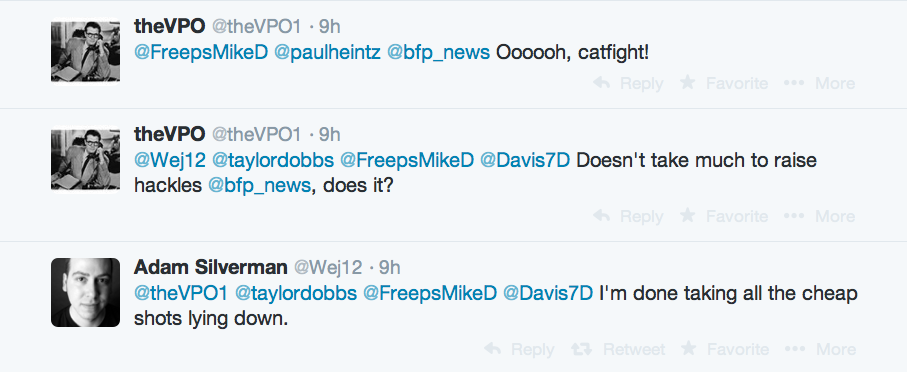
This was a reference to WCAX mistakenly broadcasting a crime scene photo including the body of a murder victim, which the Freeploid wrote up at great length. Seven Days’ Mark Davis Tweeted a reply about the ‘Loid “firing cheapshots at WCAX.” To which the Freeploid’s Adam Silverman replied “Is someone from Seven Days really one to talk about cheap shots?”

Davis pointed out the “thinly veiled glee” the Free Press was exhibiting over a competitor’s mistake. Donoghue and Silverman accused Seven Days of ignoring the story, to which Paul Heintz replied that he hadn’t gotten a call back from WCAX.

This exchange included two contraditory Tweets from Donoghue. First, he accused Seven Days of ignoring the story because the two entities are media partners; and then he insinuated that WCAX won’t return calls from Seven Days because of some unstated offense.

Which is it, Mike? They’re in bed together, or they can’t stand each other?

Anyway, that’s when I lobbed a couple of spitballs from the back of the class, and Silverman went all Charlie Bronson.

Screen Shot 2014-10-13 at 11.47.41 PM

I can just see him grabbing his crotch as he hit “SEND.”

Which brings me, finally, to the point of this post: an explanation of why I so often criticize the Free Press. Or, in the words of Mr. Silverman, why I deliver so many cheap shots.

Basically, it’s all about the words of Voltaire, best known as delivered by Peter Parker’s Uncle Ben:

With great power comes great responsibility.

The Burlington Free Press is the number-one print publication in Vermont. It ought to be the unquestioned leader in serious journalism. But, because Gannett keeps sucking out its precious bodily fluids to satiate the endless thirst of stockholders, we’re left with a depleted newspaper that can’t serve its readers well but still occupies the largest niche in the Vermont news market.

It doesn’t occupy that niche in any satisfying way, but there it sits, and because of the structure of the news marketplace, nobody can dislodge it.

The Burlington Free Press has great power. To be charitable, it does an inconsistent job of exercising that power. To be less charitable, it’s an almost daily disappointment. So when somebody like Mike Donoghue or Aki Soga positions himself as a guardian of the public trust — and yet expects to be insulated from the kinds of accountability or transparency he expects of everyone else (including WCAX) — well, it makes the rest of us throw up in our mouths a little. Likewise, when Jim Fogler or Michael Townsend serve up a column’s worth of bullshit and expect us to gobble it down like steak.

Too often, the Free Press comes across as arrogant and condescending. And its performance fails to justify its overweening sense of superiority. That’s why the Free Press gets so much criticism. And the occasional cheap shot. Expect both to continue.

A double standard at the Free Press? I am shocked! Shocked!

Ah, the Burlington Free Press: Champion of transparency everywhere outside its own doors.

The Gannett property steadfastly refuses to explain — or often even confirm — the organizational changes, comings and goings, mostly the latter, that affect the quality of its product and the ability of its readers — or should I say multiplatform consumers? — to depend on the Free Press for reliable, comprehensive journalism.

I’m sure the response from Michael Townsend would be, “Well, we’re a business! We have to protect our trade secrets and business strategy. Besides, we’re not bound to the same accountability standards as the public sector.”

Or, as he more succinctly put it to Paul “The Huntsman” Heintz earlier this week,

“I don’t talk to you guys,” he said. “I’m old-fashioned when it comes to competition.”

Oh, really? Well then, riddle me this, Batman: How come your reporters felt free to question WCAX-TV News Director Anson Tebbetts about the station’s mistaken broadcast of a photo of a murder victim?

And how come Tebbetts answered those questions?

“We’ve spent the last 24 hours apologizing for our terrible mistake,” Tebbetts told the Burlington Free Press. “We apologize to the family, her friends, the community and everyone that surrounded this case. It was a terrible mistake, and we’re deeply, deeply sorry.”

If the two men were in each other’s shoes, would Townsend have told Free Press reporters “I don’t talk to you guys”?

The Freeploid has plastered a thorough exploration of the WCAX incident in the prime spot on its webpage, seizing the opportunity to besmirch its’ competitor’s reputation.  And yet, it refuses to answer Heintz’ perfectly reasonable questions about newsroom cutbacks that will affect the quality of the Free Press’ product.

Anson Tebbetts feels a responsibility to his audience. Michael Townsend, apparently, does not.

The Burlington Free Press, transparency hypocrite.

@bfp_fail: We interrupt this debate to bring you a picture of Peter Diamondstone nodding off

Well, I tried to watch it.

The Burlington Free Press hosted a gubernatorial debate at noon today, and livestreamed it online.

Or tried to.

The first half hour was fine. After that, it kept freezing and crashing. I spent most of the ensuing half hour waiting for isolated bits of audio. Which, as Darcie Johnston pointed out on Twitter, always seemed to happen when Peter Diamondstone was talking. And the frozen image on the screen was usually Diamondstone with his eyes closed. Around 1:00, I gave up.

The Freeploid can’t blame its failure on too many viewers, either. There was a counter onscreen that tracked the number of viewers, and the highest it hit was 74. That’s not enough to crash a livestream.

Well, it shouldn’t be, anyway.

Of course, since the Freeploid only yesterday announced a corporate “reset” that includes forcing newsroom staff to reapply for their jobs, this disaster may have been an inside job. Whatever the cause, it’s a dismal performance.

Speaking of dismal performances, Scott Milne continued to hammer on the shortfalls, real and imagined, of the Shumlin Administration without offering any plans of his own.

Single-payer? Let’s wait six years.

How to cut the budget? Get rid of the governor’s SUV and out-of-state travel.

When asked for specific cuts, he tried to make a joke, talked about bringing in smart people from outside who’d be willing to take pay cuts to work in his administration, made a half-hearted call-out to the long-discredited Challenges for Change, and concluded by saying “I don’t know.”

School funding? He slammed Shumlin for failing to make tough choices, but offered nothing of his own.

And, according to the Freeploid’s Twitter feed (I’d stopped watching the unwatchable livestream by then), MIlne actually said he’d unveil a Lake Champlain cleanup plan by Election Day. 

Sheesh.

At one point, he briefly paused his attacks on Shumlin to day “It’s easy to be a Monday morning quarterback. I’m talking about the future.” And then he resumed the attacks.

Milne has managed to dribble out a few ideas, inadequate and half-assed though they are: a two-year statewide property tax freeze, Challenges for Change, maybe a regional health care exchange. But with less than four weeks until Election Day, he remains the Man Without a Plan, with apologies to Fred Tuttle.

His excuse is that he doesn’t “have a background” in government. Well, sure. But is that a positive asset for filling our top executive position? What if an applicant came to Milne Travel and said “I don’t have a background in the travel business, but you’re doing a terrible job and you should hire me”?

And even if you put a value on bringing in a fresh perspective, why can’t Milne consult with some of his “expert advisers” and come up with a few specifics? He doesn’t need years of government experience to do that.

I’ll say it again: I had some hopes for Scott Milne when his campaign began. And there’s plenty of room for an informed critique of the Shumlin Administration. But he’s just been a disaster.

Postscript. I’d slam the Freeploid for its inexplicable decision to invite Peter Diamondstone and not Dan Feliciano, except that it led to the most entertaining moment of the debate. Diamondstone wasn’t there at noon; he appeared at about 12:10, panting furiously. And continued to pant for a couple of minutes, directly into his microphone, while Milne was trying to answer a question.

The Brave New World of Journalismism is Upon Us

Oh boy, here we go… apparently Executive Editor Michael Townsend now occupies the Burlington Free Press Chair in “Good News” Editorials, recently vacated by Jim “Party City” Fogler. Because there it is, the dawning of the thorough Gannettization of Vermont’s Largest Newspaper, under the ominous title “Free Press Resets for the Future.”

The piece begins with a lengthy humblebrag about a recent Dan D’Ambrosio story on IBM that Townsend labeled “epic,” “readable and educational.”

Epic, eh? Guess that puts Homer in his place.

We are Gannett. You will be assimilated.

We are Gannett. You will be assimilated.

Right off the top, I had a strong feeling I was wading through bullshit. There was the title, first of all. But also because it was such a lengthy “soft lede” as they say in the news biz that I figured Townsend was burying the bad stuff; and finally, because I’ve been watching the news about how Gannett newspapers are “resetting for the future.”

By forcing all their newsroom staff to re-apply for their jobs. By cutting total newsroom staff. By getting rid of the formerly rigorous editorial process and relying on reporters to crank out publication-ready copy. By promoting clickbait over serious journalism. And by tearing down the walls between news and sales.

At FreePressMedia, we, as the rest of our colleagues in the Gannett company, are resetting the structure of the newsroom to better enable us to focus on the information and the presentation that you tell us via choice are most important, including accountability journalism and topics that Vermonters are known to be passionate about, such as the environment, local food and the creative economy. These changes are significant for our operations to produce content more tuned to the digital experience.

Part of this resetting is developing a new operational structure to enable us to focus more on the local content that deeply interests readers. With systemic changes in the media business in recent years including changes in approach, format and staff size, we are redefining journalism jobs for the future and our vibrant website, BurlingtonFreePress.com. During the next several weeks, the staff will apply for these jobs with new expectations. We expect time for adaption to the change in structure.

Emphases mine.

“You tell us via choice” means “we’ll abandon journalistic principles and pursue the stories that generate the most pageviews.” See that list: “The environment, local food and the creative economy”? What’s missing?

Oh, how about politics and public policy? Health care, welfare, corrections, infrastructure, taxation, investigative journalism, to name a few. Even transparency, until now a Freeploid bugaboo.

“Redefining journalism jobs” means higher expectations for production, along with lower salaries and worse benefits.

And “staff will apply for these jobs” meaning, well, senior writers, you’re probably S.O.L. We want younger, cheaper staffers more comfortable with multimedia technology.

Yesterday’s retirement announcement by senior writer Sam Hemingway suddenly makes a whole lot of sense. He saw the writing on the digital wall.

I’d expect a bunch more to follow him out the door, voluntarily or otherwise.

In the pursuit of objectivity, the truth is often a casualty

One of the faults of contemporary journalism is its tendency to bend over backwards in the name of “balance.” You have to represent both sides, even if it means including a climate change denier. You have to quote Annette Smith in any coverage of wind turbines, or Darcie Johnston in any piece about health care reform. And you have to pretend that a one-sided campaign is competitive before Election Night because it’d be “unfair” to the obvious loser.

Submitted for your approval, from the Freeploid’s political tag team of Terri Hallenbeck and Nancy Remsen (or, quite possibly, from their timorous editors):

Scott Milne, the Republican gubernatorial challenger who has been accused of getting off to a slow start, showed a surge in his fundraising…

“Accused of getting off to a slow start,” eh?

“Accused”???

That’s not an accusation, it’s an observation. It’s plain fact. Scott Milne launched his campaign on the last possible day — the filing deadline. He left everybody up in the air until that afternoon. And in his first two months on the trail, he raised virtually zero money outside of his own family and that of his business partner David Boies III.

If I published a Lexicon of Political Terms, I’d use Scott Milne’s mugshot to accompany the definition of “slow start.”

We know that Milne reacts very badly to criticism of his campaign. I’ll bet he’s had some angry calls with Freeploid editors, and this excessive timidity is the result.

Art Woolf’s arguments of convenience

Welp, Vermont’s Loudest Economist is at it again. Art Woolf’s latest dispensation of wisdom in the Thursday Burlington Free Press is chock full of half-baked research, lazy reasoning, and politically convenient conclusions.

The main conclusion, as is often the case: Vermont sucks.

The topic of Art’s latest “How We’re Doing” effort was outmigration – the fact that Vermont’s population is roughly stable (or stagnant if you prefer, as Art does) and a lot of people are leaving.

This week’s entry in the digital Freeploid is entitled “Ex-Vermonters Vote With Their Feet.” (The print edition had a different title.)

As if every decision to move is a “vote” against Vermont. Every birth, a “yes” vote; every death, a “no” vote. (The Medical Examiner ruling: Death By Taxes.)

popchgsept25The accompanying chart shows three factors in population change: births/deaths ratio, immigration (from outside the US), and Net Domestic Migration. It shows immigration as a constant: we have a relatively small trickle of foreigners setting here. The births/deaths ratio was healthy until 2008, when the birthrate began to drop. But the biggie is Net Domestic Migration, which has been negative since about 2004.

(The chart is, of course, scaled to dramatize the net-migration plunge.)

Woolf chalks up the declining birthrate to our aging population, which is reasonable (although I wonder how much the Great Recession played into it): we do have more people beyond the usual child-rearing age. Woolf speculates that our birthrate will continue to fall as our population ages.

But later, when he’s expounding on the causes of our negative Net Migration, he completely ignores the aging population. Did it occur to him that a lot of our outmigrants are senior Vermonters heading for the Sun Belt? Not to judge by his column:

When people vote with their feet, they are saying something about the desirability of a state.

Those people are saying that despite its many attractions, Vermont is not a popular place for people to live and work.

For some that’s true, but not for an 80-year old who’s tired of hauling firewood and shoveling snow.

Woolf uses our aging population as a cudgel when it’s convenient; he ignores it when it’s not.

Also, as usual, Woolf doesn’t bother to compare Vermont to similar states. The outmigration of young people is a common problem for small, rural states; is Vermont’s better or worse than, say, Maine’s or Wyoming’s? Or northern New Hampshire’s?

Finally, let’s bring up a sacred cow that Woolf would never touch: the role our employers play in making Vermont undesirable. Generally speaking, Vermont’s pay rates are on the low side. Even if you’re talking about comparable jobs, the pay is often lower in Vermont than elsewhere.

Two examples I have some familiarity with: medicine and academics. Pay scales at UVM (and Dartmouth) are lower than at similar institutions elsewhere — sometimes substantially lower. Like, 50% or more. Our institutions get away with that because (a) Vermont offers such a high quality of life that many professionals will settle for a lower salary, and (b) our cost of living is relatively low compared to, say, Boston or New York or even Albany.

Many Vermont employers, especially in technology fields, complain that they can’t find enough qualified workers. Well, maybe they aren’t paying enough. Maybe they’re not recruiting hard enough.

No, that’s not it. Must be the taxes.

To be fair, Woolf doesn’t come out and blame taxes and regulation for Vermont’s outmigration. But he omits a lot of factors that lead to other conclusions: that we have built-in disadvantages, that our employers skimp on pay and aren’t aggressive enough in attracting new residents. And that our aging population is likely a major factor in growing outmigration.

This week’s entry, like many of his columns, is meant to undergird the business point of view — that we need to fling open the door to growth by cutting taxes, regulations, and those pesky environmental laws. As a thorough, honest look at How We’re Doing, the best grade you can give is Incomplete.

Fogler Departs, Crudification of Free Press To Accelerate

Big news in Vermont media: Jim Fogler is stepping down as president and publisher of the Burlington Free Press. And leaving the newspaper business entirely, for a rewarding and soul-enriching gig as a vice president at Party City, the national chain of party supply stores.

Those journalistic ethics should come in handy over there.

I have made my share of sport at Fogler’s expense in the past — if I recall correctly, I wrote that when Jim Fogler writes an optimistic column in the Freeploid, readers (and staff) run for cover. But if I were to guess, I’d say his departure is not good news for Vermont’s Largest Newspaper.

First, there are the circumstances. His resignation is announced on September 25, and his last day at the Freeploid will be October 1. That’s a nanosecond by the standards of executive turnover. I have no inside information whatsoever, but it does make me wonder if his departure was voluntary. Not that he was fired; but rather that they let him know that he’d be replaced, and gave him time to arrange a soft landing. He had spent 26 years with Gannett, after all, so perhaps a little consideration was in order.

The big change comes as Gannett’s newspapers are transitioning into a new era of newsroom organization. A few Gannett papers have already gotten the makeover, which has resulted in the following:

— More reporters, but fewer editors. A smaller newsroom staff overall. Get ready for an explosion in typos, bad writing, and bad grammar.

— Everyone has to reapply for newly redefined jobs. Presumably with lower pay and benefits.

— A dependence on “audience analytics,” i.e. covering stories because of reader interest (pageviews!) rather than importance.

— What appears to be a troubling degree of “synergy” between news and ad sales.

Expect Gannett to parachute in a corporate loyalist (after a, cough, “nationwide search”)  to institute the new regime at the Freeploid.